
- Home
- »
- Power Generation & Storage
- »
-
Mobile Battery Energy Storage Systems Market Report, 2033GVR Report cover

Mobile Battery Energy Storage Systems Market (2026 - 2033)
Size, Share & Trends Analysis Report By Battery Chemistry (LFP, NMC, Lead-acid, Sodium-ion), By Connectivity (On-grid, Off-grid, Hybrid), By Capacity, By Application, By Region, And Segment Forecasts
Market Size, 2025
$4.2BMarket Estimate, 2026
$4.4BMarket Forecast, 2033
$17.2BCAGR, 2026–2033
21.7%Mobile Battery Energy Storage Systems Market Summary
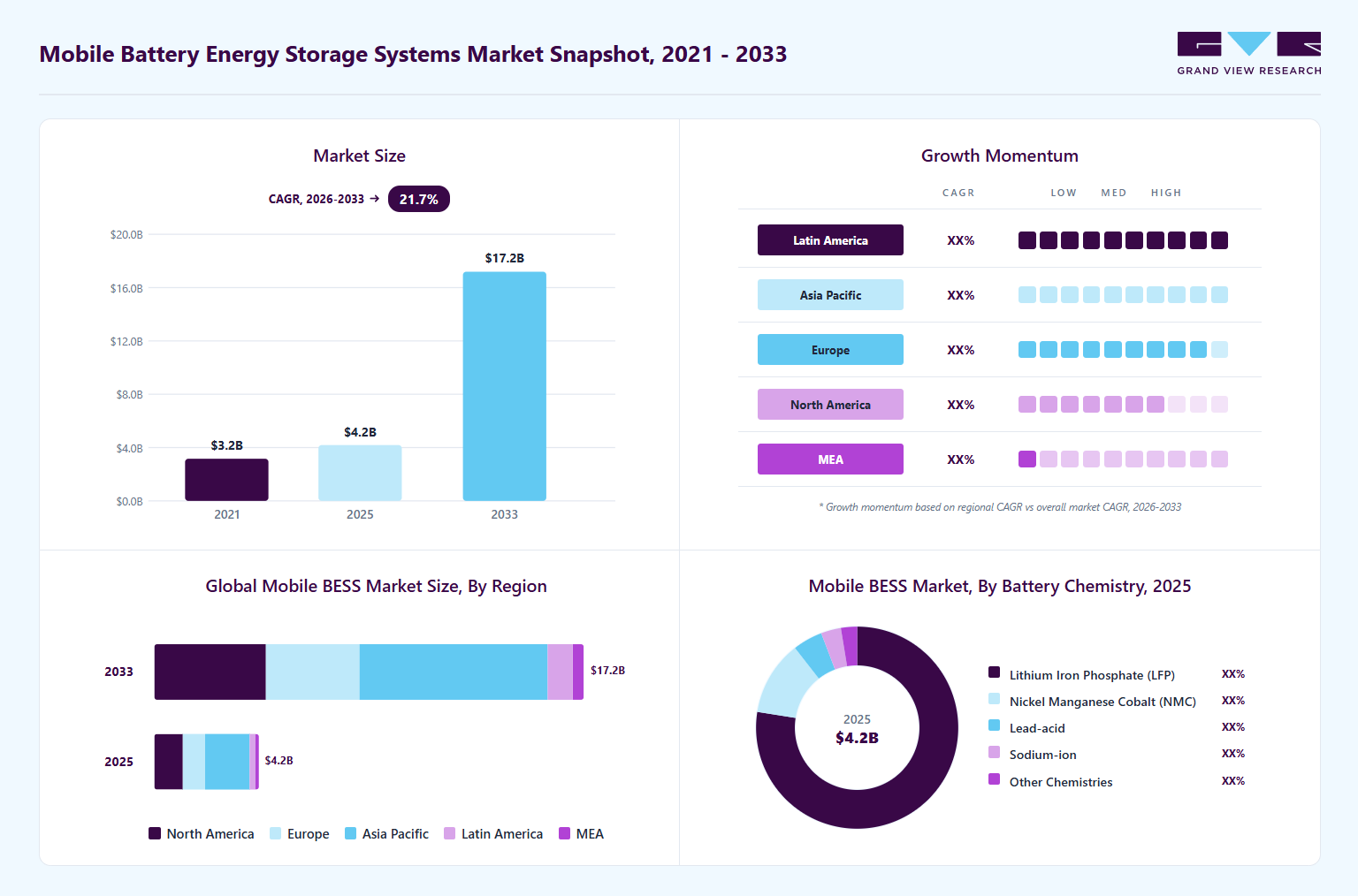
The global mobile battery energy storage systems market size was valued at USD 4.2 billion in 2025 and is projected to grow from USD 4.4 billion in 2026 to USD 17.2 billion by 2033, at a CAGR of 21.7% from 2026 to 2033. The market in Asia Pacific dominated with a revenue share of 42.5% in 2025. The market is expanding as energy-as-a-service models increase access to mobile battery energy storage systems through subscription-based and pay-per-use offerings.
 Source: Grand View Research, IR Documents, Primary Interviews, Paid DatabasesTo learn more about this report,
 Download Free Sample Report
Key Market Trends & Insights
- By battery chemistry: Lithium iron phosphate (LFP) segment held the largest market share of 77.5% in 2025.
- By capacity: 500 kwh-1 MWh segment held the largest market share of 39.2% in 2025.
- By application: Construction segment held the largest market share of 32.7% in 2025.
- By connectivity: Hybrid segment held the largest market share of 37.2% in 2025.
Regional Highlights
- Largest regional market: Asia Pacific (42.5% revenue share, 2025)
- Fastest-growing regional market: Latin America (highest CAGR, 2026-2033)
- By country: China held the largest market share in 2025
Market Size & Forecast
- Market size in 2025: USD 4.2 Billion
- Estimated market size in 2026: USD 4.4 Billion
- Projected market size by 2033: USD 17.2 Billion
- CAGR (2026-2033): 21.7%
Prism AI by Grand View Research Free to tryAsk a question about the mobile battery energy storage systems marketTry asking✓Every figure cited from GVR research Prefer the report? Download free sample →
These models reduce upfront infrastructure costs and enable industries, utilities, and commercial users to deploy flexible temporary power and energy storage solutions without significant capital investment. The market is growing due to increasing demand for flexible, reliable, and cost-efficient temporary power solutions across the industrial, utility, and commercial sectors. Mobile BESS units enable efficient energy management, peak shaving, backup power, and renewable energy integration while reducing dependence on diesel generators and minimizing fuel and maintenance costs. Their modular, transportable design also enables rapid deployment in remote and high-demand locations, improving operational efficiency and energy reliability.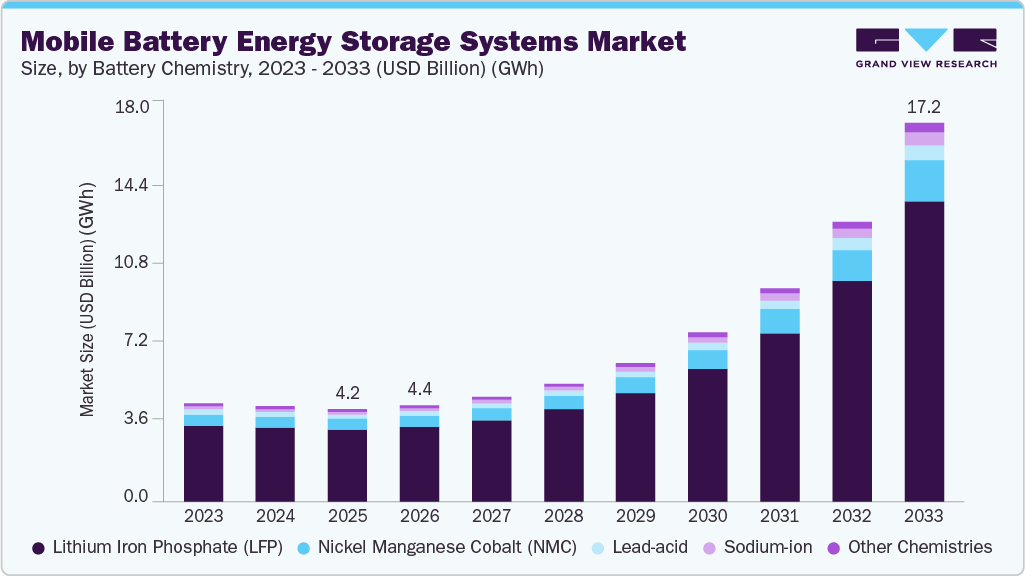 To learn more about this report, Download Free Sample Report
Economic considerations are further supporting investments in mobile battery energy storage systems as businesses and utilities prioritize low-emission and scalable energy infrastructure. Although initial deployment costs can be relatively high, declining battery prices, longer system lifespans, and advancements in lithium-ion technologies are improving overall cost competitiveness. The rise of Energy-as-a-Service (EaaS) and rental-based deployment models is reducing upfront capital requirements, making mobile BESS solutions increasingly attractive for construction sites, EV charging, disaster recovery, mining operations, and temporary grid support applications.
Market Dynamics
The market is witnessing significant growth as electric vehicle (EV) charging infrastructure expands. Mobile energy storage units are increasingly used to provide rapid, temporary EV charging solutions in remote areas, construction sites, highways, commercial hubs, and locations where permanent grid connectivity is limited or unavailable. These systems help address charging accessibility challenges while supporting the growing adoption of electric mobility across passenger and commercial vehicle segments. For instance, global EV sales surpassed 17 million units in 2024, significantly increasing demand for scalable, rapidly deployable charging infrastructure worldwide.
Rising demand for flexible and fast-deployment charging infrastructure during public events, emergencies, fleet operations, and peak travel periods is further accelerating the adoption of mobile BESS solutions. Mobile storage systems can be transported and deployed quickly to meet temporary charging demand without requiring extensive grid upgrades or fixed infrastructure investments. Their ability to integrate with renewable energy sources and reduce pressure on local electricity networks makes them an efficient and sustainable solution for supporting the global EV ecosystem.
The market faces challenges due to the high initial capital investment required for system deployment. Mobile BESS solutions rely on expensive battery technologies such as lithium-ion and LFP batteries, along with advanced battery management systems, thermal control systems, power conversion equipment, and transportable containerized or trailer-mounted infrastructure. These high upfront costs can limit adoption, particularly among small and medium-sized enterprises with constrained capital budgets.
The market is also affected by relatively long payback periods and additional expenses for system integration, maintenance, transportation, and charging infrastructure. For instance, utility-scale lithium-ion battery storage system costs can range from hundreds of thousands to several million dollars, depending on capacity and mobility configuration, creating financial barriers for smaller contractors and temporary power providers. Although operational savings and fuel cost reductions can improve long-term economics, the initial financial burden remains a significant barrier for many end users, particularly in developing regions with limited access to financing and energy infrastructure investments.
Battery Chemistry Insights
The lithium iron phosphate (LFP) segment dominated the market, accounting for 77.5% of revenue, primarily due to its superior safety, thermal stability, and long operational lifespan. LFP batteries are less prone to overheating and thermal runaway than other chemistries, such as nickel-manganese-cobalt (NMC), making them highly suitable for mobile battery energy storage systems used in utility, industrial, EV charging, and temporary power applications.
The sodium-ion segment is expected to register the fastest CAGR of 22.4% during the forecast period, driven by increasing demand for cost-effective, sustainable battery technologies with reduced dependence on critical minerals such as lithium, cobalt, and nickel. Sodium-ion batteries are gaining traction in mobile battery energy storage systems due to their improved safety profile, abundant raw material availability, and suitability for large-scale and temporary energy storage applications.
Capacity Insights
The 500 kWh-1 MWh segment accounted for the largest revenue share of 39.2% in the market due to its strong suitability for medium- to large-scale temporary power applications, including construction sites, mining operations, utility backup, EV fast charging, and industrial energy management. These systems provide an optimal balance between power capacity, mobility, deployment flexibility, and operational efficiency, making them widely adopted across commercial and utility sectors.
The 100-500 kWh segment is projected to register the second-fastest CAGR of 21.9% over the forecast period, driven by increasing demand for compact, flexible mobile energy storage solutions across commercial, construction, telecom, EV charging, and small industrial applications. These systems offer easier transportation, faster deployment, lower installation costs, and improved suitability for temporary and distributed power requirements.
Application Insights
Construction accounted for the largest revenue share of 32.7% in 2025, driven by the growing need for reliable temporary power solutions at construction sites with weak or non-existent grid connectivity. Mobile BESS units enable contractors to begin operations immediately, without waiting for utility grid expansion or reinforcement, effectively serving as a flexible, transportable temporary grid solution while reducing reliance on diesel generators.
The utility temporary power segment is projected to register the second-fastest CAGR of 21.9% from 2026 to 2033 due to increasing demand for grid stability support during planned maintenance activities, grid modernization projects, and peak electricity demand periods. Mobile battery energy storage systems provide utilities with flexible, rapidly deployable power solutions that require no permanent infrastructure upgrades, helping maintain a reliable electricity supply and improve overall grid resilience.
Connectivity Insights
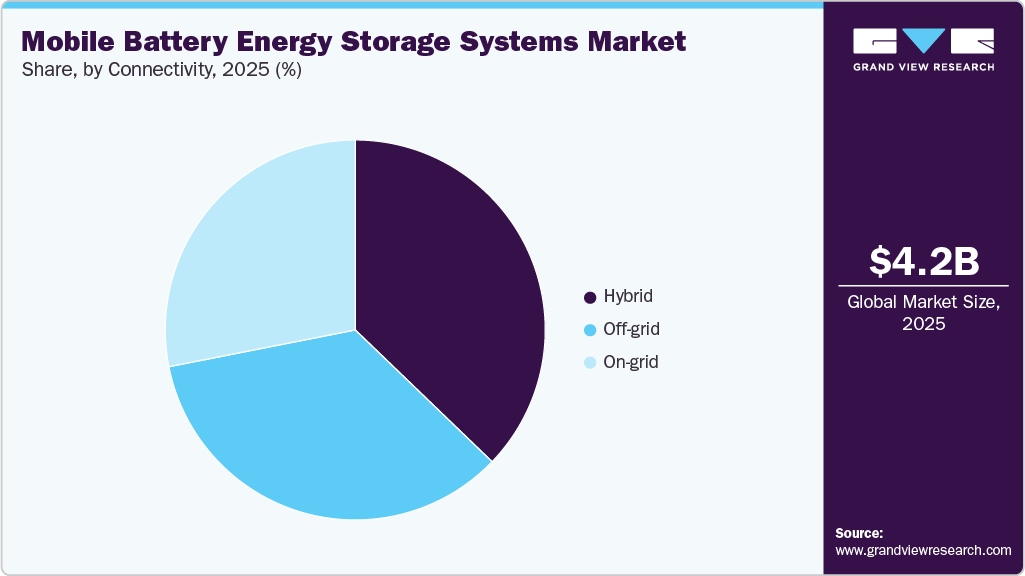
The hybrid segment held the largest revenue share of 37.2% due to its ability to combine grid connectivity, renewable energy sources, and battery storage for enhanced power reliability, flexibility, and operational efficiency. Hybrid systems are widely adopted across construction, utility, mining, and EV charging applications as they help reduce fuel consumption, lower emissions, optimize energy usage, and ensure an uninterrupted power supply in both grid-connected and off-grid environments.
 To learn more about this report, Download Free Sample Report
The off-grid segment is projected to register the second-fastest CAGR of 21.6% over the forecast period, driven by rising demand for reliable power solutions in remote and underserved locations where grid connectivity is limited or unavailable. Increasing adoption of mobile battery energy storage systems across mining sites, construction projects, telecom infrastructure, disaster recovery operations, and remote EV charging applications is further supporting segment growth.
Regional Insights
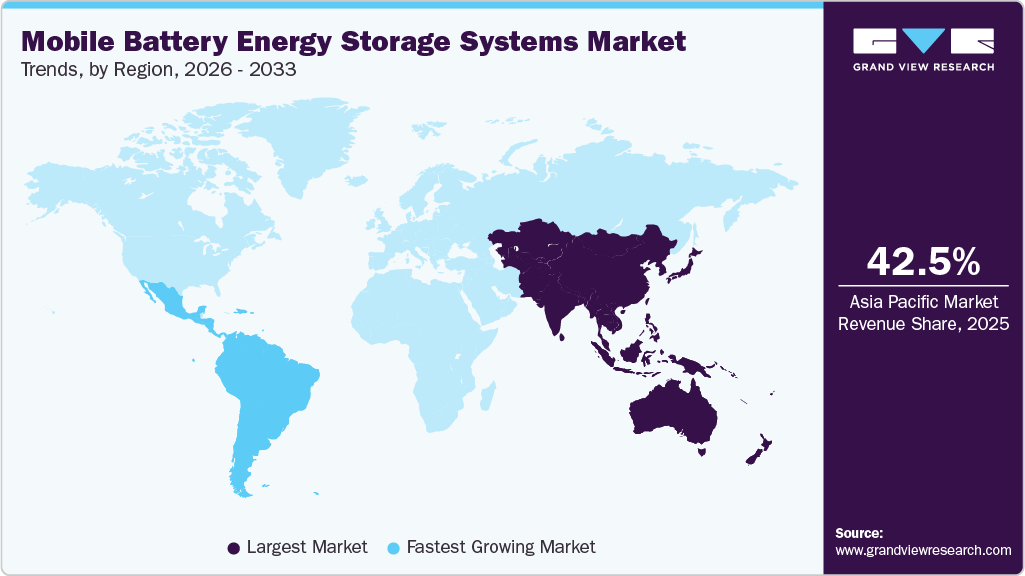
In 2025, the Asia Pacific region accounted for the largest revenue share of 42.5% in the global mobile battery energy storage system market. This was largely driven by increasing investments in grid modernization and renewable energy integration across major economies such as Japan, South Korea, and Australia. Mobile battery energy storage systems are being widely deployed to support grid stability, manage intermittent renewable power generation, and provide flexible temporary energy solutions during periods of fluctuating electricity demand. The regional market is also benefiting from rapid industrialization, expanding EV charging infrastructure, and growing demand for reliable backup power across construction, mining, and utility sectors. Supportive government policies promoting clean energy adoption and energy storage deployment are further accelerating market growth across the region.
 To learn more about this report, Download Free Sample Report
China Mobile Battery Energy Storage Systems Market Trends
The mobile battery energy storage systems industry in China is being shaped by its strong dominance in global battery manufacturing and supply chain capabilities. The country produces the majority of the world’s energy storage system (ESS) batteries, providing significant cost advantages, large-scale production capacity, and secure access to critical battery components and raw materials. China’s extensive investments in lithium-ion battery technologies, renewable energy integration, and EV infrastructure are accelerating the deployment of mobile energy storage solutions across industrial, utility, and commercial applications.
North America Mobile Battery Energy Storage Systems Market Trends
The mobile battery energy storage systems industry in North America is supported by increasing demand for grid resilience and reliable backup power solutions amid the rising frequency of power outages and extreme weather events. Mobile battery energy storage systems are widely adopted across residential, commercial, industrial, and critical infrastructure applications as a sustainable, low-emission alternative to conventional diesel generators. The region also witnesses growing investments in renewable energy integration, EV charging infrastructure, and utility grid modernization, further driving the deployment of mobile BESS solutions.
The U.S. mobile battery energy storage systems market is being driven by increasing renewable energy integration and the growing need for flexible energy management solutions. Mobile battery systems are increasingly being deployed to capture excess electricity generated from solar and wind farms that might otherwise be curtailed, enabling efficient storage and transportation of renewable energy to high-demand locations or grid-constrained areas. The market is also benefiting from rising investments in grid modernization, clean energy infrastructure, and utility-scale renewable projects across the country. For instance, the U.S. accounts for nearly 20-25% of global mobile BESS deployments, supported by large-scale solar and wind capacity additions, with curtailment levels in high-renewable states like California reaching up to 5-10% in certain periods, driving demand for mobile storage solutions to improve grid flexibility and energy utilization efficiency.
Europe Mobile Battery Energy Storage Systems Market Trends
The mobile battery energy storage systems industry in Europe is being driven by strong regulatory support for renewable energy adoption, decarbonization, and sustainable infrastructure development. Regional policies promoting clean energy integration, low-emission operations, and net-zero construction activities are accelerating the deployment of mobile energy storage solutions across utility, industrial, and commercial sectors. The market is also benefiting from growing investments in grid modernization, renewable energy projects, and temporary low-emission power systems to reduce reliance on diesel generators.
Latin America Mobile Battery Energy Storage Systems Market
The mobile battery energy storage systems industry in Latin America is growing at the fastest CAGR of 22.3%, driven by increasing grid instability, frequent power outages, and rising demand for reliable temporary power solutions across remote industrial and mining operations. Mobile battery energy storage systems are gaining traction as portable and rapidly deployable solutions capable of delivering uninterrupted power in areas with limited or unreliable grid infrastructure. The region is also witnessing growing investments in renewable energy projects, off-grid electrification, and mining sector expansion, which are further supporting the adoption of trailer-mounted and containerized mobile BESS solutions.
Middle East & Africa Mobile Battery Energy Storage Systems Market
The mobile battery energy storage systems industry in MEA is being supported by increasing decarbonization initiatives and the growing adoption of cleaner energy technologies across industrial, utility, and commercial sectors. Regional governments, particularly across GCC countries, are promoting low-emission energy solutions and encouraging the transition away from conventional diesel generators toward sustainable mobile power systems. The market is also benefiting from rising investments in renewable energy projects, smart infrastructure development, and temporary power applications for construction, oil & gas, mining, and remote operations.
Key Mobile Battery Energy Storage Systems Company Insights
Some of the key players operating in the global market include Contemporary Amperex Technology Co., Limited, and BYD.
-
Contemporary Amperex Technology Co., Limited (CATL) is a leading participant in the global market, recognized for its large-scale battery manufacturing capabilities, advanced lithium-ion and LFP battery technologies, and extensive global energy storage deployments. The company focuses on developing high-performance, modular, and transportable battery energy storage solutions for utility, industrial, EV charging, and temporary power applications. CATL’s strategy emphasizes technological innovation, supply chain integration, cost optimization, and expansion of energy storage infrastructure to support renewable energy integration and grid flexibility. For instance, CATL supplied large-scale containerized and transportable battery storage systems contributing to approximately 40 GWh of global energy storage deployments in recent years, with its utility-scale and grid-support projects increasingly used in renewable integration sites in China, Europe, and the U.S., where mobile and modular systems are being deployed to reduce losses that can reach up to 5-15% in high-renewable grids.
-
BYD is a major player in the global market, known for its vertically integrated battery manufacturing operations and broad portfolio of energy storage solutions. The company develops containerized and mobile BESS platforms designed for utility support, renewable energy integration, commercial backup power, EV charging infrastructure, and off-grid applications. BYD’s strategy focuses on expanding clean energy adoption through reliable, cost-effective battery technologies, particularly lithium iron phosphate (LFP) systems known for their safety and long operational lifespans.
Key Mobile Battery Energy Storage Systems Companies:
The following key companies have been profiled for this study on the mobile battery energy storage systems market.
- Aggreko
- BYD
- Contemporary Amperex Technology Co., Limited.
- Fluence
- Huawei Technologies Co., Ltd.
- Samsung SDI
- SUNGROW
- Tesla
- Wärtsilä
- Xiamen Hithium Energy Storage Technology
Competitive Benchmarking
Operating Strategies
Competitive Edge
Weaknesses
Mature Players: BYD; Contemporary Amperex Technology Co., Limited.; Tesla; Fluence; Wärtsilä; Samsung SDI; SUNGROW; Aggreko
- Focus on large-scale production capacity expansion and global supply chain integration to reduce battery and deployment costs.
- Strengthen partnerships with utilities, renewable energy developers, EV charging providers, and industrial customers for long-term contracts and project deployment.
- Strong technological expertise, vertically integrated manufacturing, and established global distribution networks.
- Broad product portfolios with advanced battery chemistries, integrated energy management systems, and proven large-scale deployment experience.
- High exposure to raw material price volatility and supply chain disruptions for lithium, nickel, and other battery materials.
- Large operational scale and capital-intensive manufacturing facilities can reduce flexibility and increase fixed costs.
Emerging Players: Huawei Technologies Co., Ltd.; Xiamen Hithium Energy Storage Technology
- Focus on niche applications, innovative battery technologies, and rapid commercialization of modular mobile BESS solutions.
- Expand through strategic collaborations, regional partnerships, and technology-driven differentiation in energy storage systems.
- Greater flexibility in adopting new technologies and targeting specialized market segments.
- Ability to offer customized and cost-competitive solutions for emerging mobile and distributed energy applications.
- Limited global market presence and smaller production capacity compared to established competitors.
- Higher dependence on external suppliers and challenges in scaling operations, financing, and brand recognition.
Recent Developments
-
In September 2025, Power Up Connect launched the MBESS 90 kWh mobile battery energy storage system at CES 2025, featuring a 30 kW trailer-mounted unit designed for towing behind SUVs. The system includes onboard expandable solar capacity and daisy-chain functionality to increase energy output, strengthening the company’s portable, rapid-deployment energy storage portfolio for disaster recovery, construction, and temporary power applications. This launch is expected to support growing demand for flexible off-grid and emergency power solutions across commercial and industrial sectors.
Mobile Battery Energy Storage Systems Market Report Scope
Report Attribute
Details
Market Definition
The global market refers to the global revenue generated from transportable and modular battery-based energy storage solutions used for temporary, backup, and off-grid power supply across various battery chemistries, capacities, connectivity types, and applications.
Market size in 2025
USD 4.2 billion
Estimated market size in 2026
USD 4.4 billion
Projected market size by 2033
USD 17.2 billion
Growth Rate
CAGR of 21.7% from 2026 to 2033
Historical data
2021 - 2025
Forecast period
2026 - 2033
Quantitative Units
Revenue in USD million/billion, capacity in GWh, and CAGR from 2026 to 2033
Report coverage
Revenue forecast, competitive landscape, growth factors, and trends
Segments covered
Battery chemistry, capacity, application, connectivity, region
Regional scope
North America; Europe; Asia Pacific; Latin America; MEA
Country scope
U.S.; Canada; Mexico; Germany; UK; France; Italy; Spain; China; India; Australia; Japan; South Korea; Brazil; Argentina; Saudi Arabia; UAE; South Africa
Key companies profiled
Aggreko; BYD; Contemporary Amperex Technology Co., Limited.; Fluence; Huawei Technologies Co., Ltd.; Samsung SDI; SUNGROW; Tesla; Wärtsilä; Xiamen Hithium Energy Storage Technology
Customization scope
Free report customization (equivalent up to 8 analysts working days) with purchase. Addition or alteration to country, regional & segment scope.
Pricing and purchase options
Avail customized purchase options to meet your exact research needs. Explore purchase options
Global Mobile Battery Energy Storage Systems Market Report Segmentation
This report forecasts revenue growth at global, regional, and country levels and provides an analysis of the latest industry trends in each of the sub-segments from 2021 to 2033. For this study, Grand View Research has segmented the global mobile battery energy storage systems market based on battery chemistry, capacity, application, connectivity, and region:
-
Battery Chemistry Outlook (Revenue in USD Million; Capacity in GWh; 2021 - 2033)
-
Lithium Iron Phosphate (LFP)
-
Nickel Manganese Cobalt (NMC)
-
Lead-acid
-
Sodium-ion
-
Other Chemistries
-
-
Capacity Outlook (Revenue in USD Million; Capacity in GWh; 2021 - 2033)
-
Below 100 kWh
-
100-500 kWh
-
500 kWh-1 MWh
-
Above 1 MWh
-
-
Application Outlook (Revenue in USD Million; Capacity in GWh; 2021 - 2033)
-
Construction
-
Mining
-
Utility temporary power
-
EV charging
-
Military & defense
-
Other Applications
-
-
Connectivity Outlook (Revenue in USD Million; Capacity in GWh; 2021 - 2033)
-
On-grid
-
Off-grid
-
Hybrid
-
-
Regional Outlook (Revenue in USD Million; Capacity in GWh; 2021 - 2033)
-
North America
-
U.S.
-
Canada
-
Mexico
-
-
Europe
-
Germany
-
UK
-
France
-
Italy
-
Spain
-
-
Asia Pacific
-
China
-
India
-
Australia
-
Japan
-
South Korea
-
-
Latin America
-
Brazil
-
Argentina
-
-
Middle East & Africa
-
Saudi Arabia
-
UAE
-
South Africa
-
-
Delivered Customizations
This report has been delivered with the following In-depth customizations
Client Request
Customization Delivered
Value Adds
Regional Opportunity Assessment
Apart from the standard geographic scope, additional analysis was conducted across emerging mobile battery energy storage system deployment regions to evaluate grid modernization initiatives, renewable energy integration, EV charging expansion, off-grid power demand, and temporary energy infrastructure requirements.
Identified high-growth regional opportunities driven by decarbonization policies, increasing grid instability, rising renewable energy penetration, and growing demand for flexible temporary power and mobile energy storage solutions.
Cross-Segmentation Growth Opportunity Analysis
Cross-segment analysis of growth opportunities across battery chemistries (LFP, NMC, sodium-ion, others), capacity ranges, connectivity types, and applications, including construction, mining, utility temporary power, EV charging, and military & defense, was conducted.
Identified the most profitable technology and application combinations to support product positioning, deployment strategies, infrastructure planning, and long-term market expansion initiatives.
Company Profiling (Client-Specified)
Apart from the companies profiled in the standard report, additional mobile battery energy storage system companies were analyzed. Each profile covered the company’s business overview, battery technology focus, mobile BESS offerings, partnerships, deployment strategies, and competitive positioning.
Provided a more comprehensive view of the competitive landscape. Helped support informed decision-making related to partnerships, investments, technology selection, and market entry strategies.
Frequently Asked Questions About This Report
Key players include Aggreko, BYD, Contemporary Amperex Technology Co., Limited., Fluence, Huawei Technologies Co., Ltd., Samsung SDI, SUNGROW, Tesla, Wärtsilä, Xiamen Hithium Energy Storage Technology, among others.
The key factors driving the growth of the global mobile battery energy storage systems market include increasing demand for temporary and off-grid power solutions, rising renewable energy integration, expanding EV charging infrastructure, and growing adoption of low-emission alternatives to diesel generators across industrial, utility, and commercial applications.
The lithium iron phosphate (LFP) segment led with a 77.5% revenue share in 2025, while the sodium-ion segment is the fastest-growing.
The 500 kwh-1 MWh segment led with a 39.2% revenue share in 2025.
The construction segment led with a 32.7% revenue share in 2025.
The hybrid segment led with a 37.2% revenue share in 2025.
The global mobile battery energy storage systems market size was valued at USD 4.2 billion in 2025 and is estimated at USD 4.4 billion for 2026.
The global mobile battery energy storage systems market is expected to grow at a CAGR of 21.7% from 2026 to 2033, reaching USD 17.2 billion by 2033.
Asia Pacific dominated with a 42.5% revenue share in 2025.
Latin America is the fastest-growing region over the forecast period.
About the Author(s)
Power Generation & Storage Research Team
Energy & Power · Power Generation & StorageThis report was authored by the power generation & storage research team at Grand View Research - comprising two research analysts, one senior research analyst, and one industry expert - with specialized expertise in the power generation & storage segment of the energy & power industry. All findings are based on proprietary energy & power databases, executive interviews, and regulatory analysis, subject to internal peer review prior to publication.
Last Updated:
Speak to Analyst

Customize this report to your needs - add regions, segments, or data points, with 20% free customization.
Or view our licence options:


ISO 9001:2015 & 27001:2022 Certified
We are GDPR and CCPA compliant! Your transaction & personal information is safe and secure. For more details, please read our privacy policy.


