
- Home
- »
- Next Generation Technologies
- »
-
Smart City Platforms Market Size, Industry Report, 2033GVR Report cover

Smart City Platforms Market (2026 - 2033) Size, Share & Trends Analysis Report By Offering (Platform, Services) By Technology (Edge-based, Hybrid), By Deployment Model (Offshore, Hybrid), By Application (Smart Governance, Smart Building), By Region, And Segment Forecasts
Market Size, 2025
$65.0BMarket Estimate, 2026
$76.2BMarket Forecast, 2033
$337.3BCAGR, 2026–2033
23.7%Smart City Platforms Market Report Summary
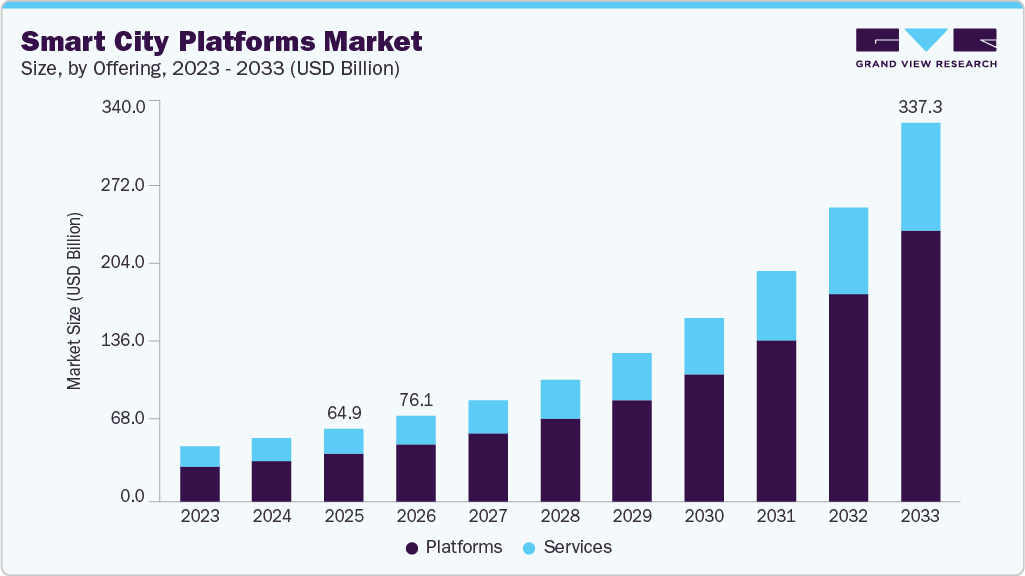
The global smart city platforms market size was valued at USD 65.0 billion in 2025 and is projected to grow from USD 76.2 billion in 2026 to USD 337.3 billion by 2033, at a CAGR of 23.7% from 2026 to 2033. The market in North America dominated with a revenue share of 32.0% in 2025. The market is primarily driven by the rapid digitalization of urban infrastructure and the increasing use of integrated platforms to manage transportation, utilities, and public services.
 Source: Grand View Research, IR Documents, Primary Interviews, Paid DatabasesTo learn more about this report,
 Download Free Sample Report
 Key Market Trends & Insights
- By offering: The platforms segment dominated the market, with a share of over 65% in 2025.
- By technology: The cloud-based platforms segment dominated the market in 2025.
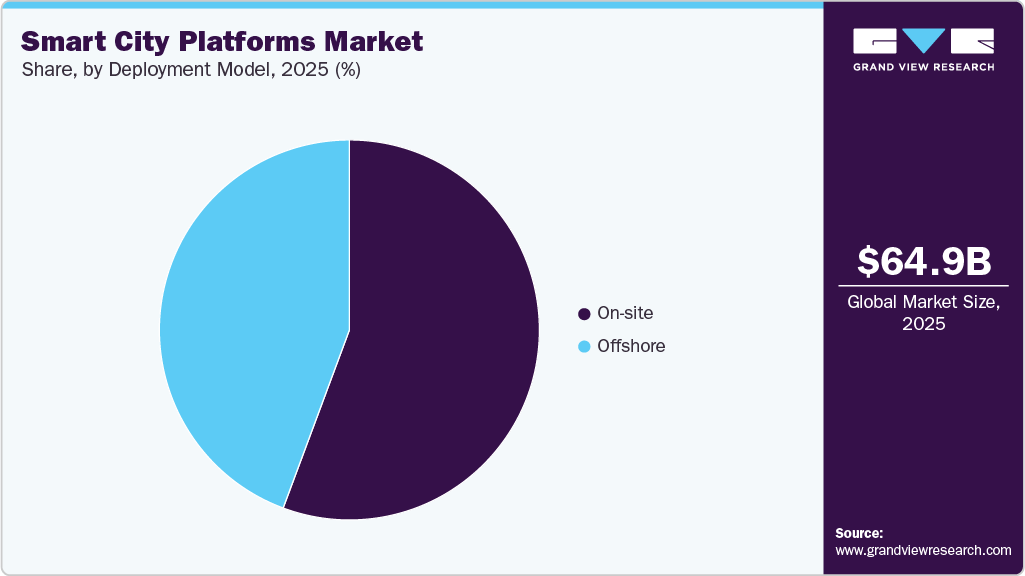
- By deployment model: The on-site segment accounted for the largest market share in 2025.
Regional Highlights
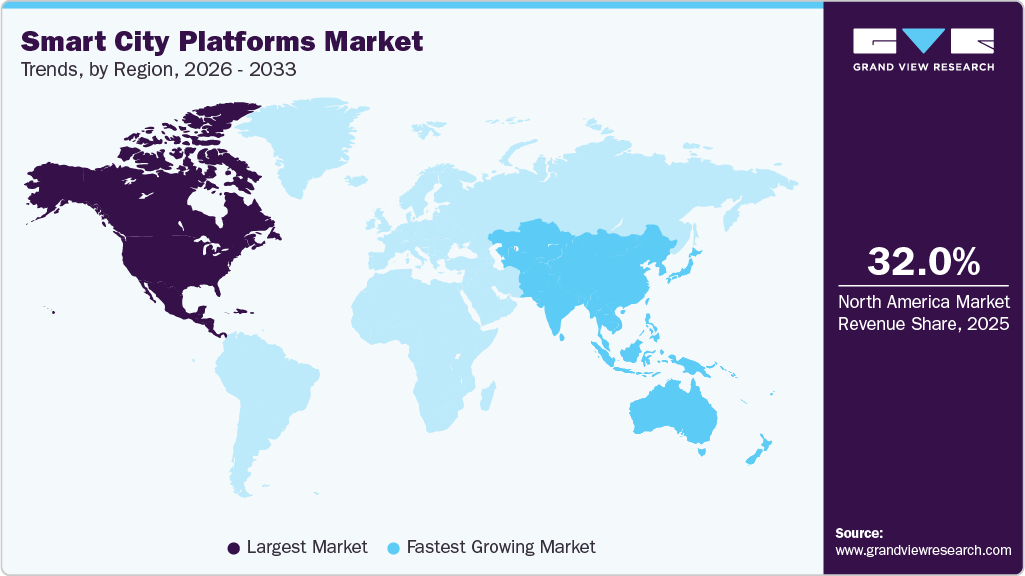
- Largest regional market: North America (32.0% revenue share, 2025)
- Fastest-growing regional market: Asia Pacific (highest CAGR, 2026-2033)
- By country: The U.S. held the largest market share in 2025.
Market Size & Forecast
- Market size in 2025: USD 65.0 Billion
- Estimated market size in 2026: USD 76.2 Billion
- Projected market size by 2033: USD 337.3 Billion
- CAGR (2026-2033): 23.7%
Three ways to get this report
Buy it, customize it, or ask a question.Ask an Analyst
Analyst response in 1 business day
- AccessReport author, directly
- Reply timeWithin 1 working day
- No sales callDirect answer only
- FormatEmail reply
- CostFree, no cost
Get the Full Report
What the study covers
- FormatsPDF · Excel · Dashboard
- Timeline2026–2033 annual, 2025 base
- Coverage20+ countries, 5 regions
- Companies10+ key players profiled
Customize the Report
20% free customization
- IncludeCountries, segments, points
- TailorTo your product definition
- ExtendDeeper competitor detail
- OrA fully bespoke study
- Turnaround5–10 working days
The rising deployment of IoT devices and sensors is generating large data volumes, fueling demand for platforms that enable efficient data integration, real-time analytics, and improved city operations.The rising adoption of artificial intelligence (AI), machine learning, and predictive analytics in urban ecosystems is a significant driver of the smart city platforms industry growth. Governments and municipalities are shifting from reactive to proactive city management models, where platforms enable predictive traffic control, smart energy optimization, and automated emergency response systems. The integration of digital twin technologies is further accelerating this trend by allowing cities to simulate, monitor, and optimize infrastructure performance in virtual environments before real-world implementation, thereby improving efficiency and reducing operational risks.
 To learn more about this report, Download Free Sample Report
 In addition, the global push toward sustainable, energy-efficient urban development is accelerating the adoption of smart city platforms. Smart city platforms are increasingly used to support carbon-reduction initiatives, smart grid management, water conservation, and waste-optimization systems. Environmental regulations and net-zero commitments are compelling cities to adopt unified digital platforms that integrate environmental data with operational systems, enabling better resource allocation and more effective sustainability tracking across multiple urban domains.
Furthermore, the shift toward cloud-based, edge-enabled, and hybrid platform architectures is transforming how smart city ecosystems are deployed and managed. While cloud platforms provide scalability and centralized control, edge computing enables low-latency processing for critical applications such as traffic management and public safety. Hybrid models are emerging as the dominant architecture, combining the strengths of both approaches to support real-time responsiveness and large-scale data processing, making platform ecosystems more flexible and resilient.
Moreover, the growing number of public-private partnerships (PPPs) and government-led smart city initiatives is significantly accelerating the expansion of the smart city platforms industry. Large-scale urban modernization programs across Asia-Pacific, the Middle East, and Europe are driving investments in integrated platform ecosystems. At the same time, rising cybersecurity concerns and the need for secure, interoperable systems are pushing demand for advanced platform solutions with built-in security, governance, and compliance capabilities, further strengthening the role of smart city platforms as the backbone of next-generation urban infrastructure. These factors are expected to drive the expansion of the smart city platform industry in the coming years.
Offering Insights
The platforms segment dominated the market, with a share of over 65% in 2025, driven by the need to unify fragmented urban systems into a single, integrated digital ecosystem. Smart city platforms act as the central operating layer connecting devices, data, applications, and services across multiple domains. A key driver is the demand for real-time analytics and AI-enabled decision-making in city operations. Governments are increasingly adopting platform-based architectures to improve efficiency and interoperability. The push toward digital governance and smart infrastructure integration is further strengthening this segment.
The services segment is expected to witness the highest CAGR of over 20% from 2026 to 2033. The segmental growth is attributed to the direct complexity of designing, deploying, and managing large-scale smart city ecosystems. Municipalities require consulting, integration, deployment, and training services due to a lack of in-house technical expertise. Another key driver is the need for continuous system upgrades, cybersecurity management, and platform optimization. Managed services are increasingly adopted to ensure uninterrupted city operations and performance monitoring. The recurring nature of these services makes them a critical component of smart city implementation.
Technology Insights
The cloud-based platforms segment dominated the market in 2025, driven by the need for scalable infrastructure to handle the massive volumes of real-time urban data generated by IoT sensors, cameras, and connected devices. Cloud platforms enable rapid deployment of smart city applications such as governance, transportation, and utilities without heavy capital investment. Another direct driver is the increasing adoption of SaaS-based urban management solutions by municipalities. Cloud also enables seamless integration of analytics and AI tools for decision-making. Growing digital transformation initiatives across governments further accelerate cloud adoption.
The edge-based platforms segment is expected to witness a significant CAGR from 2026 to 2033, driven by the direct need for real-time decision-making and ultra-low-latency processing in critical urban applications. Use cases such as traffic control, emergency response, and surveillance depend on instant data processing at the source, which edge platforms enable. A major driver is the exponential growth of IoT devices and the need to reduce bandwidth and cloud dependency. The rollout of 5G networks further strengthens edge computing capabilities in urban environments. This makes edge platforms essential for time-sensitive smart city operations.
Application Insights
The smart governance segment accounted for the largest market share in 2025, driven by the increasing adoption of e-governance platforms, rising demand for real-time, data-driven decision-making, and government initiatives to improve transparency, citizen engagement, and efficient public service delivery. Cities are increasingly deploying integrated command-and-control centers, digital identity systems, and open data platforms to streamline administrative processes and enhance interdepartmental coordination. The growing emphasis on citizen-centric services, such as online service portals, mobile governance apps, and digital grievance redressal systems, is further accelerating adoption.
The smart transportation segment is expected to witness the highest CAGR from 2026 to 2033, owing to the direct need to reduce urban congestion, improve mobility efficiency, and enhance commuter experience. Intelligent transportation systems, traffic management, and smart ticketing solutions are being deployed to optimize travel flows in real time. In addition, the growing adoption of connected vehicles and mobility-as-a-service (MaaS) models is driving the market growth. Cities are also investing in AI-based traffic optimization and predictive routing systems. Rising urbanization and vehicle density further drive the demand for smart transportation solutions.
Deployment Model Insights
The on-site segment accounted for the largest market share in 2025, driven by rising demand for data security, regulatory compliance, and stringent controls over sensitive urban infrastructure. Governments prefer on-site deployment for critical systems such as surveillance, public safety, and utility management to ensure data does not cross jurisdictional boundaries. Another direct driver is the need to integrate with legacy municipal systems that are already installed on-premises. In addition, countries with strict data localization laws are actively mandating on-site infrastructure for smart city operations. This makes on-site deployment essential for high-security urban applications.
 To learn more about this report, Download Free Sample Report
 The offshore segment is expected to witness the highest CAGR from 2026 to 2033, owing to the cost reduction pressures and the direct need to access specialized technical expertise that is not available locally within municipalities. Cities and governments are increasingly outsourcing platform development, integration, and managed operations to global service providers. Offshore delivery also enables faster implementation timelines by leveraging global delivery centers. This model is widely adopted in large multi-city or national smart infrastructure programs.
Regional Insights
North America accounted for the largest market share of over 32% in 2025, driven by strong government funding for digital infrastructure modernization and high adoption of advanced technologies such as IoT, AI, 5G, and cloud computing across urban ecosystems. Cities in the U.S. and Canada are increasingly deploying integrated platforms for traffic management, smart utilities, and public safety to improve operational efficiency and citizen services. In addition, rising focus on sustainability, cybersecurity, and data-driven governance strengthens demand for unified smart city platforms.
 To learn more about this report, Download Free Sample Report
 U.S. Smart City Platforms Market Trends
The smart city platforms market in the U.S. dominated the market with a share of over 78% in 2025, fueled by the large-scale federal and municipal investments in smart infrastructure, particularly in intelligent transportation systems, smart grids, and public safety networks. U.S. cities are rapidly adopting AI-enabled platforms for predictive analytics in traffic management, energy optimization, and emergency response. Strong presence of leading technology companies and startups supports continuous innovation in platform ecosystems. Increasing climate resilience initiatives and smart mobility programs further boost platform integration across urban systems.
Europe Smart City Platforms Market Trends
The smart city platforms market in Europe is expected to grow at a CAGR of over 21% from 2026 to 2033, driven by strong regulatory frameworks such as the EU Green Deal and smart sustainability mandates that push cities toward digital transformation. European cities are focusing on energy efficiency, smart mobility, and carbon-neutral urban development through integrated platform deployment. High emphasis on interoperability standards and cross-border digital infrastructure projects further supports adoption. In addition, public-private partnerships and funding programs are accelerating smart governance and urban digitalization initiatives.
The UK smart city platforms market is expected to grow at a significant rate in the coming years, owing to the rapid digital governance adoption and increasing investments in smart mobility, public services, and data-driven urban management systems. UK cities are leveraging smart platforms for real-time traffic optimization, e-governance, and citizen engagement solutions. Expansion of 5G networks and digital infrastructure is enabling better connectivity across urban services. The government focuses on sustainable urban development, and smart healthcare integration is further strengthening platform adoption.
The smart city platforms market in Germany is driven by strong industrial digitalization initiatives under Industry 4.0 and government-led smart city programs focusing on energy efficiency and sustainable urban planning. German cities are adopting advanced platforms for smart utilities, mobility systems, and environmental monitoring. High emphasis on data security, privacy regulations, and interoperability standards is shaping platform architecture. Collaboration among the automotive, energy, and technology sectors further accelerates the deployment of smart city platforms.
Asia Pacific Smart City Platforms Market Trends
The smart city platforms market in the Asia Pacific is expected to grow at the highest CAGR of over 27% from 2026 to 2033, driven by rapid urbanization, large-scale smart city initiatives, and massive government investments in digital infrastructure across both developed and developing economies. Countries such as India, China, Japan, and South Korea are aggressively deploying IoT-based platforms for transportation, utilities, and governance. Strong population growth and rising urban congestion further increase demand for integrated smart city platforms.
Japan smart city platforms market is gaining traction, fueled by the need to address aging population challenges and enhance urban efficiency through automation and AI-based smart systems. Japan is increasingly deploying smart city platforms for healthcare, transportation, and disaster management applications. Strong focus on robotics, IoT, and resilient infrastructure supports advanced platform integration. In addition, 5G deployment and smart mobility initiatives are accelerating real-time urban data management capabilities.
The smart city platforms market in China is rapidly expanding, driven by large-scale government-led smart city initiatives and massive investments in AI, surveillance systems, and urban digital infrastructure. China is rapidly deploying integrated platforms across transportation, public safety, and energy management to support its highly urbanized population. Strong manufacturing ecosystem for IoT devices and telecom infrastructure supports scalable deployment. In addition, centralized governance models enable faster implementation of city-wide digital platforms.
Key Smart City Platforms Company Insights
Some of the key players operating in the market are Siemens AG and Honeywell International, Inc., among others.
-
Siemens AG is a key player in the smart infrastructure and city platforms through its Siemens Xcelerator and MindSphere ecosystem. It provides integrated solutions for mobility, energy, buildings, and urban operations using digital twin and IoT technologies. Strong presence in Europe and Asia with large-scale smart city deployments.
-
Cisco Systems, Inc. is a prominent market player, offering comprehensive solutions. Cisco is a key enabler of smart city connectivity and network infrastructure through its Smart+Connected Communities and Cisco Kinetic platforms. It focuses on secure networking, IoT integration, and real-time urban data analytics. Its strength lies in edge-to-cloud architecture and cybersecurity.
Neeve, Inc. and MISTO are some of the emerging market participants.
-
Neeve, Inc. is an emerging edge cloud and smart building-focused platform company that provides secure IoT infrastructure for smart cities, particularly in buildings and urban facilities. It enables edge intelligence, cybersecurity, and real-time operational analytics across connected infrastructure. Its growth is driven by rising demand for edge computing in smart buildings, low-latency data processing, and OT/IT convergence. Neeve represents the new wave of platforms combining cybersecurity, AI, and edge-native architecture for urban environments.
-
MISTO is an emerging AI-driven smart city platform startup that integrates municipal services, urban data, and citizen engagement into a unified digital ecosystem. The platform focuses on enabling data-driven governance, real-time analytics, and service optimization for city administrations. Its growth is driven by increasing demand for centralized urban operating systems that can connect fragmented city functions such as utilities, transport, and citizen services. The company is gaining traction in Europe for its scalable and AI-enabled approach to urban digital transformation.
Key Smart City Platforms Companies:
The following key companies have been profiled for this study on the smart city platforms market.
- Siemens AG
- Cisco Systems
- IBM Corporation
- Microsoft Corporation
- Huawei Technologies Co., Ltd
- Oracle Corporation
- Hitachi Ltd.
- Schneider Electric Corporation
- Neeve, Inc.
- MISTO
Recent Developments
-
In April 2026, Schneider Electric launched 30+ energy and automation solutions at its Innovation Summit India 2026, strengthening its focus on AI-driven digital infrastructure, smart grids, and sustainable energy systems to accelerate India’s energy transition and support its growing demand for intelligent, resilient urban infrastructure.
-
In January 2026, Siemens AG and NVIDIA Corporation expanded their collaboration to build an Industrial AI Operating System. This partnership aims to bridge the gap between digital twins and physical reality, enabling AI to autonomously simulate and refine urban systems before they are implemented in the real world.
-
In May 2025, Cisco Systems, Inc. expanded its partnership with Saudi Arabia’s HUMAIN to build advanced AI infrastructure for the Kingdom, focusing on creating scalable, secure, and cloud-based AI systems to accelerate the country’s digital transformation and position it as a global AI hub under Vision 2030.
Smart City Platforms Market Report Scope
Report Attribute
Details
Market size in 2025
USD 65.0 billion
Estimated market size in 2026
USD 76.2 billion
Projected market size by 2033
USD 337.3 billion
Growth rate
CAGR of 23.7% from 2026 to 2033
Historical data
2021 - 2025
Forecast period
2026 - 2033
Quantitative units
Revenue in USD million/billion and CAGR from 2026 to 2033
Report Product
Revenue forecast, company ranking, competitive landscape, growth factors, and trends
Segments covered
Offering, technology, deployment model, application, region
Regional scope
North America; Europe; Asia Pacific; Latin America; MEA
Country scope
U.S.; Canada; Mexico; UK; Germany; France; China; Australia; Japan; India; South Korea; Brazil; South Africa; Saudi Arabia; UAE
Key companies profiled
Siemens AG; Cisco Systems, Inc.; IBM Corporation; Microsoft Corporation; Huawei Technologies Co., Ltd.; Oracle Corporation; Hitachi, Ltd.; Schneider Electric SE; Neeve, Inc.; MISTO
Customization scope
Free report customization (equivalent to up to 8 analyst’s working days) with purchase. Addition or alteration to country, regional & segment scope.
Pricing and purchase options
Avail customized purchase options to meet your exact research needs. Explore purchase options
Global Smart City Platforms Market Report Segmentation
This report forecasts revenue growth at the global, regional, and country levels and provides an analysis of the latest technological trends in each of the sub-segments from 2021 to 2033. For this study, Grand View Research has segmented the global smart city platforms report based on offering, technology, deployment model, application, and region:
-
Offering Outlook (Revenue, USD Billion, 2021 - 2033)
-
Platforms
-
Connectivity Management
-
Integration & Middleware
-
Device & Edge Management
-
Data Management & Analysis
-
Security Management
-
Others
-
-
Services
-
Professional Services (Consulting, Integration, Deployment, Training)
-
Managed Services
-
-
-
Technology Outlook (Revenue, USD Billion, 2021 - 2033)
-
Cloud‑based Platforms
-
Edge‑based Platforms
-
Hybrid Platforms
-
-
Deployment Model Outlook (Revenue, USD Billion, 2021 - 2033)
-
On‑site
-
Offshore
-
Hybrid
-
-
Application Outlook (Revenue, USD Billion, 2021 - 2033)
-
Smart Governance
-
Smart Building
-
Environmental Solution
-
Smart Utilities
-
Smart Transportation
-
Smart Healthcare
-
Smart Public Safety
-
Smart Security
-
Smart Education
-
-
Regional Outlook (Revenue, USD Billion, 2021 - 2033)
-
North America
-
U.S.
-
Canada
-
Mexico
-
-
Europe
-
UK
-
Germany
-
France
-
-
Asia Pacific
-
China
-
Japan
-
India
-
South Korea
-
Australia
-
-
Latin America
-
Brazil
-
-
Middle East & Africa
-
Saudi Arabia
-
South Africa
-
UAE
-
-
Frequently Asked Questions About This Report
Key factors include the exponential growth of IoT-enabled devices and sensors, rising adoption of AI, machine learning, and predictive analytics in urban ecosystems, and the global push toward sustainable, energy-efficient urban development are key factors driving the market growth.
North America dominated with a 32.0% revenue share in 2025.
Cloud-based platforms held the largest share in 2025.
Smart governance held the largest revenue share in 2025, while smart transportation is the fastest-growing area.
The on-site segment segment led revenue share in 2025, while offshore is the fastest-growing segment.
The global smart city platforms market size was valued at USD 65.0 billion in 2025 and is projected to reach USD 76.2 billion in 2026.
The global smart city platforms market is projected to reach USD 337.3 billion by 2033, growing at a CAGR of 23.7% from 2026 to 2033.
The platforms segment dominated the market, with a share of over 65% in 2025.
Key players include Siemens AG, Cisco Systems, Inc., International Business Machines Corporation (IBM), Microsoft Corporation, Huawei Technologies Co., Ltd., Oracle Corporation, Hitachi, Ltd., Schneider Electric SE, Neeve, Inc., and MISTO.
About the Author(s)
Next Generation Technologies Research Team
Technology · Next Generation TechnologiesThis report was authored by the next generation technologies research team at Grand View Research - comprising two research analysts, one senior research analyst, and one industry expert - with specialized expertise in the next generation technologies segment of the technology industry. All findings are based on proprietary technology databases, executive interviews, and regulatory analysis, subject to internal peer review prior to publication.
Last Updated:
Speak to Analyst

Customize this report to your needs - add regions, segments, or data points, with 20% free customization.
Or view our licence options:


ISO 9001:2015 & 27001:2022 Certified
We are GDPR and CCPA compliant! Your transaction & personal information is safe and secure. For more details, please read our privacy policy.


