
- Home
- »
- Network Security
- »
-
BFSI Cybersecurity Market Size & Share Report, 2026-2033GVR Report cover

BFSI Cybersecurity Market (2026 - 2033)
Size, Share & Trends Analysis Report By Component (Solutions, Services), By Deployment (On-Premises, Cloud, Hybrid), By Security Type, By Industry, By End User, By Region, And Segment Forecasts
Market Size, 2025
$48.3BMarket Estimate, 2026
$54.3BMarket Forecast, 2033
$130.9BCAGR, 2026–2033
13.4%BFSI Cybersecurity Market Summary
The global BFSI cybersecurity market size was valued at USD 48.3 billion in 2025 and is projected to grow from USD 54.3 billion in 2026 to USD 130.9 billion by 2033, at a CAGR of 13.4% from 2026 to 2033. North America dominated the market, accounting for 36.2% revenue share in 2025. The global market is witnessing substantial growth due to the rapid digital transformation across banking, financial services, and insurance institutions worldwide.
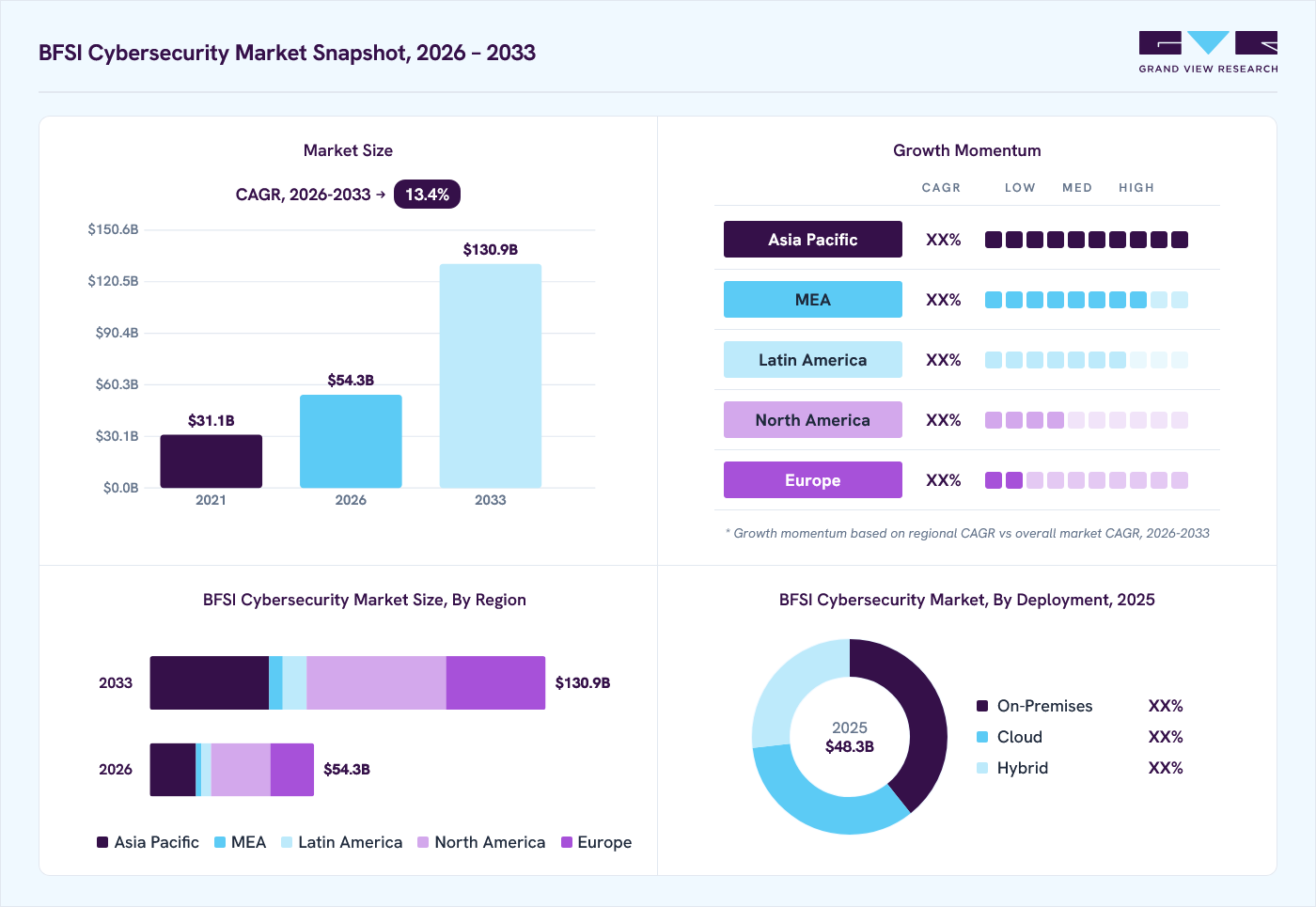 Source: Grand View Research, IR Documents, Primary Interviews, Paid DatabasesTo learn more about this report,
 Download Free Sample Report
 Key Market Trends & Insights
- By component: Solutions segment held the largest revenue share of 78.7% in 2025
- By security type: Cloud security held the largest revenue share of 18.4% in 2025
- By deployment: On-premises segment held the largest market share in 2025
- By industry: Banking held the largest market share in 2025
- By end use: Banks held the largest market share in 2025
Regional Highlights
- Largest regional market: North America (36.2% revenue share, 2025)
- Fastest-growing regional market: Asia Pacific (highest CAGR, 2026-2033)
- By country: The U.S. held the largest market share in 2025
Market Size & Forecast
- Market size in 2025: USD 48.3 billion
- Estimated market size in 2026: USD 54.3 billion
- Projected market size by 2033: USD 130.9 billion
- CAGR (2026-2033): 13.4%
Three ways to get this report
Buy it, customize it, or ask a question.Ask an Analyst
A direct answer, usually in 1 working day
- AccessReport author, directly
- Reply timeWithin 1 working day
- No sales callDirect answer only
- FormatEmail reply
- CostFree, no cost
Get the Full Report
What the study covers
- FormatsPDF · Excel · Dashboard
- Timeline2026–2033 annual, 2025 base
- Coverage20+ countries, 5 regions
- Companies10+ key players profiled
Customize the Report
20% free customization
- IncludeCountries, segments, points
- TailorTo your product definition
- ExtendDeeper competitor detail
- OrA fully bespoke study
- Turnaround5–10 working days
Increasing adoption of digital banking platforms, mobile payment systems, cloud-based financial applications, and fintech services has significantly expanded the cyber threat landscape for BFSI organizations. As a result, financial institutions are increasingly investing in advanced cybersecurity solutions to safeguard sensitive customer data, prevent fraud, and ensure uninterrupted financial operations. The market is projected to grow at a strong CAGR over the forecast period, supported by rising cybersecurity awareness and stringent regulatory compliance requirements.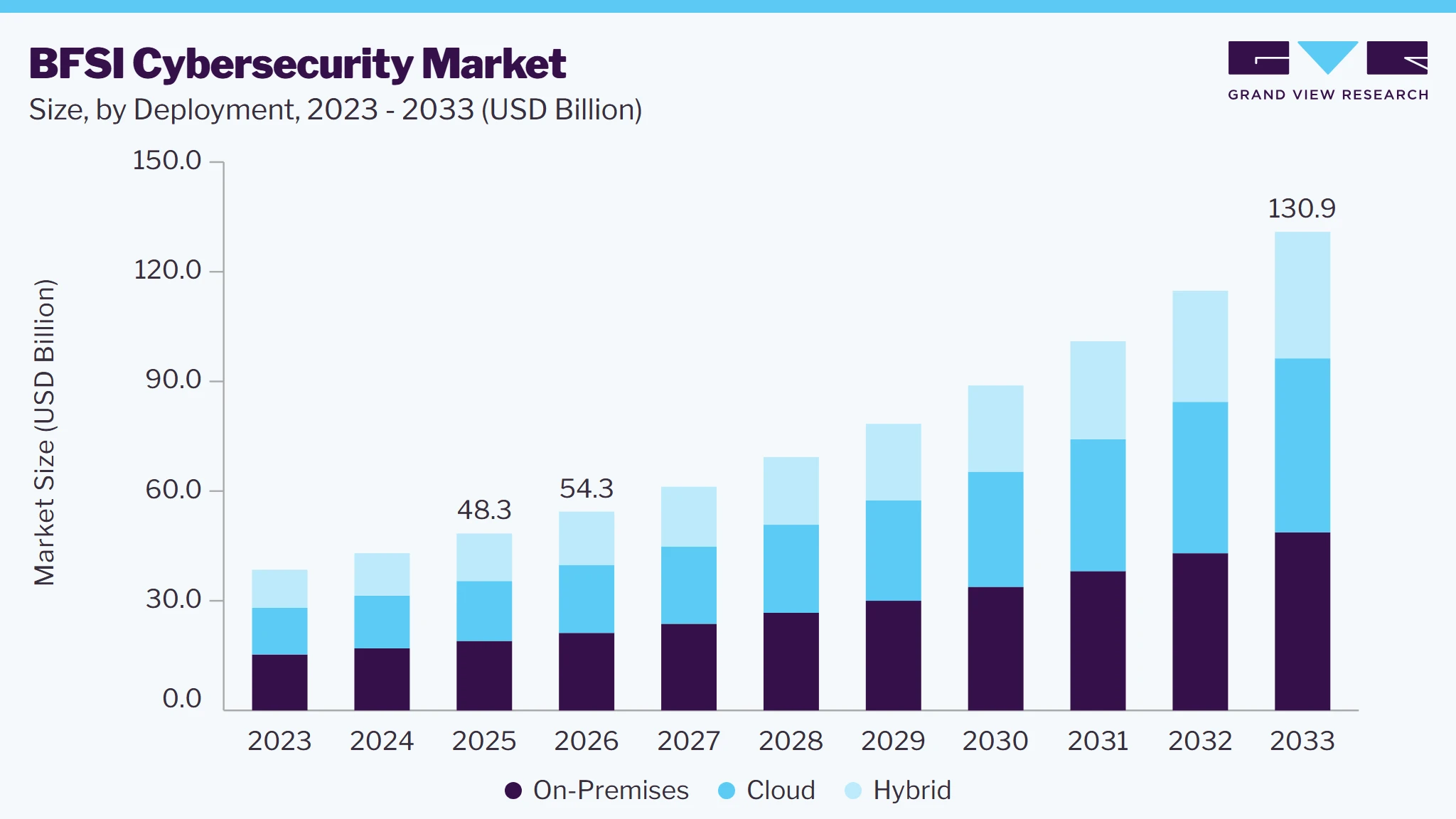 To learn more about this report, Download Free Sample Report
 Rising ransomware attacks, phishing campaigns, identity thefts, data breaches, and payment frauds are major factors accelerating demand for cybersecurity technologies in the BFSI sector. Financial institutions are prioritizing solutions such as identity and access management (IAM), security information and event management (SIEM), encryption & tokenization, firewall systems, endpoint protection, and intrusion detection & prevention systems (IDPS). In addition, the adoption of artificial intelligence (AI), machine learning (ML), behavioral analytics, and zero-trust security frameworks is transforming cybersecurity strategies within the industry by enabling real-time threat detection and automated incident response capabilities.
By industry, the banking segment holds the dominant share of the global BFSI cybersecurity market due to high digital transaction volumes and increasing online banking penetration. FinTech companies and payment service providers are expected to witness the fastest growth owing to rapid digital payment adoption, open banking ecosystems, and cloud-native financial services. Regionally, North America leads the market due to strong cybersecurity infrastructure, high technology spending, and stringent financial regulations, while Asia Pacific is anticipated to register the fastest growth driven by expanding fintech ecosystems, growing internet penetration, and rising cyberattack incidents in emerging economies such as India and China.
The competitive landscape of the market is characterized by continuous innovation, strategic partnerships, mergers & acquisitions, and increasing investments in cloud and AI-driven security platforms. Cybersecurity vendors are focusing on offering integrated and scalable security solutions tailored for BFSI institutions to address evolving threat complexities and regulatory demands. Furthermore, the growing adoption of managed security services, multi-factor authentication, biometric verification, and secure digital identity management is expected to create significant opportunities for market expansion in the coming years.
Market Dynamics
The BFSI cybersecurity market is being driven by the rapid digitalization of banking, insurance, capital markets, and payment ecosystems, which has significantly expanded the attack surface across cloud platforms, mobile banking applications, open banking APIs, and fintech partnerships. Financial institutions are increasingly facing sophisticated cyber threats such as AI-powered phishing, deepfake-enabled fraud, account takeover attacks, ransomware, and identity-based breaches. As a result, organizations are accelerating investments in advanced security architectures, including Zero Trust, Identity Threat Detection and Response (ITDR), Extended Detection and Response (XDR), Security Information and Event Management (SIEM), and AI-driven fraud analytics. Regulatory agencies across major economies are simultaneously tightening cybersecurity, data privacy, and operational resilience requirements, compelling banks and insurers to strengthen cyber governance, continuous monitoring, and incident response capabilities.
A major trend in reshaping the BFSI cybersecurity landscape is the growing adoption of artificial intelligence for both cyber defense and threat detection. Financial institutions are deploying AI-powered security operations centers (SOCs), behavioral analytics, automated threat hunting, and real-time fraud detection systems to combat increasingly automated cyberattacks. At the same time, cybercriminals are leveraging generative AI to create highly personalized phishing campaigns, synthetic identities, and deep-fake-based social engineering attacks, intensifying the cybersecurity arms race. The industry is also witnessing increased focus on third-party risk management, cloud security, API protection, and cyber resilience frameworks as financial ecosystems become more interconnected. Additionally, the emergence of AI governance, machine identity security, and post-quantum cryptography preparedness is creating new growth opportunities for cybersecurity vendors serving the BFSI sector.
The rapid expansion of digital banking, mobile payment platforms, online financial services, and fintech ecosystems is a major driver fueling the growth of the BFSI cybersecurity market. Financial institutions are increasingly adopting cloud computing, AI-enabled banking systems, digital wallets, and real-time payment infrastructure to enhance customer experience and operational efficiency. However, this digital transformation has significantly increased exposure to cyber threats, including ransomware attacks, phishing, identity theft, payment fraud, and data breaches. As a result, banks, insurance providers, fintech firms, and payment service providers are heavily investing in advanced cybersecurity solutions, including identity & access management (IAM), encryption, SIEM, endpoint security, and fraud detection systems to protect sensitive financial data and maintain regulatory compliance.
The high cost associated with deploying and maintaining advanced cybersecurity infrastructure is a major restraint for the growth of the BFSI cybersecurity market. Financial institutions, particularly small and medium-sized banks, NBFCs, and credit unions, often face challenges allocating substantial budgets for sophisticated security technologies, ongoing system upgrades, employee training, and regulatory compliance. In addition, integrating modern cybersecurity solutions with legacy banking systems can be technically complex and time-consuming, leading to operational disruptions and increased implementation costs. The shortage of skilled cybersecurity professionals and the rapidly evolving nature of cyber threats further add to the complexity of managing robust security frameworks across BFSI organizations.
Market Concentration & Characteristics
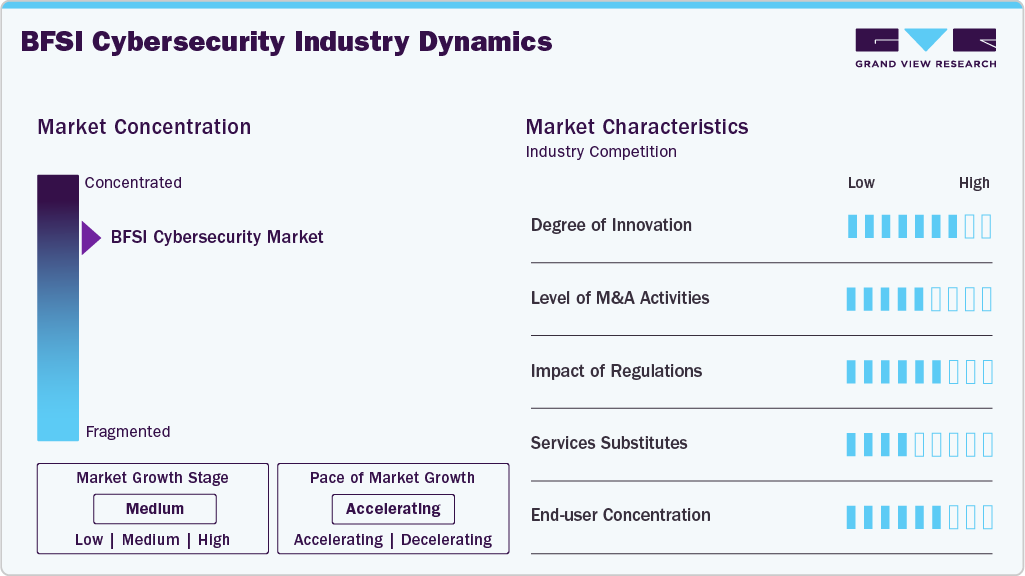
The global BFSI cybersecurity market is moderately concentrated, with a mix of established cybersecurity providers, cloud security companies, and specialized fintech security vendors competing to strengthen their market presence. Major players such as IBM, Cisco Systems, Palo Alto Networks, Fortinet, and Check Point Software Technologies dominate the market through extensive product portfolios, strong global distribution networks, and continuous investments in AI-driven threat detection and cloud security solutions. At the same time, emerging cybersecurity startups and niche vendors are gaining traction by offering specialized fraud prevention, identity management, and zero-trust security platforms tailored for BFSI institutions.
 To learn more about this report, Download Free Sample Report
 The BFSI cybersecurity industry is characterized by a high level of innovation, driven by rising cyber threats and increasing digitalization across financial institutions. Companies are focusing on AI- and ML-based threat detection, zero-trust architecture, cloud-native security, biometric authentication, and XDR solutions to enhance security capabilities. The market is moderately concentrated, with major players continuously expanding through mergers, acquisitions, and strategic partnerships to strengthen cloud security, fraud prevention, and identity management offerings. Additionally, growing demand for managed security services and regulatory compliance solutions is encouraging continuous technological advancements and competitive market expansion.
Analyst Perspective
The BFSI cybersecurity market is entering a new phase of growth as financial institutions shift from traditional perimeter-based security models to AI-driven cyber resilience strategies. The rapid rise of generative AI-powered phishing, deepfake fraud, identity attacks, and sophisticated ransomware campaigns is compelling banks, insurers, and fintech companies to significantly increase cybersecurity investments. Organizations are increasingly adopting Zero Trust Architecture, AI-powered Security Operations Centers (SOCs), behavioral analytics, and real-time fraud detection platforms to counter evolving threats. Regulatory initiatives focused on operational resilience, third-party risk management, and AI governance are further accelerating market demand. Additionally, the expansion of open banking, cloud-native financial services, embedded finance, and digital payment ecosystems is creating new security requirements across interconnected financial networks.
Component Insights
The solutions segment dominated the BFSI cybersecurity industry, accounting for the largest share of 78.7% in 2025, primarily driven by the increasing frequency of cyberattacks targeting financial institutions and the rising adoption of advanced security technologies across digital banking ecosystems. Growing regulatory compliance requirements, cloud adoption, real-time payment infrastructure, and the need for secure customer authentication are further accelerating demand for cybersecurity solutions such as IAM, SIEM, encryption, and threat detection platforms. For instance, in April 2026, aiComply launched NavigateCyber Financial Services to help banks transition from the FFIEC Cybersecurity Assessment Tool (CAT) to the NIST Cybersecurity Framework (CSF) 2.0, enabling regulated financial institutions to strengthen cybersecurity governance, preserve existing assessment frameworks, and improve compliance readiness. Therefore, the increasing adoption of digital transformation initiatives and evolving cybersecurity compliance standards are expected to continue driving strong demand for advanced cybersecurity solutions in the BFSI industry.
The services segment is expected to grow at the fastest CAGR from 2026 to 2033, driven by the rising demand for managed security services, cybersecurity consulting, incident response, and continuous threat monitoring solutions among financial institutions. Increasing cyberattack complexity, growing regulatory compliance requirements, and the shortage of skilled cybersecurity professionals are encouraging banks, insurance providers, fintech firms, and payment companies to outsource cybersecurity operations to specialized service providers. Additionally, the rapid adoption of cloud-based banking infrastructure and digital financial platforms is driving the need for scalable, real-time cybersecurity support services across the BFSI sector.
Deployment Insights
The on-premises segment dominated the BFSI cybersecurity market in 2025, driven by the increasing adoption of cloud-based banking platforms, digital payment systems, and remote financial operations across banking, financial services, and insurance institutions. Financial organizations are rapidly shifting toward cloud infrastructure to enhance scalability, operational flexibility, cost efficiency, and real-time data accessibility. This transition has significantly increased the demand for cloud security solutions, including identity & access management, data encryption, threat intelligence, and cloud workload protection, to safeguard sensitive financial information and ensure regulatory compliance. Additionally, the growing integration of AI-driven security analytics and multi-cloud environments is further supporting the dominance of the cloud deployment segment.
The cloud segment is projected to grow notably during the forecast period, as many BFSI institutions continue to prioritize infrastructure ownership and internal control over critical cybersecurity operations. Financial organizations handling high-value transactions and sensitive customer records often rely on dedicated in-house security environments to minimize external vulnerabilities and maintain tighter governance standards. Moreover, the continued use of legacy core banking systems, coupled with institution-specific security customization requirements, is encouraging steady investment in on-premises cybersecurity deployments across the global BFSI sector.
Security Type Insights
The cloud security segment accounted for the largest share of the BFSI cybersecurity industry in 2025, owing to the accelerated migration of banking and financial operations toward cloud-based platforms and digital ecosystems. BFSI organizations are increasingly adopting cloud security solutions to secure remote access, digital transactions, customer databases, and multi-cloud environments while improving operational agility and scalability. The growing use of SaaS banking applications, AI-powered fraud detection systems, and hybrid work models has further strengthened demand for advanced cloud protection technologies across the sector. As financial institutions continue to modernize their IT infrastructure and expand digital service offerings, demand for cloud-centric cybersecurity solutions is expected to remain strong throughout the forecast period.
Endpoint & IoT security is projected to witness a significant CAGR during the forecast period due to the increasing adoption of connected devices, smart banking infrastructure, remote workforce models, and mobile financial applications across the BFSI sector. Financial institutions are strengthening endpoint protection measures to secure laptops, mobile devices, ATMs, POS terminals, and IoT-enabled banking systems against ransomware, malware, phishing, and unauthorized access attempts. In addition, the growing integration of IoT technologies in payment processing, branch automation, and customer authentication systems is driving demand for advanced endpoint detection, real-time monitoring, and device-level security solutions. The rising focus on securing distributed digital ecosystems and minimizing operational cyber risks is expected to further accelerate growth in the endpoint & IoT security segment over the coming years.
Industry Insights
The banking segment held the largest revenue share of the BFSI cybersecurity market in 2025, driven by the rapid expansion of digital banking services, increasing online transaction volumes, and growing exposure to sophisticated cyber threats targeting financial institutions. Banks are continuously investing in advanced cybersecurity frameworks to protect customer credentials, payment systems, core banking infrastructure, and sensitive financial data from ransomware, phishing, identity theft, and fraud-related attacks. The rising adoption of mobile banking applications, AI-enabled financial services, and real-time payment ecosystems has further accelerated demand for multi-layered security solutions across the banking sector. Moreover, stringent regulatory requirements related to data privacy, transaction security, and operational resilience continue to encourage banks to strengthen their cybersecurity capabilities globally.
The financial services segment is expected to grow at a significant CAGR from 2026 to 2033, driven by the increasing digitization of investment platforms, wealth management services, stock trading applications, and digital lending operations. Financial service providers are increasingly adopting advanced cybersecurity technologies to secure customer data, digital assets, online transactions, and API-driven financial ecosystems from evolving cyber threats. The growing presence of fintech collaborations, open banking models, and cloud-based financial applications is further creating strong demand for real-time threat intelligence, identity verification, and fraud prevention solutions. Additionally, rising regulatory scrutiny and the need to maintain customer trust in digital financial operations are expected to support sustained cybersecurity investments across the financial services industry.
End-User Insights
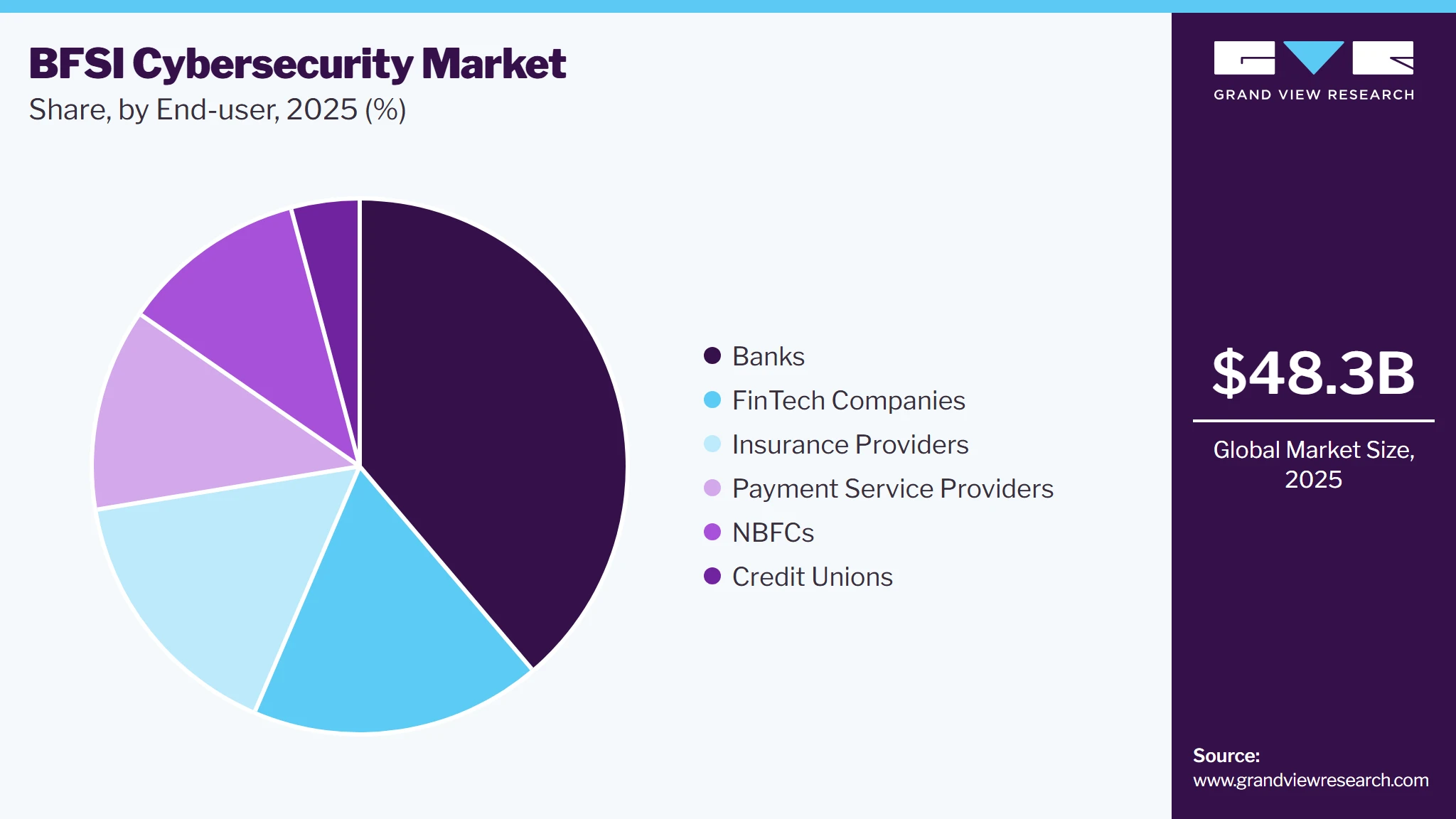
The banks segment accounted for the largest revenue share of the BFSI cybersecurity market in 2025, driven by their extensive exposure to high-volume digital transactions, large customer databases, and continuously expanding online and mobile banking ecosystems. Banks remain primary targets for cybercriminals because of the high value of financial assets and sensitive personal information they manage, leading to increased investment in advanced cybersecurity solutions such as fraud detection, identity protection, endpoint security, and real-time threat monitoring. In addition, strict regulatory compliance requirements, rising incidents of ransomware and phishing attacks, and the rapid adoption of digital payment systems and cloud-based core banking infrastructure have further compelled banks to strengthen their cybersecurity frameworks, driving their dominant market position.
 To learn more about this report, Download Free Sample Report
 The fintech companies segment is expected to grow at the fastest CAGR over the forecast period, driven by the rapid expansion of digital-first financial platforms, increasing adoption of mobile payment solutions, and growing reliance on API-driven ecosystems for seamless financial transactions. Fintech firms operate in highly digitized and cloud-native environments, making them more exposed to evolving cyber threats such as account takeover attacks, payment fraud, and data breaches, thereby driving strong demand for advanced cybersecurity solutions. Additionally, the surge in digital lending, neobanking, and embedded finance services, along with intense competition in the fintech space, is driving companies to invest heavily in real-time fraud detection, identity verification, and AI-driven threat intelligence systems to ensure secure, trusted financial operations.
Regional Insights
North America held the largest share of 36.2% in 2025, supported by the strong presence of leading financial institutions, highly digitized banking infrastructure, and early adoption of advanced cybersecurity technologies across the region. The region has witnessed large-scale deployment of zero-trust security architectures, AI-driven threat intelligence platforms, and behavioral analytics tools, particularly among major banks and insurance providers, to counter increasingly sophisticated ransomware and account takeover attacks. In addition, the rapid expansion of real-time payment systems such as RTP and FedNow in the U.S., along with growing cloud migration of core banking workloads, has significantly increased the demand for cloud security, identity and access management (IAM), and fraud detection solutions. Regulatory frameworks such as GLBA, NYDFS Cybersecurity Regulation, and continuous SEC cybersecurity disclosure requirements are also pushing BFSI organizations to strengthen incident reporting, data protection, and operational resilience capabilities. Furthermore, strong investments from U.S.-based cybersecurity vendors and frequent collaborations between banks and technology providers are further reinforcing North America’s leadership in the market.
 To learn more about this report, Download Free Sample Report
 U.S. BFSI Cybersecurity Market Trends
The BFSI cybersecurity industry in the U.S. is expected to grow significantly from 2026 to 2033, due to the increasing sophistication of cyberattacks targeting financial institutions and the rapid expansion of digital banking and fintech ecosystems. Financial organizations are heavily investing in advanced security frameworks such as zero-trust architecture, AI-based fraud detection, and real-time threat intelligence to safeguard high-value transactions and sensitive customer data. The rising adoption of cloud-native banking platforms, embedded finance solutions, and instant payment systems is further amplifying the need for robust cybersecurity infrastructure across the sector. In addition, stringent regulatory requirements from agencies such as the SEC and compliance mandates like the NYDFS Cybersecurity Regulation are compelling banks, insurance providers, and financial service firms to continuously enhance their cyber resilience, driving sustained market growth throughout the forecast period.
Asia Pacific BFSI Cybersecurity Market Trends
The Asia Pacific BFSI cybersecurity industry is expected to grow at the fastest CAGR during the forecast period, driven by rapid digital transformation across banking and financial services, increasing penetration of mobile and internet banking, and the strong expansion of fintech ecosystems in countries such as India, China, and Southeast Asia. The region is witnessing a surge in digital payment adoption, including UPI-like real-time payment systems, e-wallets, and cross-border digital transactions, which is significantly increasing the cyber risk exposure of BFSI institutions. In addition, the rising frequency of cyberattacks targeting financial infrastructure, coupled with growing regulatory focus on data protection and cybersecurity compliance, is compelling banks, NBFCs, and fintech companies to invest heavily in advanced security solutions such as fraud detection, identity management, and cloud security. Expanding cloud adoption and increasing investments from both global and regional cybersecurity vendors are further accelerating market growth across the Asia Pacific BFSI cybersecurity landscape.
The China BFSI cybersecurity marketheld a significant share in 2025, supported by the rapid digitization of banking and financial services, large-scale adoption of mobile payment platforms, and strong expansion of digital financial ecosystems led by major banks and fintech players. The country’s highly developed digital payment infrastructure, including widespread use of mobile wallets and real-time transaction systems, has increased the need for advanced cybersecurity solutions to protect against fraud, data breaches, and increasingly sophisticated cyberattacks. In addition, stringent national cybersecurity regulations, data localization requirements, and growing emphasis on financial system resilience have encouraged BFSI organizations in China to invest heavily in identity protection, encryption technologies, cloud security, and fraud detection systems, strengthening the country’s position in the global market.
The BFSI cybersecurity market in Japan is witnessing strong expansion, driven by the rapid digital transformation of the financial sector, increasing adoption of online and mobile banking services, and the modernization of legacy banking infrastructure. Japanese banks and insurance providers are increasingly integrating cloud-based platforms, AI-enabled financial services, and automated payment systems, which is significantly increasing the need for advanced cybersecurity solutions to protect sensitive financial data and ensure operational continuity. In addition, rising concerns over ransomware attacks, phishing incidents, and supply-chain vulnerabilities, along with stringent regulatory frameworks and national cybersecurity initiatives, are compelling BFSI organizations to strengthen investments in identity and access management, encryption technologies, and real-time threat monitoring systems.
The India BFSI cybersecurity market is experiencing strong growth due to the rapid expansion of digital banking services, widespread adoption of mobile payment systems such as UPI, and increasing penetration of internet-based financial platforms across urban and rural regions. The surge in fintech innovation, digital lending, and online insurance services has significantly increased the exposure of BFSI institutions to cyber risks such as phishing, fraud, identity theft, and ransomware attacks, driving higher demand for advanced cybersecurity solutions. In addition, strong regulatory oversight from the Reserve Bank of India (RBI), growing emphasis on data protection and compliance frameworks, and rising investments in cloud-based banking infrastructure are further accelerating the adoption of identity management, fraud detection, encryption, and endpoint security solutions across India’s BFSI sector.
Europe BFSI Cybersecurity Market Trends
The Europe BFSI cybersecurity industry is expected to grow at a significant CAGR from 2026 to 2033, driven by the increasing digitization of financial services, widespread adoption of cloud-based banking platforms, and rising integration of advanced fintech solutions across the region. Financial institutions across Europe are accelerating investments in cybersecurity to protect against growing incidents of ransomware, payment fraud, and data breaches, particularly as online banking and digital payment usage continue to expand rapidly. In addition, stringent regulatory frameworks such as GDPR and the Digital Operational Resilience Act (DORA) are compelling banks, insurance companies, and financial service providers to strengthen their cybersecurity posture through enhanced risk management, real-time monitoring, and incident response capabilities. The growing emphasis on data privacy, operational resilience, and cross-border financial transaction security is further supporting sustained demand for advanced cybersecurity solutions across the European BFSI sector.
The BFSI cybersecurity market in the UK is witnessing strong growth due to the rapid digitalization of banking and financial services, increasing adoption of online banking platforms, and the expansion of fintech ecosystems, particularly in London as a global financial hub. Financial institutions are increasingly investing in advanced cybersecurity solutions to mitigate rising threats such as ransomware attacks, phishing schemes, and financial fraud, which have intensified with the growing volume of digital transactions and cloud-based banking operations. In addition, strong regulatory oversight from frameworks such as the Financial Conduct Authority (FCA) guidelines and the Bank of England’s operational resilience requirements is pushing BFSI organizations to strengthen their cybersecurity infrastructure through real-time monitoring, identity and access management, and data protection solutions, further driving market growth.
The Germany BFSI cybersecurity market held a significant share in 2025, driven by the country’s strong banking infrastructure, high adoption of digital financial services, and increasing focus on securing critical financial systems against sophisticated cyber threats. German banks and insurance providers are actively investing in advanced cybersecurity frameworks to protect sensitive customer data, ensure secure online transactions, and strengthen resilience against ransomware attacks and data breaches. In addition, strict regulatory requirements under GDPR and growing alignment with EU-wide cybersecurity standards are compelling financial institutions to adopt robust identity management, encryption technologies, and real-time threat detection systems. The rising shift toward cloud-based banking operations and digital payment ecosystems is further reinforcing demand for advanced cybersecurity solutions across Germany’s BFSI sector.
Key BFSI Cybersecurity Company Insights
Some of the key companies operating in the market include Accenture, AhnLab, Broadcom, and Check Point Software Technologies. These companies are some of the leading participants in the BFSI cybersecurity market.
-
In January 2026, Palo Alto Networks continued its aggressive expansion strategy with multiple acquisitions, including Chronosphere (2025) and CyberArk, strengthening its AI-powered Cortex platform for enterprise and BFSI security operations. These moves enhance identity security, cloud monitoring, and automated threat response capabilities for financial institutions.
-
In June 2025, Zscaler expanded its partnership with Vectra AI (AI-driven threat detection in cloud security) to strengthen Secure Access Service Edge (SASE) offerings used in BFSI digital banking environments to secure remote access and cloud workloads.
Key BFSI Cybersecurity Companies
The following key companies have been profiled for this study of the BFSI cybersecurity market.
-
Accenture
-
AhnLab
-
Broadcom
-
Check Point Software Technologies
-
Cisco Systems
-
CrowdStrike
-
Fortinet
-
IBM
-
Kaspersky
-
McAfee
-
Microsoft
-
Palo Alto Networks
-
Trend Micro
-
Trellix
-
Zscaler
Competitive Benchmarking
Operating Strategies
Competitive Edge
Weaknesses
Mature Players: Microsoft; IBM; Cisco Systems; Broadcom (Symantec); Fortinet; Check Point Software Technologies; Trend Micro; McAfee; Trellix; Accenture
- Embedding compliance mapping tools within extensive multi-solution security suites to automatically align technical controls with global financial mandates
- Providing highly specialized, deep-layer security architectures designed to safely monitor and insulate legacy banking transaction cores and on-premise mainframes without interrupting high-volume throughput.
- The unique ability to embed security configurations natively within the physical routing, switching, and firewall fabrics that form the backbone of global banking data centers.
- The logistical capacity of firms like Accenture or IBM to deploy global engineering armies for extensive, multi-jurisdictional post-breach remediation and systemic infrastructure upgrades.
- Large, multi-module legacy platforms can be notoriously difficult to configure, occasionally requiring lengthy deployment cycles and specialized external consulting fees.
- The immense corporate scale of these conglomerates can lead to slower adaptation rates when delivering real-time, cloud-native fixes against newly engineered zero-day exploits.
Emerging Players: CrowdStrike; Palo Alto Networks; Zscaler; AhnLab; Kaspersky
- Leveraging advanced machine learning and automated playbooks to isolate high-velocity threats at the endpoint and cloud boundary in milliseconds without manual intervention.
- Championing secure access service edge (SASE) infrastructures to enforce granular, identity-based access control policies for distributed hybrid-banking workforces and cloud-hosted financial applications.
- Processing trillions of live, cross-organizational signals daily to achieve "community immunity" instantly shielding all global financial clients the moment an indicator is flagged at a single endpoint.
- Deploying non-disruptive, agentless, or lightweight software overlays that instantly hook into modern DevOps pipelines and multi-cloud database environments without causing processing latency.
- Specialized cloud and endpoint platforms often lack direct control over the underlying physical network switching hardware or non-security core database mainframes.
- Financial institutions frequently seek to minimize their vendor footprints, making niche point-product specialists vulnerable to being marginalized by all-inclusive platform offerings from larger enterprise titans.
BFSI Cybersecurity Market Report Scope
Report Attribute
Details
Market size in 2025
USD 48.3 billion
Estimated market size in 2026
USD 54.3 billion
Projected market size by 2033
USD 130.9 billion
Growth rate
CAGR of 13.4% from 2026 to 2033
Actual data
2021 - 2025
Forecast period
2026 - 2033
Quantitative units
Revenue in USD billion and CAGR from 2026 to 2033
Report coverage
Revenue forecast, company share, competitive landscape, growth factors, and trends
Segments covered
Component, deployment, security type, industry, end user, region
Regional scope
North America; Europe; Asia Pacific; Latin America; MEA
Country scope
U.S.; Canada; Mexico; UK; Germany; France; China; India; Japan; Australia; South Korea; Brazil; UAE; Saudi Arabia; South Africa
Key companies profiled
Accenture; AhnLab; Broadcom; Check Point Software Technologies; Cisco Systems; CrowdStrike; Fortinet; IBM; Kaspersky; McAfee; Microsoft; Palo Alto Networks; Trend Micro; Trellix; Zscaler
Customization scope
Free report customization (equivalent to 8 analysts working days) with purchase. Addition or alteration to country, regional & segment scope.
Pricing and purchase options
Avail customized purchase options to meet your exact research needs. Explore purchase options
Global BFSI Cybersecurity Market Report Segmentation
This report forecasts revenue growth at the global, regional, and country levels and provides an analysis of the latest industry trends in each of the sub-segments from 2021 to 2033. For this study, Grand View Research has segmented the BFSI cybersecurity market report based on component, deployment, security type, industry, end user, and region:
-
Component Outlook (Revenue, USD Billion, 2021 - 2033)
-
Solutions
-
Identity & Access Management (IAM)
-
Firewall
-
Antivirus/Antimalware
-
Encryption & Tokenization
-
Security Information & Event Management (SIEM)
-
Intrusion Detection & Prevention System (IDPS)
-
Others
-
-
Services
-
Professional Services
-
Consulting
-
Integration & Deployment
-
Training & Support
-
-
Managed Services
-
-
-
Deployment Outlook (Revenue, USD Billion, 2021 - 2033)
-
On-Premises
-
Cloud
-
Hybrid
-
-
Security Type Outlook (Revenue, USD Billion, 2021 - 2033)
-
Network Security
-
Endpoint & IoT Security
-
Application Security
-
Cloud Security
-
Data Security
-
Identity Security
-
Others
-
-
Industry Outlook (Revenue, USD Billion, 2021 - 2033)
-
Banking
-
Financial Services
-
Insurance
-
-
End User Outlook (Revenue, USD Billion, 2021 - 2033)
-
Banks
-
Retail Banks
-
Commercial Banks
-
Investment Banks
-
-
NBFCs
-
Insurance Providers
-
Payment Service Providers
-
FinTech Companies
-
Credit Unions
-
-
Regional Outlook (Revenue, USD Billion, 2021 - 2033)
-
North America
-
U.S.
-
Canada
-
Mexico
-
-
Europe
-
Germany
-
UK
-
France
-
-
Asia Pacific
-
China
-
India
-
Japan
-
South Korea
-
Australia
-
-
Latin America
-
Brazil
-
-
Middle East & Africa
-
UAE
-
Saudi Arabia
-
South Africa
-
-
Research Methodology
The BFSI cybersecurity market figures in this report are based on a proven research process that combines executive interviews with secondary research from proprietary databases, company filings, and recognized regulatory and institutional sources. Market size is built through value-chain sizing—reconciling supply-side and demand-side estimates—and triangulated with bottom-up and top-down approaches. Every estimate passes multiple levels of expert validation before publication, with each BFSI cybersecurity segment quantified using the revenue-capture definitions in the table below.
Segment Definition
Segment - Component
Revenue Capture Definition
Solutions
Revenue generated from BFSI cybersecurity software platforms and integrated security solutions designed to protect banking, financial services, insurance, and digital payment ecosystems from cyber threats. Includes network security, endpoint and IoT security, identity and access management (IAM), fraud detection, security information and event management (SIEM), cloud security, data protection, application security, threat intelligence, zero-trust security, and security analytics solutions deployed across financial institutions.
Services
Revenue generated from professional and managed cybersecurity services supporting the implementation, operation, monitoring, and optimization of security programs within BFSI organizations. Includes consulting, risk assessment, penetration testing, security audits, compliance management, incident response, managed security services (MSS), security operations center (SOC) services, system integration, training, support, and maintenance services.
Segment - Security Type
Revenue Capture Definition
Network Security
Revenue generated from solutions designed to protect banking networks, payment infrastructure, communication channels, APIs, and connected financial systems from unauthorized access, malware, ransomware, and network-based cyberattacks. Includes firewalls, intrusion detection and prevention systems (IDS/IPS), network access control, secure web gateways, and network monitoring solutions.
Endpoint & IoT Security
Revenue generated from solutions protecting endpoints and connected devices used within BFSI environments, including employee workstations, mobile devices, ATMs, POS terminals, payment devices, customer service terminals, and IoT-enabled banking infrastructure. Includes endpoint detection and response (EDR), anti-malware, device management, and threat protection solutions.
Application Security
Revenue generated from solutions that secure banking applications, digital banking platforms, mobile banking apps, payment applications, insurance platforms, and financial software environments against vulnerabilities, unauthorized access, and cyber threats. Includes application testing, runtime protection, API security, and DevSecOps solutions.
Cloud Security
Revenue generated from solutions protecting cloud-hosted financial applications, banking workloads, digital payment platforms, customer data, and hybrid cloud environments. Includes cloud workload protection, cloud security posture management (CSPM), cloud access security brokers (CASB), and cloud threat detection solutions.
Data Security
Revenue generated from solutions that safeguard sensitive financial data, customer information, transaction records, payment data, and confidential business information through encryption, tokenization, data loss prevention (DLP), data monitoring, and access control technologies.
Identity Security
Revenue generated from solutions focused on identity verification, authentication, privileged access management, identity governance, multi-factor authentication (MFA), biometric authentication, and fraud prevention across BFSI organizations and customer-facing platforms.
Others
Revenue generated from additional cybersecurity technologies including threat intelligence, security analytics, fraud detection and prevention, security orchestration and automated response (SOAR), cyber resilience platforms, governance, risk and compliance (GRC) solutions, and emerging AI-driven security technologies.
Segment - Deployment
Revenue Capture Definition
On-Premises
Revenue generated from BFSI cybersecurity solutions deployed within customer-owned data centers, banking infrastructure, and enterprise IT environments. Includes locally installed security software, security appliances, monitoring systems, and compliance management platforms maintained within the organization's infrastructure.
Cloud
Revenue generated from cybersecurity solutions delivered through cloud-based deployment models. Includes cloud-hosted security platforms, security analytics, identity management, threat intelligence, managed detection and response (MDR), fraud prevention, and subscription-based cybersecurity services accessible via public or private cloud environments.
Hybrid
Revenue generated from cybersecurity solutions deployed across a combination of on-premises and cloud environments. Includes integrated security architectures that provide centralized visibility, policy management, threat detection, and compliance monitoring across distributed banking and financial ecosystems.
Segment - Industry
Revenue Capture Definition
Banking
Revenue generated from cybersecurity solutions deployed by retail banks, commercial banks, private banks, investment banks, and digital banks to secure customer accounts, payment systems, transaction processing platforms, digital banking channels, and core banking infrastructure.
Financial Services
Revenue generated from cybersecurity solutions adopted by financial institutions including asset management firms, brokerage firms, securities exchanges, wealth management companies, investment firms, and capital market participants to protect financial transactions, customer data, and operational systems.
Insurance
Revenue generated from cybersecurity solutions utilized by life, health, property, casualty, and reinsurance providers to secure policy administration systems, customer information, claims processing platforms, digital insurance applications, and enterprise operations.
Segment - End User
Revenue Capture Definition
Banks
Revenue generated from cybersecurity solutions and services adopted by retail, commercial, corporate, investment, cooperative, and digital banks to secure financial operations, customer transactions, digital channels, and regulatory compliance requirements.
NBFCs
Revenue generated from cybersecurity solutions deployed by non-banking financial companies (NBFCs) to protect lending platforms, customer databases, financial transactions, digital services, and operational infrastructure from cyber threats and fraud.
Insurance Providers
Revenue generated from cybersecurity solutions adopted by insurance companies to protect policyholder data, claims systems, underwriting platforms, digital customer engagement channels, and enterprise applications.
Payment Service Providers
Revenue generated from cybersecurity solutions utilized by payment processors, payment gateways, card networks, merchant acquirers, digital wallet providers, and transaction service providers to secure payment infrastructure, transaction data, and digital payment ecosystems.
FinTech Companies
Revenue generated from cybersecurity solutions adopted by fintech firms offering digital banking, lending, wealth management, embedded finance, cryptocurrency, insurtech, regtech, and payment services to protect digital platforms, APIs, customer data, and financial transactions.
Credit Unions
Revenue generated from cybersecurity solutions deployed by credit unions and member-owned financial cooperatives to secure member accounts, online banking services, payment systems, internal operations, and regulatory compliance activities.
Delivered Customizations
This report has been delivered with the following In-depth customizations
Client Request
Customization Delivered
Value Adds
Monetization and structural optimization framework for a Tier-1 retail banking infrastructure provider
- Comparative analysis of API monetization strategies (freemium vs. tier-based consumption models) underpinning Open Finance ecosystems.
- Qualitative evaluation of moving from product-centric licensing to value-based pricing tied to customer lifetime value (LTV) and processing cost reduction.
- Facilitated a structural unit-cost optimization strategy, aligning legacy core application rationalization with cloud-native migration frameworks.
- Provided a roadmap to navigate shifting net interest margins (NIM) through alternative tech-enabled fee revenue streams.
Agentic AI and operational capacity benchmarking for a multi-national wealth management institution
- Maturity mapping of the transition from reactive Generative AI "co-pilots" to autonomous Agentic AI workflows across front-office advisory and back-office credit decisioning.
- Deep-dive assessment of cross-channel contextual consistency across mobile, conversational AI, and trust-anchor brick-and-mortar branches.
- Formulated an enterprise labor-leverage framework, establishing KPIs for the "10x Bank" model where human capital is optimized to orchestrate multi-agent AI teams.
- Mitigated systemic risk by defining continuous, real-time auditing and explainability boundaries for AI-led model risk management (MRM).
Evolving risk orchestration and regulatory response analysis for a tier-1 insurance and capital markets enterprise
- Structural evaluation of risk perimeter expansion moving from static, boundary-based cybersecurity to dynamic, interoperable data fabric architectures and zero-trust verification pipelines.
- Assessment of implementation trends in automated regulatory compliance engine deployments to satisfy complex global mandates.
- Identified operational efficiencies by replacing disjointed legacy data silos with a fluid data ecosystem, effectively compressing Mean Time to Detect (MTTD) fraud.
- Supported proactive asset protection strategies, leveraging advanced behavioral biometrics to counteract sophisticated Adversary-in-the-Middle (AitM) and deepfake threats.
Frequently Asked Questions About This Report
The global BFSI cybersecurity market size was estimated at USD 48.3 billion in 2025 and is expected to reach USD 54.3 billion in 2026.
The global BFSI cybersecurity market is expected to grow at a compound annual growth rate of 13.4% from 2026 to 2033 to reach USD 130.9 billion by 2033.
Asia Pacific is the fastest-growing region over the forecast period.
North America dominated with 36.2% revenue share in 2025.
Key factors include rapid digital transformation across banking, financial services, and insurance institutions and increasing adoption of digital banking platforms, mobile payment systems, cloud-based financial applications, and fintech services.
Key players operating in the BFSI cybersecurity market include Accenture, AhnLab, Broadcom, Check Point Software Technologies, Cisco Systems, CrowdStrike, Fortinet, IBM, Kaspersky, McAfee, Microsoft, Palo Alto Networks, Trend Micro, Trellix, Zscaler, and Others.
The solutions segment led with a 78.7% revenue share in 2025, while services segment is the fastest-growing segment.
The cloud security segment led with a 18.4% revenue share in 2025 and is also the fastest-growing segment.
The on-premises segment led with a 39.3% revenue share in 2025, while cloud segment is the fastest-growing segment.
About the Author(s)
Network Security Research Team
Technology · Network SecurityThis report was authored by the network security research team at Grand View Research - comprising two research analysts, one senior research analyst, and one industry expert - with specialized expertise in the network security segment of the technology industry. All findings are based on proprietary technology databases, executive interviews, and regulatory analysis, subject to internal peer review prior to publication.
Last Updated:
Speak to Analyst

Customize this report to your needs - add regions, segments, or data points, with 20% free customization.
Or view our licence options:


ISO 9001:2015 & 27001:2022 Certified
We are GDPR and CCPA compliant! Your transaction & personal information is safe and secure. For more details, please read our privacy policy.


