
- Home
- »
- Next Generation Technologies
- »
-
Immersive Live Entertainment Market Size Report 2026-2033GVR Report cover

Immersive Live Entertainment Market (2026 - 2033)
Size, Share & Trends Analysis Report By Technology (Virtual Reality (VR), Mixed Reality (MR), Projection Mapping & Immersive Visual Effects), By Experience Type, By Venue Type, By Region, And Segment Forecasts
Market Size, 2025
$24.6BMarket Estimate, 2026
$31.1BMarket Forecast, 2033
$149.5BCAGR, 2026–2033
25.2%Immersive Live Entertainment Market Summary
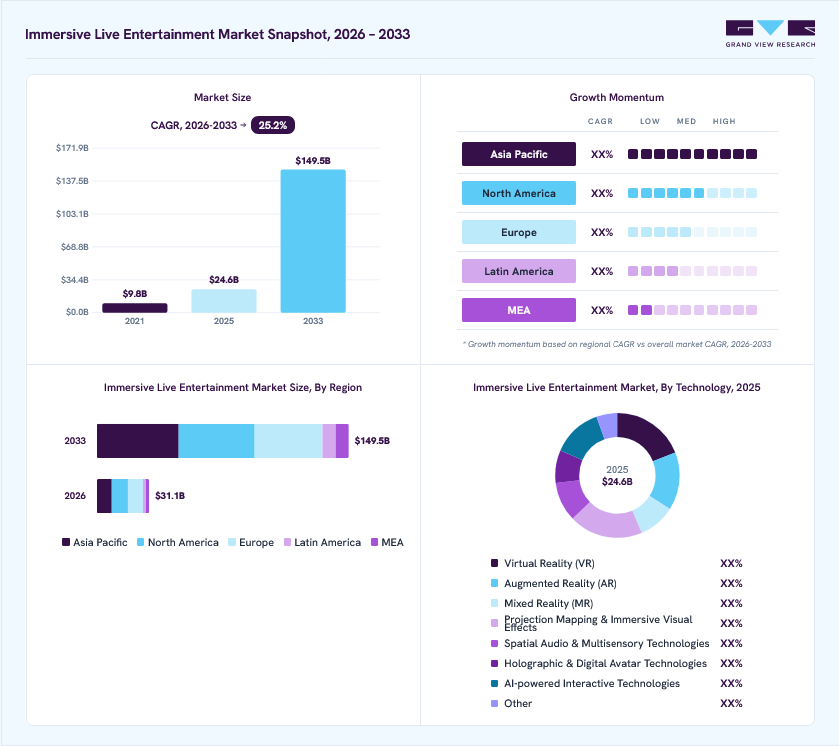
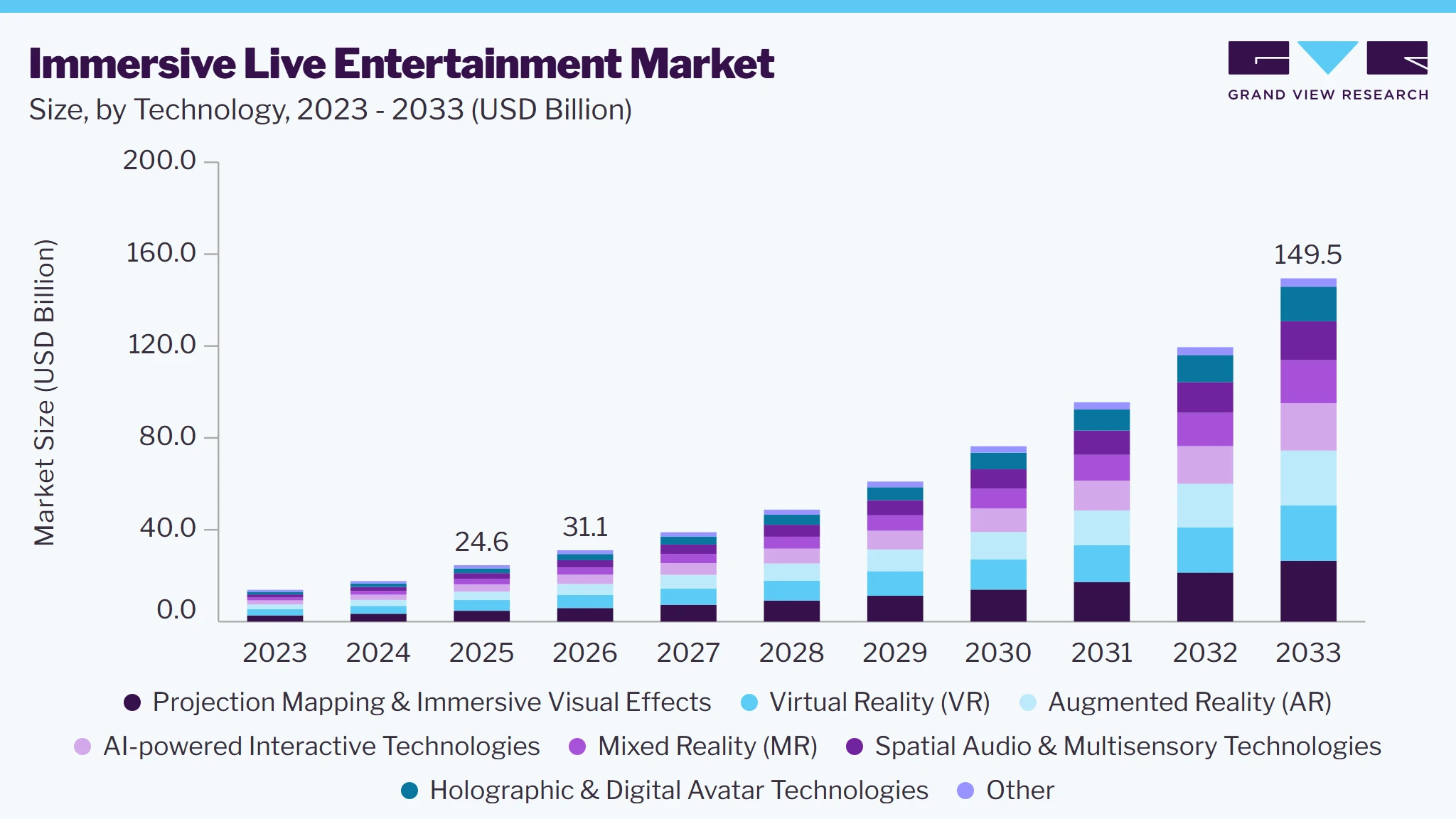
The global immersive live entertainment market size was valued at USD 24.6 billion in 2025 and is projected to grow from USD 31.1 billion in 2026 to USD 149.5 billion by 2033, at a CAGR of 25.2% from 2026 to 2033. The market in North America dominated with a revenue share of 31.0% in 2025. Growth is primarily driven by rising consumer demand for interactive and multisensory experiences, increasing investments in immersive venues, and rapid advancements in VR, AR, MR, projection mapping, spatial audio, and AI-powered technologies.
 Source: Grand View Research, IR Documents, Primary Interviews, Paid DatabasesTo learn more about this report,
 Download Free Sample Report
Key Market Trends & Insights
- By technology: Projection mapping & immersive visual effects segment held the largest market share of 19.2% in 2025.
- By experience type: Immersive concert experiences segment held the largest market share in 2025.
- By venue type: Concert arenas & stadiums segment held the largest market share in 2025.
Regional Highlights
- Largest regional market: North America (31.0% revenue share, 2025)
- Fastest-growing regional market: Asia Pacific (highest CAGR, 2026-2033)
- By country: The U.S. held the largest market share in 2025
Market Size & Forecast
- Market size in 2025: USD 24.6 Billion
- Estimated market size in 2026: USD 31.1 Billion
- Projected market size by 2033: USD 149.5 Billion
- CAGR (2026-2033): 25.2%
Prism AI by Grand View Research Free to tryAsk a question about the immersive live entertainment marketTry asking✓Every figure cited from GVR research Prefer the report? Download free sample →The growing popularity of immersive concerts, theater, festivals, sports, and location-based experiences, along with the integration of physical and digital entertainment formats, is further supporting the expansion of the immersive live entertainment industry. The market is advancing through the integration of emerging technologies that enhance audience engagement and create more interactive experiences. Advancements in virtual reality, augmented reality, mixed reality, projection mapping, spatial audio, holographic displays, and artificial intelligence are enabling entertainment providers to deliver personalized and multisensory experiences. The development of dedicated immersive venues, interactive installations, and hybrid physical-digital formats is further expanding the range of applications across concerts, theater, festivals, sports, cultural events, and location-based entertainment experiences.
 To learn more about this report, Download Free Sample Report
Additionally, the expansion of immersive entertainment venues and increasing investments in experiential entertainment infrastructure are accelerating demand for technologies that support audience interaction, real-time content rendering, multisensory engagement, and personalized experiences. Entertainment providers are also investing in advanced projection systems, LED displays, spatial audio, augmented reality, virtual reality, and AI-powered solutions to enhance content quality and differentiate live experiences. These investments are expected to support continued technology adoption as immersive concerts, theater productions, festivals, and location-based experiences scale globally.
Furthermore, immersive live entertainment requires highly integrated technology ecosystems capable of coordinating visual effects, audio systems, interactive displays, digital content, lighting, audience tracking, and real-time effects. Integrated immersive technologies improve audience engagement, content synchronization, environmental responsiveness, and operational efficiency, supporting more sophisticated and scalable entertainment experiences across venues. This growing dependence on integrated technology infrastructure is expected to strengthen adoption across the immersive live entertainment ecosystem. These developments are expected to support continued market growth throughout the forecast period.
Moreover, the integration of artificial intelligence, extended reality, real-time rendering, cloud computing, spatial computing, and advanced analytics is transforming immersive entertainment development and operations. AI-powered technologies can enable personalized content, interactive characters, real-time audience responses, automated content generation, and dynamic experience optimization. Advanced digital production and simulation tools also improve content development and testing efficiency, while data analytics enables operators to better understand audience behavior and preferences. These technological advancements are expanding immersive entertainment capabilities and encouraging stakeholders to invest in next-generation experiential infrastructure.
Market Dynamics
The immersive live entertainment market is shaped by rapid technological development, evolving consumer preferences, increasing investments in immersive venues, and the expansion of experiential entertainment infrastructure. Growth is supported by investments from entertainment companies, technology providers, venue operators, content creators, and event organizers. However, high technology and content development costs, complex venue integration requirements, cybersecurity and data privacy concerns, fragmented technology standards, and uncertain audience adoption across emerging formats remain key challenges. Ongoing innovation in extended reality, real-time rendering, AI, projection systems, spatial audio, and interactive technologies continues to shape the competitive landscape.
Consumers increasingly seek interactive, personalized, and multisensory entertainment experiences that offer greater engagement than conventional live formats. This has accelerated demand for immersive technologies that integrate visual effects, spatial audio, interactive environments, extended reality, AI-generated content, and real-time audience participation. The shift toward experience-driven entertainment is increasing demand for immersive concerts, theater productions, festivals, sports experiences, and location-based entertainment.
Interactive content, real-time audience engagement, personalized experiences, and immersive environments can improve audience satisfaction and create differentiated entertainment offerings compared with conventional live experiences. Their ability to support highly engaging and memorable experiences makes these capabilities important to entertainment providers. Moreover, venue operators and content producers are increasing investments in immersive technologies, supporting sustained market growth.
The development of immersive live entertainment experiences requires advanced display systems, projection technologies, spatial audio, interactive hardware, software platforms, real-time rendering, content creation, and extensive testing, making production programs technically complex and costly. High technology and content-development expenditures, coupled with the integration of multiple systems across entertainment venues, increase overall project costs.
Additionally, lengthy development timelines and evolving technology standards can delay the launch of immersive experiences, particularly for emerging entertainment companies and smaller venue operators. The need for continuous software updates, content refreshes, cybersecurity management, equipment maintenance, and compatibility testing further adds to lifecycle costs. These technical and financial challenges may slow adoption, especially among operators with limited investment budgets.
Increasing investments in immersive entertainment venues, experiential attractions, live events, and digital entertainment ecosystems are creating significant opportunities for the Immersive Live Entertainment Market. Immersive Entertainment Centers, Dome & LED Screen Venues, concert arenas, theaters, museums, cultural venues, and theme parks are investing in technologies that enable interactive storytelling, multisensory experiences, real-time content delivery, audience engagement, and scalable entertainment formats.
Emerging technologies such as AI-powered content generation, spatial computing, real-time rendering, digital twins, interactive projection, spatial audio, holographic displays, and location-based immersive platforms are creating new opportunities for innovation. As immersive entertainment expands across concerts, theater, festivals, sports, cultural events, and location-based experiences, the need for integrated technologies across content development, venue operations, audience engagement, and experience management is expected to increase. These investments are expected to accelerate the adoption of specialized immersive technologies and support sustained market growth over the forecast period.
Market Concentration & Characteristics
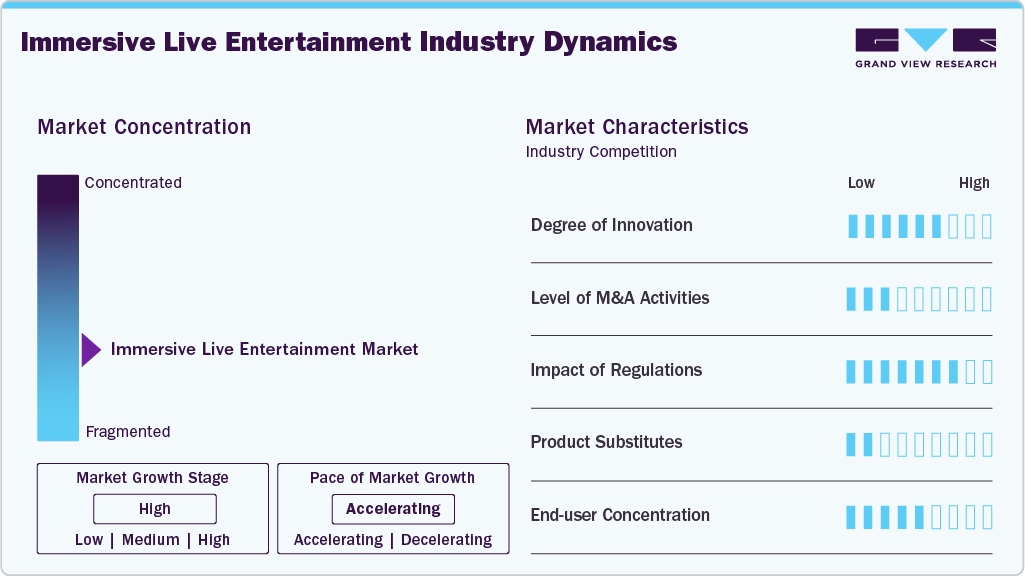
The global immersive live entertainment market is moderately fragmented, with immersive experience operators, entertainment companies, technology providers, venue operators, content studios, and specialized experiential technology firms competing across different market layers. The market demonstrates a high degree of innovation, driven by advancements in artificial intelligence, extended reality, projection mapping, spatial computing, real-time rendering, spatial audio, interactive technologies, and digital content production. The market also witnesses partnerships and selective M&A activity as established entertainment companies collaborate with specialized technology and content providers to strengthen capabilities across emerging immersive experiences and venues globally.
 To learn more about this report, Download Free Sample Report
The immersive live entertainment industry is significantly affected by technology standards, data privacy requirements, cybersecurity considerations, venue regulations, intellectual property requirements, and government policies supporting digital entertainment and cultural infrastructure. Traditional live entertainment formats continue to serve as substitutes in selected applications, while immersive technologies offer differentiated experiences through interactive and multisensory engagement. The competitive landscape remains moderately fragmented, with entertainment operators, technology providers, content creators, venue owners, event organizers, museums, theme parks, and cultural institutions representing major demand centers. Expanding investments in experiential entertainment are broadening adoption opportunities across emerging experience types and venues globally.
Analyst Perspective
The immersive live entertainment market is poised for steady expansion, driven by rising consumer demand for interactive entertainment, growing investments in immersive venues, advancements in visual, audio, and interactive technologies, and the increasing use of immersive experiences across concerts, theater, sports, festivals, and location-based entertainment. Growing demand for high-quality visual effects, spatial audio, AI-enabled, virtual, augmented, and mixed reality experiences, coupled with expanding applications in immersive storytelling, audience participation, cultural events, and hybrid physical-digital experiences, is expected to accelerate market adoption throughout the coming years across the evolving immersive entertainment ecosystem.
Technology Insights
The projection mapping & immersive visual effects segment dominated the immersive live entertainment industry, accounting for the largest revenue share of over 19.2% in 2025, driven by increasing demand for large-scale visual experiences, immersive stage environments, digital backdrops, and interactive visual effects across concerts, festivals, theater productions, sports events, and location-based entertainment venues. The growing adoption of high-resolution projection systems, real-time visual content, and digitally enhanced venue environments is further strengthening the segment's dominance. These developments are expected to strengthen demand for projection mapping and immersive visual effects across live entertainment applications throughout the forecast period.
The mixed reality (MR) segment is expected to grow at the fastest CAGR from 2026 to 2033, driven by the rising demand for interactive audience experiences, real-time digital overlays, virtual content integration, spatial interaction, and personalized entertainment environments. Increasing adoption of MR technologies across concerts, sports, theater, festivals, and location-based entertainment is expected to accelerate technology deployment. These developments are expected to strengthen demand for mixed reality solutions across immersive live entertainment applications throughout the forecast period.
Experience Type Insights
The immersive concert experiences segment dominated the immersive live entertainment market, accounting for the largest revenue share in 2025, driven by rising demand for enhanced audience engagement, interactive performances, 360-degree visual experiences, spatial audio, holographic displays, and digitally augmented concert environments. The growing adoption of immersive technologies by artists, event organizers, and entertainment venues is further supporting segment growth. These developments are expected to strengthen demand for immersive concert experiences across live entertainment events throughout the forecast period.
The immersive sports entertainment segment is expected to grow at the fastest CAGR from 2026 to 2033, driven by rising demand for interactive fan experiences, augmented viewing environments, virtual participation, real-time data visualization, immersive replays, and digitally enhanced stadium experiences. Increasing investments by sports organizations and venue operators in technologies that improve audience engagement are expected to accelerate adoption. These developments are expected to strengthen demand for immersive sports entertainment across stadiums, arenas, and digital sports experiences throughout the forecast period.
Venue Type Insights
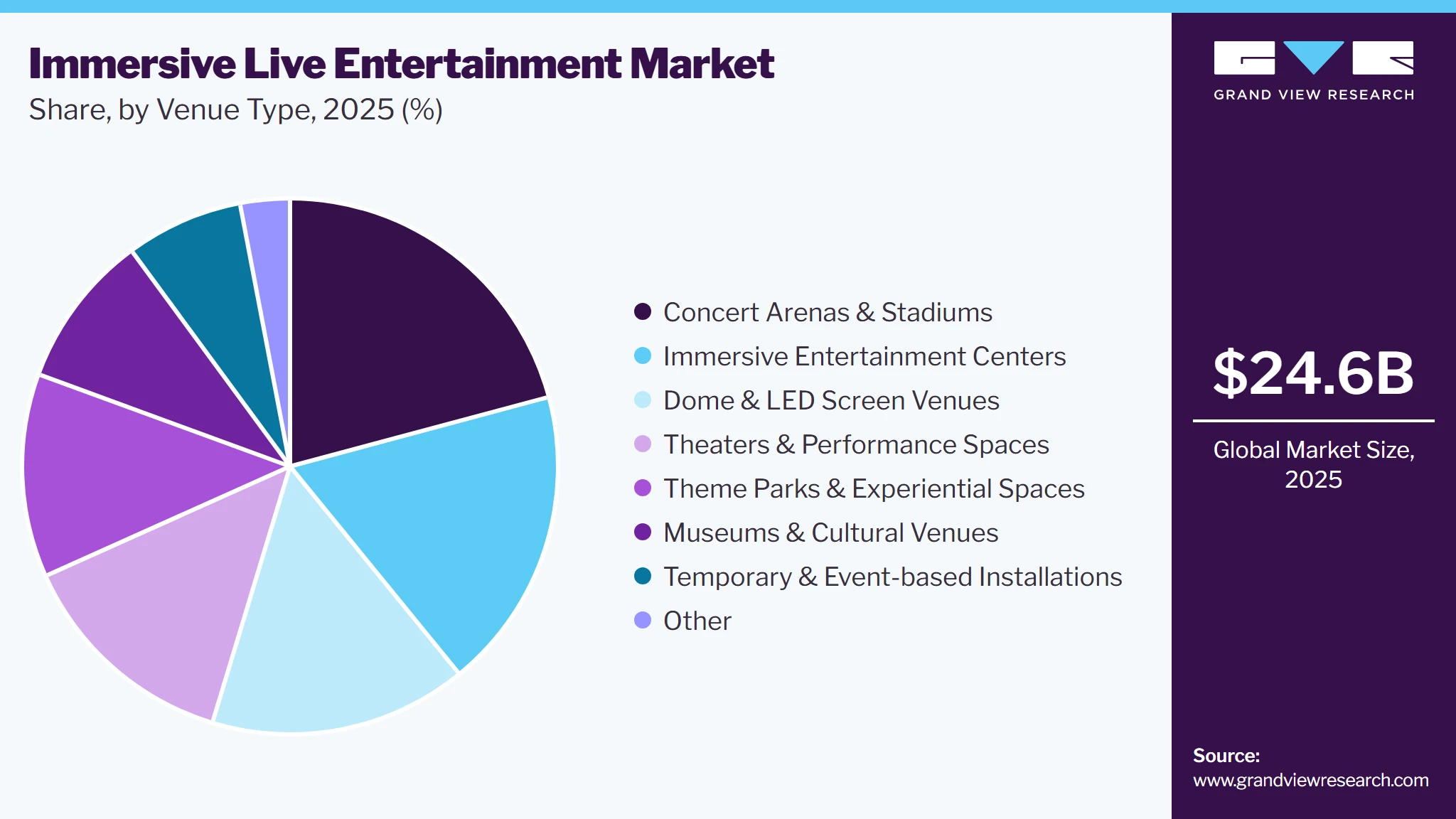
The concert arenas & stadiums segment dominated the immersive live entertainment industry, accounting for the largest revenue share in 2025, owing to increasing adoption of large-scale projection systems, spatial audio, augmented visuals, holographic displays, and interactive technologies across concerts and major live events. The ability of large venues to accommodate substantial audiences while supporting sophisticated immersive technology installations is further supporting segment dominance. These developments are expected to strengthen demand for immersive live entertainment solutions across concert arenas and stadiums throughout the forecast period.
 To learn more about this report, Download Free Sample Report
The immersive entertainment centers segment is expected to grow at the fastest CAGR from 2026 to 2033, driven by rising consumer demand for interactive, technology-enabled, and repeatable entertainment experiences. Increasing investments in location-based entertainment, VR and MR experiences, projection-based attractions, interactive installations, and personalized digital environments are expected to accelerate the development of immersive entertainment centers. These developments are expected to strengthen demand for immersive technologies across entertainment centers and location-based venues throughout the forecast period.
Regional Insights
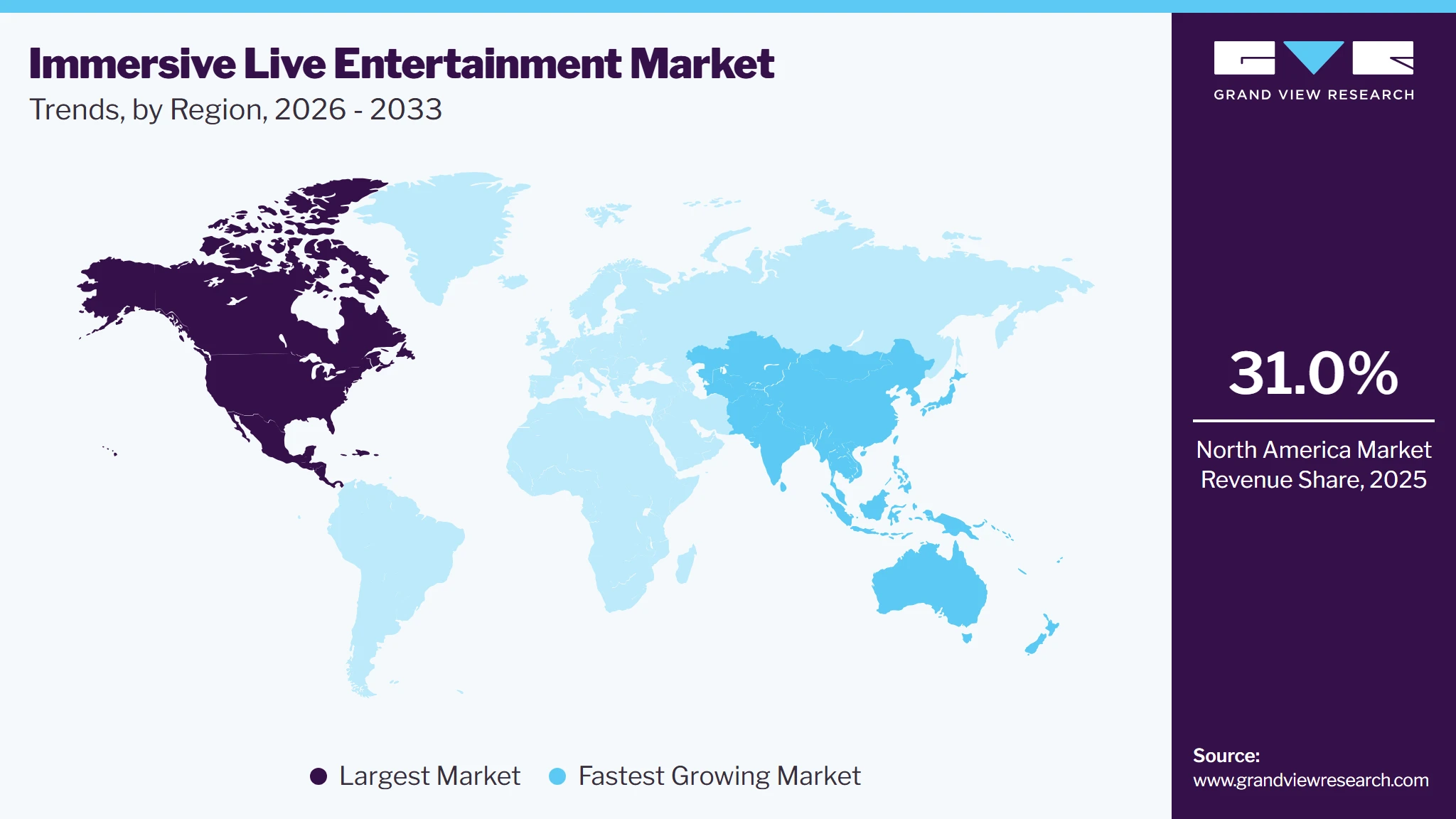
The North America immersive live entertainment market accounted for the largest global revenue share of over 31.0% in 2025, driven by the presence of established entertainment and technology companies, strong consumer spending on live experiences, widespread adoption of immersive technologies, and growing investments in experiential venues. The region benefits from a well-developed entertainment ecosystem, major concert and event infrastructure, and growing demand for interactive experiences that incorporate virtual reality, augmented reality, projection mapping, spatial audio, and other advanced technologies across concerts, theater, sports, and location-based entertainment.
 To learn more about this report, Download Free Sample Report
U.S. Immersive Live Entertainment Market Trends
The U.S. immersive live entertainment industry dominated in 2025, supported by rising consumer demand for interactive experiences, increasing investments in experiential venues, rapid adoption of immersive technologies, and growing integration of projection mapping, spatial audio, augmented reality, and virtual reality across concerts, festivals, theater productions, sports, and location-based entertainment.
Europe Immersive Live Entertainment Market Trends
The Europe immersive live entertainment industry is expected to grow at a CAGR of over 24.0% from 2026 to 2033, propelled by increasing consumer interest in experiential entertainment, rising investments in immersive venues, strong cultural and creative industries, and growing adoption of augmented reality, virtual reality, projection mapping, and spatial audio technologies. The region’s established theater, music, festival, and event ecosystem is further encouraging producers and venue operators to develop interactive, technology-enabled experiences that attract diverse audiences and support premium ticket pricing.
The Germany immersive live entertainment market is expected to grow significantly in the coming years, fueled by increasing demand for interactive cultural experiences, expanding investments in digital entertainment infrastructure, and the integration of immersive technologies across concerts, theater, festivals, and exhibitions. Germany’s strong creative industries established event ecosystem, and growing interest in technology-enabled experiences are encouraging entertainment producers and venues to introduce innovative formats that combine physical environments with digital content, interactive storytelling, and real-time audience engagement.
The immersive live entertainment market in the UK is witnessing rapid expansion, supported by the country’s strong theater, music, festival, and cultural entertainment ecosystem. Growing consumer preference for experiential formats, increasing investment in immersive venues, and the adoption of projection mapping, augmented reality, virtual reality, and spatial audio are encouraging the development of new experience concepts. London and other major cities are emerging as important hubs for immersive productions, while collaborations between technology providers, creative studios, artists, and venue operators are broadening the range of interactive entertainment offerings.
Asia Pacific Immersive Live Entertainment Market Trends
The Asia Pacific immersive live entertainment industry is expected to grow at the fastest CAGR from 2026 to 2033, driven by rising consumer spending on experiential entertainment, increasing investments in immersive venues, rapid adoption of augmented and virtual reality, and expansion of concerts, festivals, theater, and location-based experiences. Countries across the region are developing digital entertainment infrastructure, creative technology capabilities, and innovative experience formats to support the growing demand for interactive, technology-enabled entertainment experiences.
The China immersive live entertainment market is accelerated by strong investments in experiential venues, digital entertainment, immersive technology, and domestic creative capabilities. The country is expanding the use of projection mapping, virtual reality, augmented reality, spatial audio, and interactive installations across concerts, cultural attractions, festivals, and location-based entertainment. Government support for digital cultural development and growing consumer interest in technology-enabled experiences continue to encourage innovative immersive productions. These trends are supporting broader adoption of immersive live entertainment across major Chinese cities.
The immersive live entertainment market in Japan is expanding steadily, driven by investments in digital entertainment, interactive experiences, advanced visual technologies, and location-based attractions. Japan is focusing on immersive theater, projection mapping, virtual reality, augmented reality, and interactive storytelling to enhance audience engagement. Collaboration among technology companies, creative studios, entertainment producers, and venue operators is further supporting market development. These trends are expected to remain important for creating differentiated and technologically advanced live entertainment experiences across the country.
Key Immersive Live Entertainment Company Insights
Some of the key players operating in the market include Meow Wolf, Inc. and teamLab Inc.
-
Meow Wolf, Inc. is a major immersive-entertainment provider with a strong presence in the Immersive Live Entertainment Market through large-scale immersive art installations, interactive storytelling, experiential venues, and technology-enabled environments. The company develops integrated digital and physical experiences supporting audience participation and location-based entertainment. Its established venue network, creative expertise, and distinctive experience portfolio provide a significant competitive advantage in the market. These developments are expected to strengthen demand for immersive experiences across entertainment, cultural, and experiential venues.
-
teamLab Inc. is a major immersive-art company with a strong presence in the immersive live entertainment industry through projection mapping, interactive digital environments, spatial experiences, and technology-enabled installations. The company develops integrated digital art and interactive solutions supporting advanced immersive entertainment formats. teamLab benefits from extensive creative capabilities, established international installations, and expertise in interactive experiences for large-scale venues. These investments are expected to support the continued adoption of immersive technologies as experiential entertainment scales.
Moment Factory Inc. and Sphere Entertainment Group, LLC are among the emerging, specialized participants in the global immersive live entertainment market.
-
Moment Factory Inc. is a prominent immersive-entertainment company specializing in multimedia experiences, projection mapping, interactive installations, spatial storytelling, and digital visual solutions. The company has strengthened its position in live entertainment through immersive experiences supporting concerts, cultural attractions, festivals, and destination venues. Its focus on large-scale multimedia productions and international partnerships supports its role in the immersive live entertainment ecosystem across emerging experiences and venues globally.
-
Sphere Entertainment Group, LLC is an established provider of immersive entertainment, large-format visual experiences, and advanced venue technologies, offering solutions relevant to concerts, live events, and location-based entertainment. The company focuses on large-scale digital displays, immersive audio, visual content, and audience-engagement solutions that support next-generation entertainment experiences. Through technology development and content partnerships, Sphere Entertainment can expand its role in the next-generation immersive live entertainment ecosystem. These trends support continued adoption across the market.
Key Immersive Live Entertainment Companies
The following key companies have been profiled for this study of the immersive live entertainment market.
-
Meow Wolf, Inc.
-
teamLab Inc.
-
Moment Factory Inc.
-
Sphere Entertainment Group, LLC
-
Punchdrunk International Ltd.
-
Illuminarium Experiences, LLC
-
Superblue, LLC
-
ARTECHOUSE, Inc.
-
Dreamscape Immersive, Inc.
-
Sandbox VR, Inc.
Competitive Benchmarking
Operating Strategies
Competitive Edge
Weaknesses
Established Players (Meow Wolf, Inc.; teamLab Inc.; Moment Factory Inc.; Sphere Entertainment Group, LLC)
- Focus on long-term partnerships with entertainment venues, cultural institutions, event organizers, and technology providers to deliver immersive experiences, interactive installations, projection mapping, spatial audio, and experiential entertainment solutions.
- Invest heavily in R&D for immersive technologies, interactive storytelling, digital content, projection systems, spatial computing, AI-enabled experiences, and integrated audience-engagement technologies.
- Strong immersive entertainment expertise, established creative capabilities, and extensive experience in developing large-scale experiential and technology-enabled entertainment.
- Established relationships with entertainment venues, artists, technology providers, and audiences, supported by global creative, production, and operational infrastructure.
- High development and production costs associated with large-scale immersive entertainment experiences and technology-enabled venues.
- Complex content-development requirements and lengthy production processes can delay deployment of new immersive experiences and limit scalability across different markets.
Emerging & Specialized Players (Punchdrunk International Ltd.; Illuminarium Experiences, LLC; Superblue, LLC; ARTECHOUSE, Inc.; Dreamscape Immersive, Inc.; Sandbox VR, Inc.)
- Focus on specialized immersive entertainment capabilities, including interactive storytelling, location-based entertainment, virtual reality, projection mapping, experiential venues, digital art, and audience-participation experiences.
- Expand immersive entertainment capabilities through technology partnerships, strategic collaborations, vertical integration, and development of proprietary immersive content and venue experiences.
- Faster innovation cycles and greater ability to optimize immersive experiences specifically for emerging entertainment formats and changing audience preferences.
- Strong expertise in integrating immersive technologies, creative content, interactive environments, spatial audio, visual effects, and digital systems directly with purpose-built entertainment experiences.
- Limited commercial scale and operational experience compared with established global entertainment and technology providers.
- Smaller content-development resources and limited access to large-scale venues, international audiences, and established distribution and production infrastructure.
Recent Developments
-
In April 2026, Meow Wolf, Inc. expanded its immersive entertainment initiatives through continued development of large-scale experiential installations and interactive storytelling formats. The company is focusing on combining physical environments, digital content, interactive elements, and narrative-driven experiences to enhance audience engagement. These initiatives are expected to support the development of scalable location-based entertainment concepts and strengthen the company's presence across the global immersive entertainment ecosystem.
-
In May 2026, teamLab Inc. continued expanding its immersive digital-art ecosystem through new installations and technology-enabled experiences integrating interactive visuals, projection systems, spatial environments, and audience participation. The company's ongoing development focuses on creating large-scale immersive environments that combine art and technology. These initiatives are expected to support continued adoption of interactive entertainment experiences across cultural attractions, tourism destinations, and experiential venues.
-
In May 2026, Sphere Entertainment Group, LLC continued expanding its immersive live entertainment capabilities through advanced visual displays, immersive audio technologies, and large-format experiential content. The company is focusing on integrating high-resolution digital environments with live performances and interactive audience experiences. These developments are expected to support the broader adoption of immersive technologies across concerts, events, and location-based entertainment while strengthening demand for technologically advanced live entertainment formats.
Immersive Live Entertainment Market Report Scope
Report Attribute
Details
Market size in 2025
USD 24.6 billion
Estimated market size in 2026
USD 31.1 billion
Projected market size by 2033
USD 149.5 billion
Growth rate
CAGR of 25.2% from 2026 to 2033
Base year of estimation
2025
Actual data
2021 - 2024
Forecast period
2026 - 2033
Quantitative units
Revenue in USD million/billion and CAGR from 2026 to 2033
Report coverage
Report coverage, company ranking, competitive landscape, growth factors, and trends
Segments covered
Technology, experience type, venue type, and region
Regional scope
North America; Europe; Asia Pacific; Latin America; Middle East & Africa
Country scope
U.S.; Canada; Mexico; Germany; UK: France; China; Japan; India; South Korea; Australia; Brazil; UAE; Saudi Arabia; South Africa
Key companies profiled
Meow Wolf, Inc.; teamLab Inc.; Moment Factory Inc.; Sphere Entertainment Group, LLC; Punchdrunk International Ltd.; Illuminarium Experiences, LLC; Superblue, LLC; ARTECHOUSE, Inc.; Dreamscape Immersive, Inc.; Sandbox VR, Inc.
Customization scope
Free report customization (equivalent up to 8 analysts working days) with purchase. Addition or alteration to country, regional & segment scope.
Global Immersive Live Entertainment Market Report Segmentation
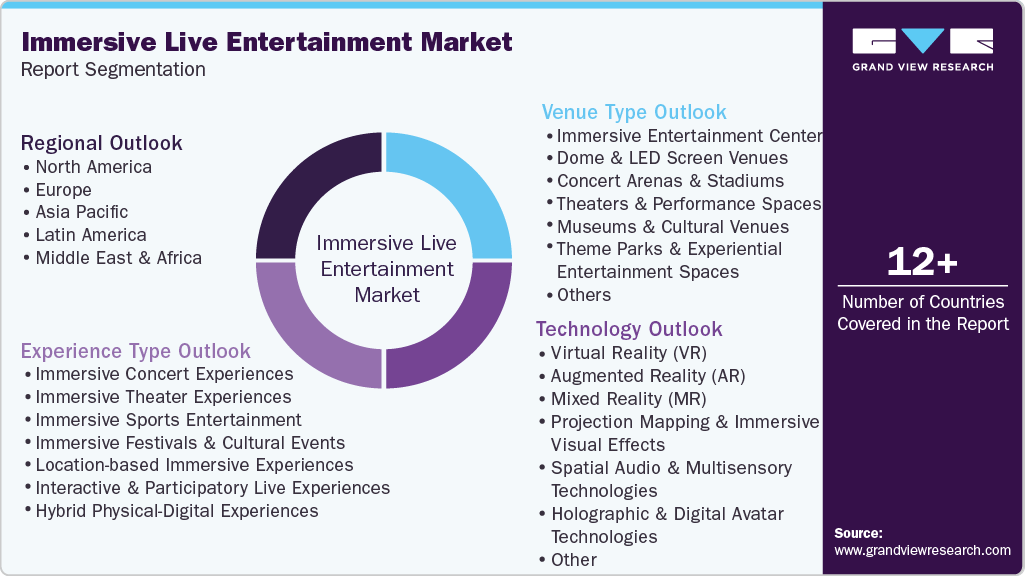
This report forecasts revenue growth at the global, regional & country levels and provides an analysis of the latest industry trends in each of the sub-segments from 2021 to 2033. For this study, Grand View Research has segmented the global immersive live entertainment market report based on technology, experience type, venue type, and region:
 To learn more about this report, Download Free Sample Report
-
Technology Outlook (Revenue, USD Million/Billion, 2021 - 2033)
-
Virtual Reality (VR)
-
Augmented Reality (AR)
-
Mixed Reality (MR)
-
Projection Mapping & Immersive Visual Effects
-
Spatial Audio & Multisensory Technologies
-
Holographic & Digital Avatar Technologies
-
AI-powered Interactive Technologies
-
Other
-
-
Experience Type Outlook (Revenue, USD Million/Billion, 2021 - 2033)
-
Immersive Concert Experiences
-
Immersive Theater Experiences
-
Immersive Sports Entertainment
-
Immersive Festivals & Cultural Events
-
Location-based Immersive Experiences
-
Interactive & Participatory Live Experiences
-
Hybrid Physical-Digital Experiences
-
Other
-
-
Venue Type Outlook (Revenue, USD Million/Billion, 2021 - 2033)
-
Immersive Entertainment Centers
-
Dome & LED Screen Venues
-
Concert Arenas & Stadiums
-
Theaters & Performance Spaces
-
Museums & Cultural Venues
-
Theme Parks & Experiential Entertainment Spaces
-
Temporary & Event-based Installations
-
Other
-
-
Regional Outlook (Revenue, USD Million/Billion, 2021 - 2033)
-
North America
-
U.S.
-
Canada
-
Mexico
-
-
Europe
-
Germany
-
UK
-
France
-
-
Asia Pacific
-
China
-
Japan
-
India
-
South Korea
-
Australia
-
-
Latin America
-
Brazil
-
-
Middle East and Africa (MEA)
-
UAE
-
Saudi Arabia
-
South Africa
-
-
Research Methodology
The Immersive live entertainment market figures in this report are based on a proven research process that combines executive interviews with secondary research from proprietary databases, company filings, and recognized regulatory and institutional sources. Market size is built through value-chain sizing-reconciling supply-side and demand-side estimates-and triangulated with bottom-up and top-down approaches. Every estimate passes multiple levels of expert validation before publication, with each Immersive live entertainment segment quantified using the revenue-capture definitions in the table below.
Segment Definition
Technology
Revenue capture definition
Virtual Reality (VR)
Revenue is generated from immersive live entertainment experiences using VR headsets, virtual environments, 360-degree content, and computer-generated simulations that provide audiences with interactive and fully or partially virtual entertainment experiences across concerts, theater, sports, festivals, and location-based venues.
Augmented Reality (AR)
Revenue is generated from immersive live entertainment experiences that overlay digital content, graphics, animations, and interactive elements onto physical environments through smartphones, smart glasses, projection systems, and other AR-enabled technologies.
Mixed Reality (MR)
Revenue is generated from immersive live entertainment experiences combining physical and digital environments, allowing audiences to interact with virtual objects, characters, and environments while maintaining interaction with real-world surroundings.
Projection Mapping & Immersive Visual Effects
Revenue is generated from projection mapping, large-format visual displays, LED systems, lighting effects, and digitally enhanced environments used to transform physical venues and create immersive visual experiences for audiences.
Spatial Audio & Multisensory Technologies
Revenue is generated from spatial audio, immersive sound systems, haptic technologies, lighting, scent, motion, and other multisensory technologies designed to enhance audience immersion and create synchronized sensory entertainment experiences.
Holographic & Digital Avatar Technologies
Revenue is generated from holographic displays, digital avatars, virtual performers, volumetric visuals, and related technologies used to create digitally rendered characters, performers, and three-dimensional entertainment experiences.
AI-powered Interactive Technologies
Revenue is generated from AI-powered technologies enabling personalized content, interactive characters, real-time audience responses, generative visuals, automated storytelling, and adaptive entertainment experiences across immersive live environments.
Other
Revenue is generated from other immersive technologies, including motion tracking, interactive sensors, wearable technologies, computer vision, and emerging technologies used to enhance live entertainment experiences.
Experience Type
Revenue capture definition
Immersive Concert Experiences
Revenue is generated from concerts and live music performances incorporating immersive visuals, spatial audio, projection mapping, extended reality, interactive environments, and other technologies designed to enhance audience engagement.
Immersive Theater Experiences
Revenue is generated from theater productions incorporating interactive environments, immersive storytelling, digital effects, spatial audio, audience participation, and technology-enabled performances that extend beyond conventional stage formats.
Immersive Sports Entertainment
Revenue is generated from sports entertainment experiences incorporating immersive displays, augmented reality, virtual reality, interactive content, spatial audio, and other technologies that enhance live sporting events and audience engagement.
Immersive Festivals & Cultural Events
Revenue is generated from festivals, cultural celebrations, exhibitions, and public events incorporating projection mapping, interactive installations, digital content, multisensory technologies, and other immersive formats to enhance visitor experiences.
Location-based Immersive Experiences
Revenue is generated from dedicated immersive experiences operated at fixed venues, including immersive art exhibitions, VR attractions, interactive installations, experiential entertainment centers, and other location-based entertainment formats.
Interactive & Participatory Live Experiences
Revenue is generated from live entertainment experiences requiring active audience participation through interactive storytelling, physical activities, digital interfaces, gamification, audience-controlled environments, and real-time interaction with performers or content.
Hybrid Physical-Digital Experiences
Revenue is generated from entertainment experiences combining physical performances, venues, and live events with digital content, virtual environments, online platforms, extended reality, and interactive technologies.
Other
Revenue is generated from other immersive entertainment formats that do not fall within concerts, theater, sports, festivals, location-based, interactive, or hybrid physical-digital experiences.
Venue Type
Revenue capture definition
Immersive Entertainment Centers
Revenue is generated from immersive entertainment experiences operated within dedicated centers featuring interactive environments, digital installations, virtual reality attractions, projection systems, and other technology-enabled entertainment formats.
Dome & LED Screen Venues
Revenue is generated from immersive experiences hosted in dome venues, large-format LED environments, spherical screens, and digitally enhanced spaces designed to provide panoramic visual and audiovisual experiences.
Concert Arenas & Stadiums
Revenue is generated from immersive entertainment experiences delivered within concert arenas, stadiums, and large event venues using large-format displays, projection mapping, spatial audio, lighting, augmented reality, and interactive technologies.
Theaters & Performance Spaces
Revenue is generated from immersive entertainment experiences hosted in theaters, performance halls, and other live performance spaces incorporating interactive staging, digital effects, projection systems, spatial audio, and immersive storytelling.
Museums & Cultural Venues
Revenue is generated from immersive exhibitions, digital art installations, cultural experiences, interactive displays, and technology-enabled attractions operated within museums, galleries, cultural centers, and heritage venues.
Theme Parks & Experiential Entertainment Spaces
Revenue is generated from immersive attractions, rides, interactive environments, themed experiences, digital installations, and technology-enabled entertainment operated within theme parks and experiential entertainment destinations.
Temporary & Event-based Installations
Revenue is generated from temporary immersive installations, pop-up experiences, touring exhibitions, festival installations, corporate events, brand activations, and other short-duration entertainment environments.
Other
Revenue is generated from immersive live entertainment delivered through other venue formats, including outdoor spaces, retail environments, hospitality venues, public spaces, and unconventional entertainment locations.
Estimation Model
Layer No.
Layer Name
Key Question
Description
01
Immersive Technology & Experience Layer
What technologies and systems enable immersive live entertainment experiences?
Represents the core technologies, digital systems, visual technologies, audio systems, and enabling components that drive immersive live entertainment. Includes Virtual Reality (VR), Augmented Reality (AR), Mixed Reality (MR), projection mapping, immersive visual effects, spatial audio, multisensory technologies, holographic and digital avatar technologies, AI-powered interactive technologies, and other technologies that improve audience engagement, immersion, interactivity, and overall entertainment quality.
02
Immersive Live Entertainment Experience Type & Venue Layer
Where are immersive live entertainment experiences deployed and which segments generate demand?
Represents the Experience Types and venue segments driving demand for immersive live entertainment. Key Experience Types include immersive concerts, theater experiences, sports entertainment, festivals and cultural events, location-based immersive experiences, Interactive & Participatory Live Experiences, and hybrid physical-digital experiences. Primary venues include immersive entertainment centers, dome and LED screen venues, concert arenas and stadiums, theaters, museums, theme parks, and temporary event-based installations.
03
Immersive Content & Experience Development Layer
How are immersive live entertainment experiences developed, integrated, and managed throughout their operational lifecycle?
Covers the design, development, integration, testing, deployment, upgrading, maintenance, and lifecycle management of immersive entertainment experiences across different venues and operating environments. Includes content development, digital asset creation, technology integration, interactive system development, audiovisual synchronization, audience interaction, software compatibility, technical calibration, content updates, venue management, and performance monitoring that ensure long-term reliability, experience quality, audience engagement, and operational performance.
04
Immersive Live Entertainment Procurement & Market Monetization Layer
How is revenue generated in the Immersive Live Entertainment Market?
Revenue is generated through ticket sales, venue admissions, immersive experience fees, event-based revenues, licensing, content partnerships, sponsorships, merchandise, and related services. Key revenue streams include immersive concert and theater experiences, location-based entertainment, festivals and cultural events, Interactive & Participatory Live Experiences, venue-based experiences, digital content, technology-enabled attractions, and hybrid physical-digital experiences purchased or accessed by consumers, event organizers, entertainment operators, cultural institutions, and commercial venue owners.
Delivered Customizations
This report has been delivered with the following In-depth customizations
Client Request
Customization Delivered
Value Adds
Market Sizing, Segmentation & Growth Opportunity Assessment
Assessed the global Immersive Live Entertainment Market size, historical trends, forecast growth outlook, and detailed segmentation by Technology (Virtual Reality (VR), Augmented Reality (AR), Mixed Reality (MR), Projection Mapping & Immersive Visual Effects, Spatial Audio & Multisensory Technologies, Holographic & Digital Avatar Technologies, AI-powered Interactive Technologies, Other), Experience Type (Immersive Concert Experiences, Immersive Theater Experiences, Immersive Sports Entertainment, Immersive Festivals & Cultural Events, Location-based Immersive Experiences, Interactive & Participatory Live Experiences, Hybrid Physical-Digital Experiences, Other), and Venue Type (Immersive Entertainment Centers, Dome & LED Screen Venues, Concert Arenas & Stadiums, Theaters & Performance Spaces, Museums & Cultural Venues, Theme Parks & Experiential Entertainment Spaces, Temporary & Event-based Installations, Other). Evaluated demand patterns across immersive concerts, theater, sports, festivals, location-based entertainment, interactive experiences, and hybrid physical-digital formats.
Enables immersive entertainment companies, technology providers, venue operators, event organizers, content creators, investors, and other stakeholders to identify high-growth market segments, prioritize technology investments, optimize experience portfolios, and capture revenue opportunities across consumer and professional immersive entertainment formats.
Technology Landscape & Immersive Entertainment Innovation Analysis
Evaluated the adoption of next-generation technologies across immersive live entertainment experiences, including Virtual Reality (VR), Augmented Reality (AR), Mixed Reality (MR), projection mapping, immersive visual effects, spatial audio, multisensory technologies, holographic and digital avatar technologies, AI-powered interactive technologies, and integrated physical-digital systems. Analyzed technological advancements improving visual quality, audience engagement, interactivity, personalization, sensory immersion, operational efficiency, and experience performance across live entertainment formats.
Helps immersive entertainment companies, technology providers, creative studios, venue operators, and other stakeholders identify emerging innovation opportunities, improve experience quality, strengthen differentiation, integrate advanced technologies, and develop next-generation immersive entertainment formats aligned with evolving audience expectations.
Regional Immersive Live Entertainment Demand & Adoption Analysis
Assessed regional demand across North America, Europe, Asia Pacific, Latin America, and the Middle East & Africa by evaluating consumer spending, entertainment infrastructure, immersive venue development, technology adoption, cultural and creative industries, live event activity, tourism, investment trends, digital infrastructure, and adoption of advanced immersive experiences across regional markets.
Provides actionable insights into regional growth opportunities, adoption priorities, competitive positioning, and investment hotspots, enabling stakeholders to align market-entry strategies, strengthen technology and content partnerships, prioritize regional resources, and capitalize on increasing demand for immersive live entertainment driven by expanding experiential and technology-enabled entertainment formats.
Frequently Asked Questions About This Report
North America accounted for the largest revenue share of 31.0% in 2025.
Rising consumer demand for interactive and multisensory experiences, increasing investments in immersive venues, and rapid advancements in VR, AR, MR, projection mapping, spatial audio, and AI-powered technologies are the significant factors driving the market growth.
Asia Pacific is expected to grow at the highest CAGR of 27.5% from 2026 to 2033.
The global immersive live entertainment market size was valued at USD 24.6 billion in 2025 and is estimated at USD 31.1 billion for 2026.
The global immersive live entertainment market is expected to grow at a CAGR of 25.2% from 2026 to 2033, reaching USD 149.5 billion by 2033.
By technology, the projection mapping & immersive visual effects segment accounted for the largest revenue share of over 19.0% in 2025.
Key players in the immersive live entertainment market are Meow Wolf, Inc., teamLab Inc., Moment Factory Inc., Sphere Entertainment Group, LLC, Punchdrunk International Ltd., Illuminarium Experiences, LLC, Superblue, LLC, ARTECHOUSE, Inc., Dreamscape Immersive, Inc., and Sandbox VR, Inc.
By experience type, immersive concert experiences accounted for the largest overall market revenue share in 2025 worldwide.
By venue type, the concert arenas & stadiums segment held the largest market revenue share in 2025.
About the Author(s)
Next Generation Technologies Research Team
Technology · Next Generation TechnologiesThis report was authored by the next generation technologies research team at Grand View Research - comprising two research analysts, one senior research analyst, and one industry expert - with specialized expertise in the next generation technologies segment of the technology industry. All findings are based on proprietary technology databases, executive interviews, and regulatory analysis, subject to internal peer review prior to publication.
Last Updated:
Speak to Analyst

Customize this report to your needs - add regions, segments, or data points, with 20% free customization.
Or view our licence options:


ISO 9001:2015 & 27001:2022 Certified
We are GDPR and CCPA compliant! Your transaction & personal information is safe and secure. For more details, please read our privacy policy.


