
- Home
- »
- Advanced Interior Materials
- »
-
Ocean Plastic Textile Fibers Market Size Report, 2026-2033GVR Report cover

Ocean Plastic Textile Fibers Market (2026 - 2033)
Size, Share & Trends Analysis Report By Plastic Source (Ocean-Bound Plastic, Ocean-Recovered Plastic, Coastal/Beach Plastic, Other Marine Plastic Waste), By Polymer Type, By Fiber Form, By End-use, By Region, And Segment Forecasts
Market Size, 2025
$247.6MMarket Estimate, 2026
$274.3MMarket Forecast, 2033
$586.3MCAGR, 2026–2033
11.5%Ocean Plastic Textile Fibers Market Summary
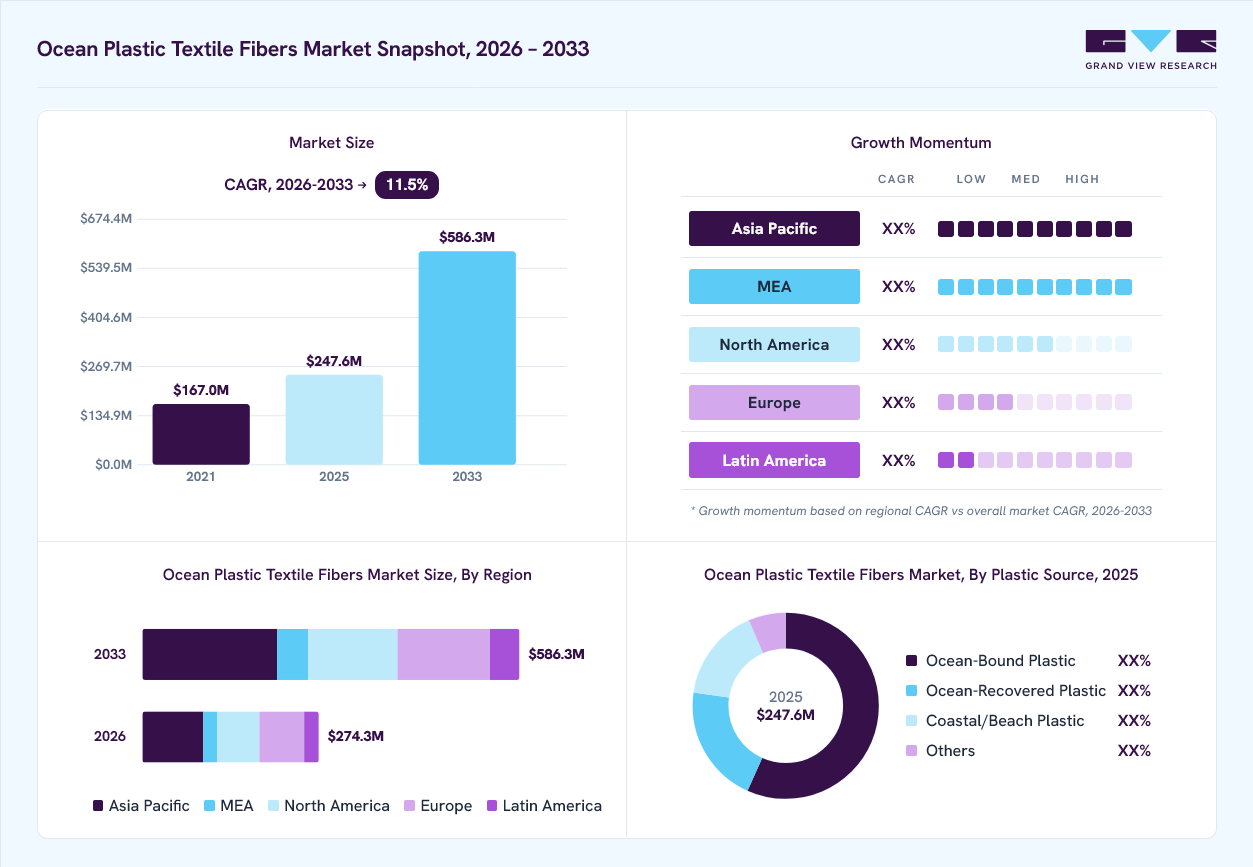
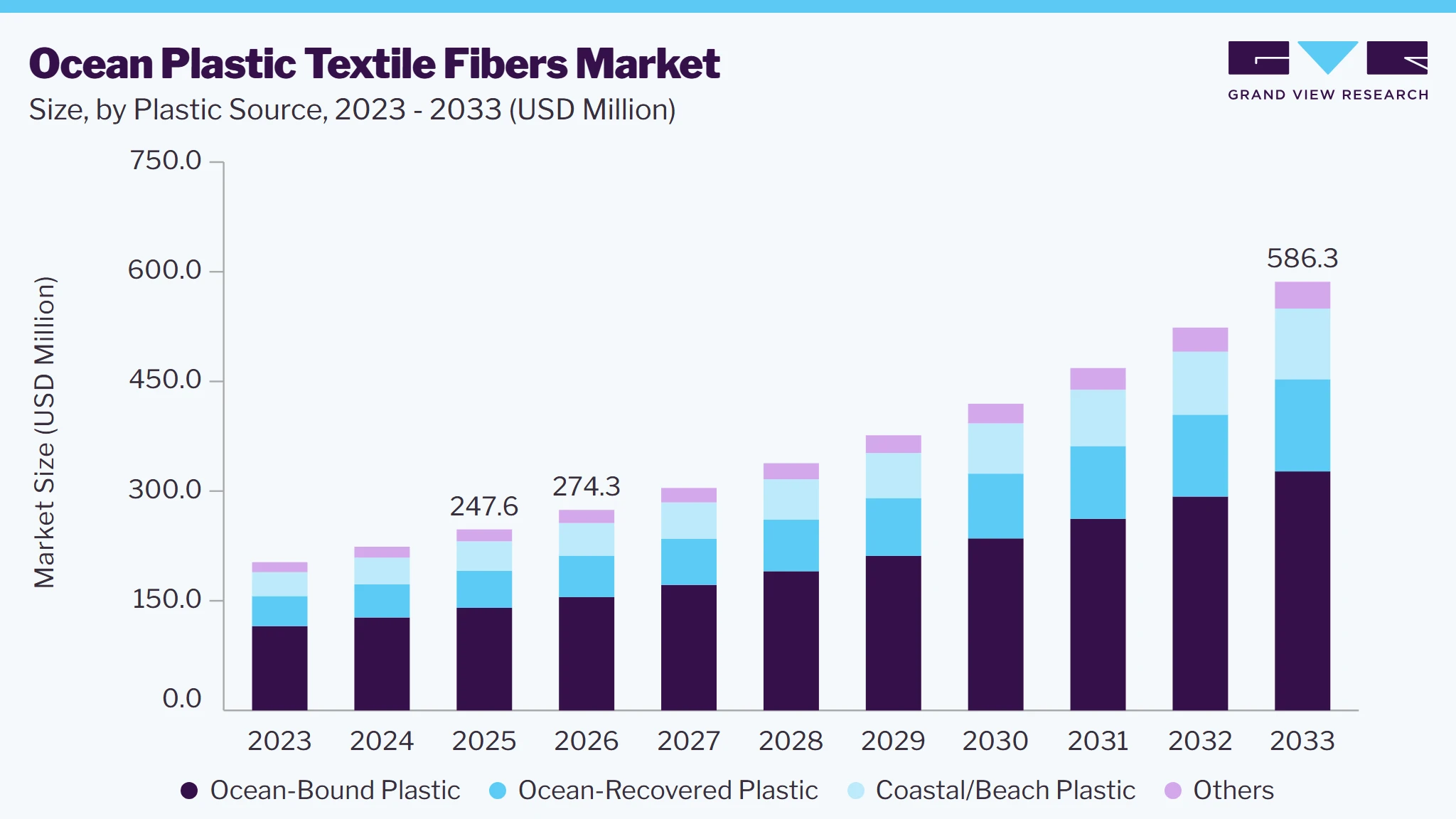
The global ocean plastic textile fibers market size was valued at USD 247.6 million in 2025 and is projected to grow from USD 274.3 million in 2026 to USD 586.3 million by 2033, at a CAGR of 11.5% from 2026 to 2033. Asia Pacific dominated the market, accounting for the largest revenue share of 34.3% in 2025. The market is gaining traction as apparel, footwear, sportswear, and textile manufacturers increasingly adopt recycled materials to reduce dependence on virgin synthetic fibers and address plastic pollution.
 Source: Grand View Research, IR Documents, Primary Interviews, Paid DatabasesTo learn more about this report,
 Download Free Sample Report
Key Market Trends & Insights
- By plastic source: Ocean-bound plastic segment held the highest revenue share of 56.7% in 2025.
- By polymer type: Polyamide (PA/Nylon) segment dominated the market with a revenue share of 68.0% in 2025.
- By fiber form: Staple fibers segment held the highest revenue market share of 60.9% in 2025.
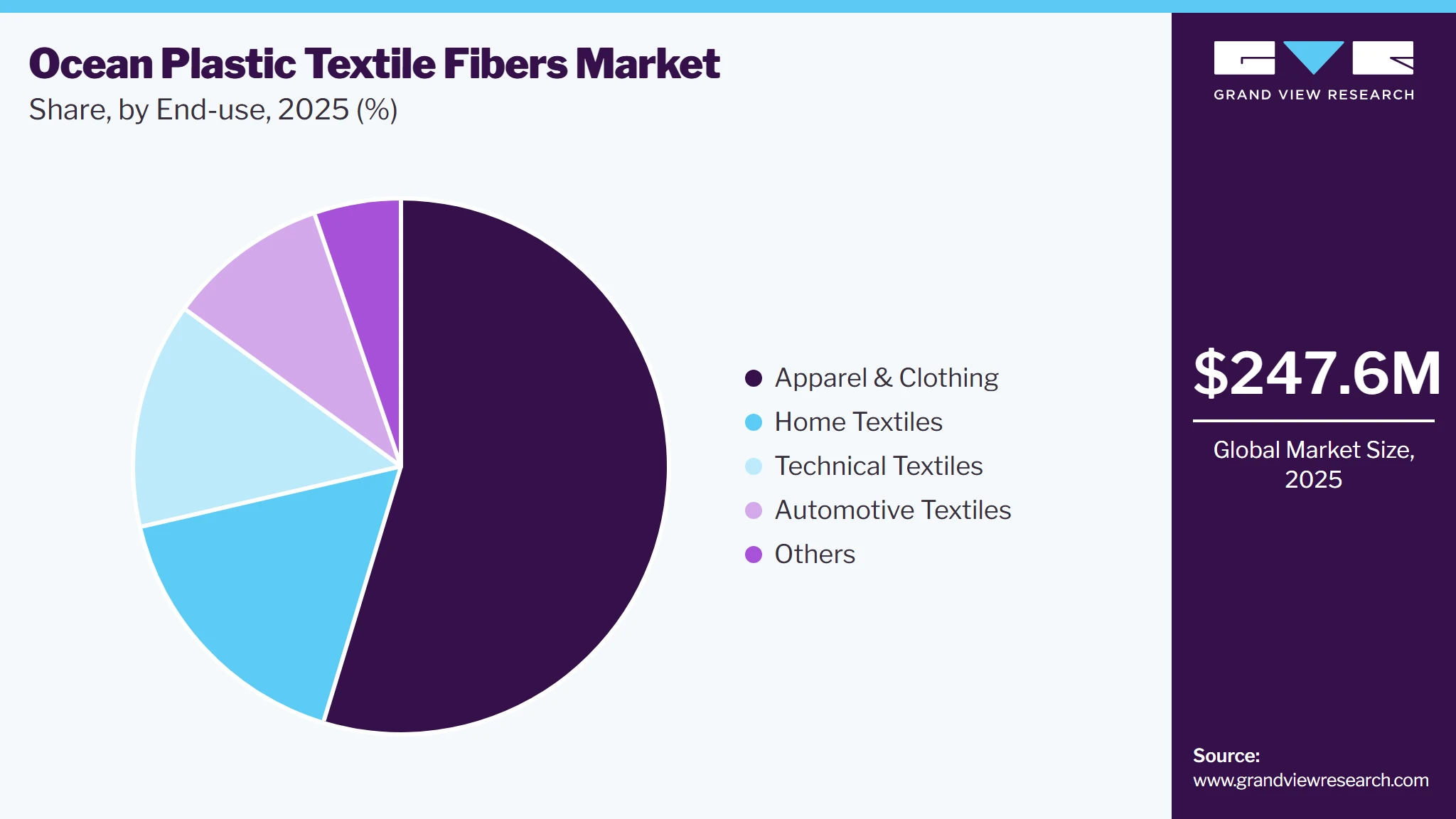
- By end use: Apparel & clothing segment dominated the market with a revenue share of 54.7% in 2025.
Regional Highlights
- Largest regional market: Asia Pacific (34.3% revenue share, 2025)
- By country: India held the largest market share in 2025.
Market Size & Forecast
- Market size in 2025: USD 247.6 Million
- Estimated market size in 2026: USD 274.3 Million
- Projected market size by 2033: USD 586.3 Million
- CAGR (2026-2033): 11.5%
Prism AI by Grand View Research Free to tryAsk a question about the ocean plastic textile fibers market✓Every figure cited from GVR research Prefer the report? Download free sample →
Ocean-bound plastics, such as discarded fishing nets, ropes, bottles, packaging, and other marine-associated plastic waste, are increasingly being recovered and converted into textile-grade recycled polymers. Recycled polyester and recycled polyamide are the primary material pathways, with applications extending across apparel, footwear, accessories, home textiles, and technical textiles.Demand is primarily supported by the rapid adoption of recycled polyester and recycled nylon across the global textile industry. Apparel and footwear brands are increasingly seeking recycled feedstocks to replace virgin petroleum-derived polymers without significantly altering existing textile manufacturing processes. Ocean-plastic fibers offer an additional value proposition because the feedstock is sourced from the recovery of plastic from coastal and marine environments. Sportswear, outdoor apparel, swimwear, and footwear are particularly attractive applications because recycled synthetic fibers already have strong acceptance in these categories.
 To learn more about this report, Download Free Sample Report
Technological development is focused on improving the quality, scalability, and traceability of fibers derived from marine-associated plastic waste. Advanced sorting, washing, contamination removal, filtration, extrusion, and melt-spinning technologies are improving the consistency of recovered polymers. Chemical recycling is also gaining attention for polyester and polyamide waste because it can recover polymer building blocks and produce materials with properties closer to those of virgin polymers. Digital traceability systems and certification mechanisms are being used to verify the origin of feedstock and strengthen the credibility of ocean-plastic claims.
Market Dynamics
The ocean plastic textile fibers market is being shaped by the convergence of marine plastic pollution concerns, increasing demand for recycled textile materials, corporate sustainability commitments, and improvements in plastic recovery technologies. Ocean-plastic fibers offer manufacturers a way to incorporate recycled polymers while linking textile production with plastic-waste recovery initiatives. However, the market remains constrained by feedstock availability, contamination, collection costs, processing complexity, and competition from conventional recycled fibers. The development of traceable supply chains and certification systems is increasingly important because brands and consumers require credible evidence regarding the origin of recovered plastic.
The increasing replacement of virgin polyester and nylon with recycled alternatives is a major driver for the market. Synthetic fibers account for a substantial portion of textile production, creating a large addressable market for recycled polymers. Ocean-bound PET and other suitable plastic waste can be processed into recycled polyester, while discarded fishing nets can provide feedstock for recycled polyamide.
Textile and apparel manufacturers can incorporate these recycled polymers into existing yarn and fabric production systems, reducing the need for completely new downstream manufacturing processes. Growing sustainability targets among apparel, footwear, sportswear, and outdoor brands are therefore increasing demand for recycled synthetic fibers with documented feedstock origins.
The heterogeneous nature of marine-associated plastic waste creates significant challenges for fiber manufacturers. Recovered materials can contain salt, sand, organic matter, coatings, labels, mixed polymers, and other contaminants that require extensive sorting, washing, purification, and filtration. Feedstock quality can also vary according to collection location and source, making consistent polymer properties more difficult to maintain. These additional processing requirements can increase production costs compared with conventional recycled polyester based on relatively standardized post-consumer PET streams. Limited collection infrastructure and fragmented recovery networks can further restrict the availability of consistent feedstock at commercial scale.
Advanced mechanical and chemical recycling technologies provide significant opportunities to improve the quality and scalability of ocean-plastic textile fibers. Chemical recycling can potentially convert polyester and polyamide waste into reusable chemical building blocks, allowing manufacturers to produce higher-quality recycled polymers from more challenging waste streams. Discarded fishing nets provide another attractive opportunity because recovered nylon can be converted into higher-value performance fibers for swimwear, activewear, sportswear, and technical textiles. The expansion of premium applications can improve the economics of recovery by increasing the value generated from each unit of recovered plastic. Integration of ocean-plastic recovery with textile-to-textile recycling could further strengthen circular material systems.
Market Concentration & Characteristics
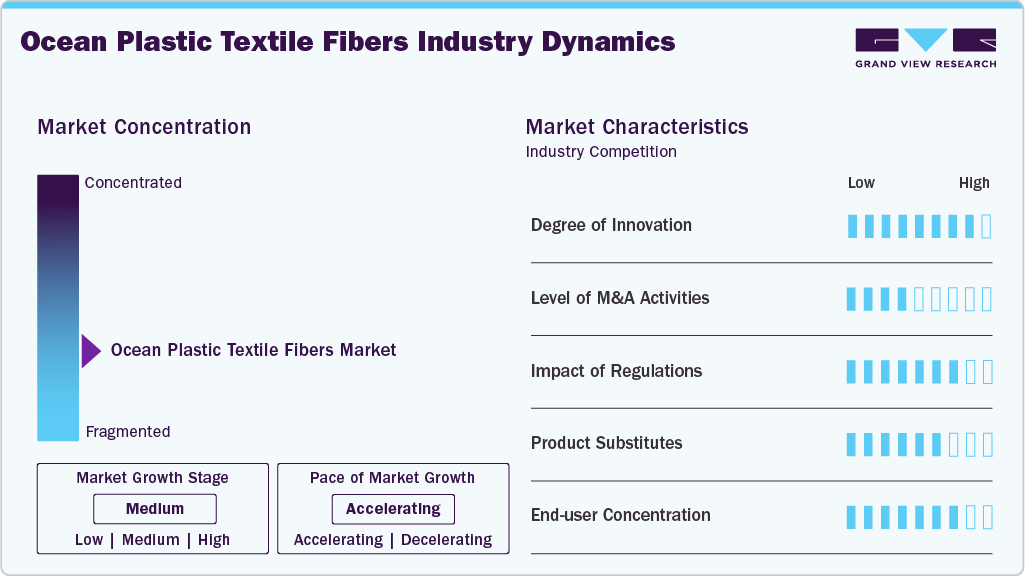
The ocean plastic textile fibers market is fragmented, with the value chain comprising marine-waste collection organizations, recyclers, polymer producers, specialty fiber manufacturers, textile producers, certification organizations, and global apparel brands. The market remains less consolidated than conventional polyester and nylon because ocean-plastic recovery is highly dependent on regional collection networks and specialized recycling capabilities. Companies with established feedstock networks, proprietary recycling technologies, certifications, and long-term brand partnerships have stronger competitive positions.
 To learn more about this report, Download Free Sample Report
The ocean plastic textile fibers market faces a moderate threat from substitutes. Conventional recycled polyester and recycled nylon are the most direct substitutes because they can deliver comparable textile performance while benefiting from more established feedstock and manufacturing infrastructure. Bio-based synthetic fibers, regenerated cellulosic fibers, cotton, and other natural fibers can also compete in applications where brands prioritize renewable or lower-fossil-feedstock materials. Virgin polyester and nylon remain substitutes in cost-sensitive applications because of their consistent quality and large-scale availability.
Analyst Perspective
The ocean plastic textile fibers market is expected to remain a high-potential but relatively specialized segment within the broader recycled and sustainable textile fibers industry. Market growth will be driven primarily by increasing demand from apparel, sportswear, footwear, and technical textile brands seeking traceable recycled materials and by expanding efforts to recover ocean-bound and marine plastic waste. PET and polyamide are likely to remain the most commercially relevant polymers, supported by established recycling and fiber-processing technologies, while staple and filament fibers will serve different downstream applications.
Plastic Source Insights
The ocean-bound plastic segment held the highest revenue share of 56.7% in 2025, due to its relatively established collection infrastructure and greater scalability compared with plastic recovered directly from marine environments. Ocean-bound plastic is typically collected from coastal areas before it enters the ocean, making recovery more practical and enabling a more consistent feedstock for recycling into textile-grade polymers. The availability of certification systems and established supply chains has further supported its adoption by fiber manufacturers and apparel brands.
The ocean-recovered plastic segment is expected to grow at a CAGR of 12.1% over the forecast period, as companies increasingly invest in marine litter recovery and form partnerships with coastal communities, the fishing industry, recyclers, and sustainability organizations. Recovered fishing nets, ropes, containers, and other marine plastics provide opportunities for producing recycled polyester, nylon, and other textile fibers. Increasing consumer awareness of marine pollution and the premium sustainability positioning associated with directly recovered ocean waste are expected to encourage adoption, particularly in sportswear, outdoor apparel, footwear, and other sustainability-focused applications.
Polymer Type Insights
The polyethylene terephthalate (PET) segment held the highest revenue share of 68.0% in 2025 because PET is widely used in textile production and has well-established recycling, polymer processing, and fiber-spinning infrastructure. Ocean-bound PET bottles and other PET waste can be mechanically recycled into polyester flakes, pellets, staple fibers, and filament yarns using technologies compatible with existing polyester manufacturing systems. The broad use of polyester across apparel, home textiles, automotive applications, and technical textiles further strengthens PET demand.
The polyamide (PA/Nylon) segment is expected to grow at a CAGR of 12.2% over the forecast period, as discarded fishing nets and other marine nylon waste become increasingly important feedstocks for regenerated nylon fibers. Companies are developing dedicated recovery and recycling systems that convert fishing nets into high-performance nylon suitable for swimwear, activewear, outdoor apparel, footwear, and technical textiles. The established performance characteristics of nylon, including strength, abrasion resistance, elasticity, and durability, make recycled marine nylon particularly attractive for performance-oriented applications.
Fiber Form Insights
The staple fibers segment held the highest revenue market share of 60.9% in 2025, because staple recycled fibers can be incorporated into a broad range of yarns, fabrics, nonwovens, apparel, home textiles, and technical textile products. Their compatibility with conventional spinning and blending processes allows manufacturers to combine ocean-plastic-derived fibers with other recycled or conventional fibers while maintaining targeted fabric characteristics. Staple fibers are therefore suitable for applications where flexibility in yarn construction, blending, and fabric development is important.
The filament fibers segment is expected to grow at a CAGR of 11.8% over the forecast period, as textile manufacturers increasingly demand continuous recycled fibers for performance-oriented apparel, sportswear, footwear, automotive textiles, and technical applications. Advances in polymer purification, extrusion, and spinning are improving the consistency and performance of recycled marine-plastic filaments. Filament yarns can provide smoothness, strength, lightweight construction, and consistent surface characteristics, making them particularly suitable for applications requiring high-performance and aesthetically refined fabrics.
End Use Insights
The apparel & clothing segment held the highest revenue market share of 54.7% in 2025, due to the increasing use of recycled polyester and nylon in sportswear, activewear, swimwear, outdoor clothing, casualwear, and fashion products. Apparel brands are increasingly incorporating recycled ocean-plastic fibers into collections to support recycled-content targets and differentiate products through marine-plastic recovery narratives. The high volume of synthetic fibers used in apparel manufacturing and strong consumer visibility of sustainable clothing further support this segment.
 To learn more about this report, Download Free Sample Report
The technical textiles segment is expected to grow at a CAGR of 12.1% over the forecast period, as ocean-plastic-derived fibers increasingly move into higher-performance applications requiring durability, strength, abrasion resistance, and functional performance. Automotive interiors, industrial fabrics, filtration materials, marine upholstery, outdoor fabrics, and other technical applications can provide attractive opportunities for recycled PET and nylon. Growing interest in specification-grade recycled materials, combined with improvements in fiber quality and processing consistency, is allowing ocean-plastic fibers to expand beyond conventional apparel applications.
Regional Insights
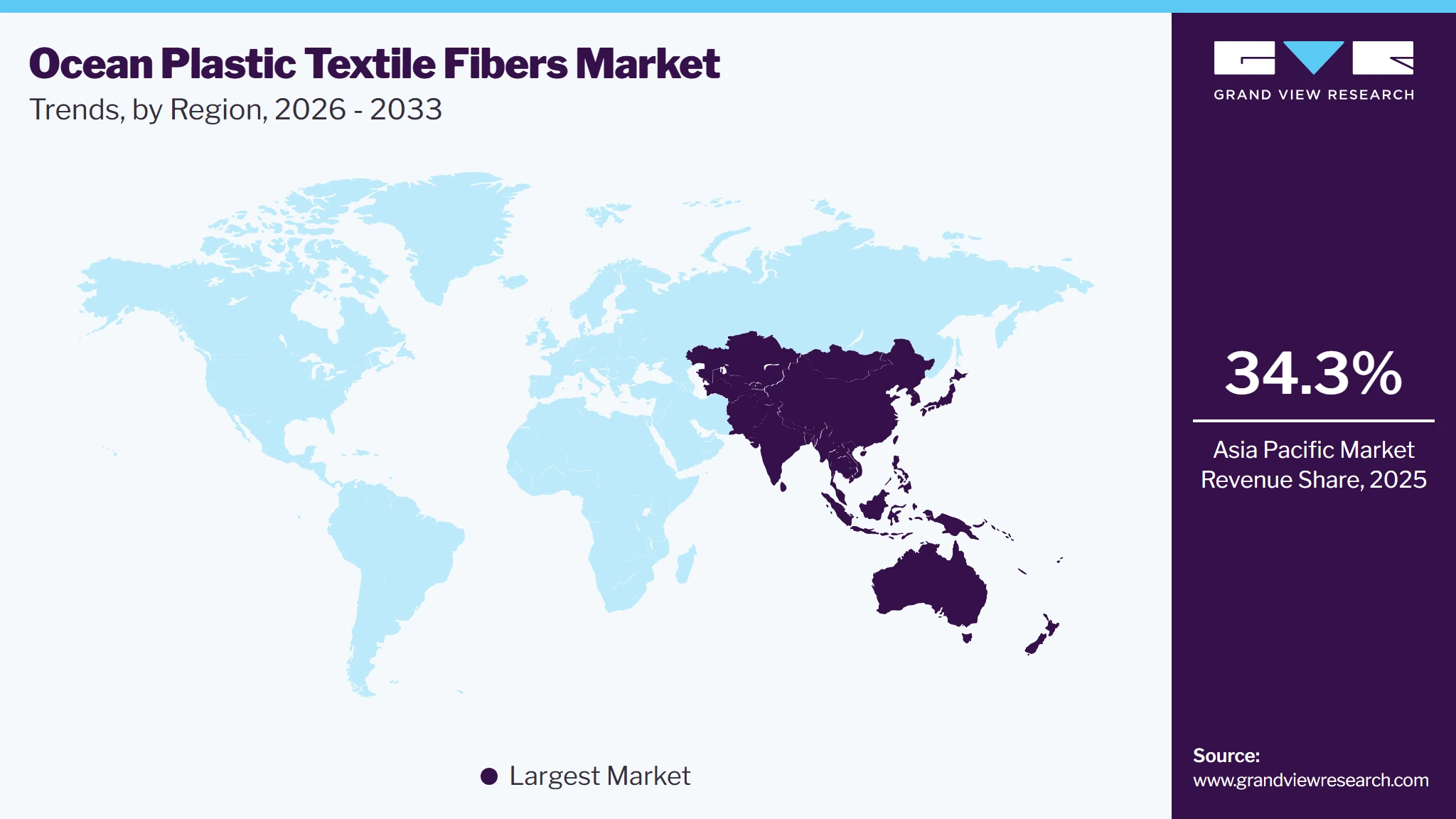
Asia Pacific dominated the global ocean plastic textile fibers market, accounting for the largest revenue share of 34.3% in 2025, owing to its extensive textile and apparel manufacturing base, large polyester and polyamide production capacity, and expanding recycling ecosystem. The region contains major textile manufacturing hubs that can integrate recycled ocean-plastic polymers into existing yarn, fabric, and garment production. Extensive coastlines and plastic-waste generation also provide opportunities for marine and ocean-bound plastic recovery. Increasing sustainability requirements from international apparel brands sourcing from Asia are encouraging manufacturers to adopt recycled and traceable materials.
 To learn more about this report, Download Free Sample Report
China Ocean Plastic Textile Fibers Market Trends
China represents a significant market due to its dominant textile manufacturing position and extensive polymer-processing infrastructure. The country has large-scale polyester and polyamide production, recycling facilities, spinning capacity, and downstream textile manufacturing capabilities. This integrated industrial base provides an advantage in converting recovered plastics into commercially viable textile fibers. Increasing emphasis on resource efficiency, waste management, and circular manufacturing is supporting recycled-material adoption.
North America Ocean Plastic Textile Fibers Market Trends
North America is expected to witness continued demand growth due to strong adoption of sustainable apparel, footwear, outdoor products, and performance textiles. The region has a well-developed ecosystem of recycling companies, material innovators, environmental organizations, and major consumer brands. Sustainability commitments from apparel and footwear companies are encouraging the incorporation of recycled fibers into mainstream product lines. Ocean-plastic fibers are particularly relevant for outdoor, sportswear, swimwear, and premium products where consumers place greater value on environmental attributes.
The U.S. ocean plastic textile fibers market represents a major demand center because of its large apparel, footwear, sportswear, outdoor recreation, and consumer-goods markets. Brands operating in these categories are increasingly incorporating recycled polyester and nylon into products and exploring differentiated sources of recycled feedstock. Consumer awareness of plastic pollution provides additional support for products marketed using verified ocean-plastic or ocean-bound-plastic materials.
Europe Ocean Plastic Textile Fibers Market Trends
Europe is expected to be a strong regional market because of its focus on circular economy, textile sustainability, resource efficiency, waste reduction, and recycled materials. European apparel and textile companies are increasingly evaluating alternative and recycled fibers as part of broader circularity strategies. Regulatory developments are increasing the importance of recycled content, traceability, durability, and environmental performance across the textile value chain.
The Germany ocean plastic textile fibers market is an important European market due to its advanced industrial capabilities, recycling infrastructure, emphasis on resource efficiency, and environmentally conscious consumer base. Textile manufacturers and brands are increasingly evaluating recycled materials and circular production systems. Germany's technological capabilities can support improvements in plastic sorting, purification, recycling, and polymer processing.
Central & South America Ocean Plastic Textile Fibers Market Trends
Central and South America offers growth opportunities because of its extensive coastlines, marine plastic pollution concerns, growing recycling initiatives, and established apparel and footwear manufacturing industries in selected countries. Coastal waste collection can potentially provide feedstock for recycled textile fibers while creating localized circular-economy value chains. The region also has opportunities to develop partnerships between plastic recovery organizations, recyclers, textile manufacturers, and international brands.
Middle East & Africa Ocean Plastic Textile Fibers Market Trends
The Middle East & Africa market is currently at an earlier stage but offers long-term potential due to increasing attention toward plastic waste management, marine pollution, and sustainable materials. Coastal countries can develop collection systems targeting marine litter, fishing gear, packaging, and other recoverable plastics. Africa offers opportunities for decentralized collection and recycling models that can connect plastic recovery with local manufacturing and export-oriented textile supply chains.
Key Ocean Plastic Textile Fibers Company Insights
Some of the key players operating in the market include Far Eastern New Century Corporation and Unifi, Inc.
-
Far Eastern New Century (FENC) is a major Taiwan-based manufacturer of polyester and recycled textile materials, with capabilities spanning polymer production, fibers, yarns, and textiles. The company has developed recycled ocean-polyester fibers, using recovered plastic bottles and marine-related waste streams to produce textile-grade materials, positioning it strongly in sustainable and circular textile solutions.
-
Unifi, Inc. is a major recycled-fiber manufacturer best known for its REPREVE recycled performance fiber and resin portfolio. Its REPREVE Our Ocean product uses post-consumer plastic bottles collected from communities near coastlines at high risk of entering the ocean and converts them into traceable recycled polyester fiber and yarn for apparel, footwear, automotive, and home applications.
BIONIC and ANTEX are some of the emerging market participants in the ocean plastic textile fibers market.
-
BIONIC develops recycled textile materials and yarns using recovered plastic waste, with a focus on converting plastic collected from coastal and marine environments into performance-oriented textile materials. Its model combines material recovery with textile applications, making it a specialized participant in the ocean-plastic fiber ecosystem.
-
ANTEX is a Spanish textile manufacturer and filament producer involved in SEAQUAL YARN, producing recycled yarns incorporating marine plastic waste. The company's SEAQUAL offerings include recycled yarns and fibers for applications across apparel, home textiles, and other textile products, with production integrated into the SEAQUAL ecosystem.
Key Ocean Plastic Textile Fibers Companies
The following key companies have been profiled for this study on the ocean plastic textile fibers market.
-
Far Eastern New Century Corporation
-
Unifi, Inc.
-
Aquafil
-
Hyosung TNC
-
Toray Industries
-
Textil Santanderina
-
ANTEX
-
BIONIC
-
#tide ocean material
-
Bureo
Competitive Benchmarking
Category
Operating Strategies
Competitive Edge
Weakness
Established Players (Far Eastern New Century Corporation, Unifi, Inc., Aquafil, Hyosung TNC, Toray Industries, Textil Santanderina)
- Invest in advanced recycling and fiber technologies to convert marine plastic into textile-grade fibers and yarns.
- Expand capacity through partnerships with apparel brands, recyclers, and textile manufacturers.
- Increase recycled content, fiber quality, traceability, and reduce dependence on virgin polymers.
- Strong expertise in recycled polyester, regenerated nylon, and high-performance fibers.
- Established relationships with global brands and textile manufacturers support commercialization.
- Strong R&D capabilities and production scale provide a competitive advantage.
- High capital requirements for recycling infrastructure and production expansion.
- Variable quality and contamination of marine plastic can affect processing and fiber consistency.
- Dependence on reliable feedstock and brand adoption can limit scaling.
Emerging Players (ANTEX, BIONIC, #tide ocean material, Bureo)
- Develop specialized solutions for ocean plastic, fishing nets, and other marine waste.
- Expand through partnerships with brands, recyclers, textile manufacturers, and sustainability organizations.
- Improve recycling processes, material quality, traceability, and scalability.
- Strong specialization in ocean-bound plastic, fishing nets, recycled polyester, and nylon.
- Flexible operations enable faster development of specialized material solutions.
- Strong positioning in marine plastic recovery provides differentiation.
- Smaller production scale and geographic reach than established fiber manufacturers.
- Greater dependence on partnerships, financing, and feedstock availability.
- Challenges remain around collection costs, contamination, scalability, and price competitiveness.
Recent Developments
-
In April 2025, UNIFI launched REPREVE with CiCLO Technology, combining recycled polyester and nylon with technology designed to enhance the biodegradation of synthetic fibers. The offering is available across REPREVE products, including REPREVE Our Ocean.
-
In May 2025, #tide expanded its textile-material applications through Diade, a new upholstery textile developed by Kvadrat using #tide's 100% ocean-bound-plastic material.
Ocean Plastic Textile Fibers Market Report Scope
Report Attribute
Details
Market size in 2025
USD 247.6 million
Estimated market size in 2026
USD 274.3 million
Projected market size by 2033
USD 586.3 million
Growth rate
CAGR of 11.5% from 2026 to 2033
Base year for estimation
2025
Actual data
2021 - 2024
Forecast period
2026 - 2033
Quantitative units
Revenue in USD million and CAGR from 2026 to 2033
Report coverage
Revenue forecast, company ranking, competitive landscape, growth factors, and trends
Segments covered
Plastic source, fiber form, polymer type, end use, region
Regional scope
North America; Europe; Asia Pacific; Central & South America; Middle East & Africa
Country scope
U.S.; Canada; Mexico; Germany; UK; France; Italy; Spain; China; Japan; India; South Korea; Brazil; Saudi Arabia
Key companies profiled
Far Eastern New Century Corporation; Unifi, Inc.; Aquafil; Hyosung TNC; Toray Industries; Textil Santanderina; ANTEX; BIONIC; #tide ocean material; Bureo
Customization scope
Free report customization (equivalent up to 8 analysts working days) with purchase. Addition or alteration to country, regional & segment scope.
Pricing and purchase options
Avail customized purchase options to meet your exact research needs. Explore purchase options
Global Ocean Plastic Textile Fibers Market Report Segmentation
This report forecasts revenue growth at regional & country levels and provides an analysis on the industry trends in each of the sub-segments from 2021 to 2033. For the purpose of this study, Grand View Research has segmented the ocean plastic textile fibers market on the basis of plastic source, fiber form, polymer type, end use, and region:
-
Plastic Source Outlook (Revenue, USD Million, 2021 - 2033)
-
Ocean-Bound Plastic
-
Ocean-Recovered Plastic
-
Coastal/Beach Plastic
-
Other Marine Plastic Waste
-
-
Polymer Type Outlook (Revenue, USD Million, 2021 - 2033)
-
Polyethylene Terephthalate (PET)
-
Polyamide (PA/Nylon)
-
Polypropylene (PP)
-
Polyethylene (PE)
-
Other Polymers
-
-
Fiber Form Outlook (Revenue, USD Million, 2021 - 2033)
-
Staple Fibers
-
Filament Fibers
-
-
End Use Outlook (Revenue, USD Million, 2021 - 2033)
-
Apparel & Clothing
-
Home Textiles
-
Technical Textiles
-
Automotive Textiles
-
Others
-
-
Regional Outlook (Revenue, USD Million, 2021 - 2033)
-
North America
-
U.S.
-
Canada
-
Mexico
-
-
Europe
-
UK
-
Germany
-
France
-
Italy
-
Spain
-
-
Asia Pacific
-
China
-
Japan
-
India
-
South Korea
-
-
Central and South America
-
Brazil
-
-
Middle East and Africa
-
Saudi Arabia
-
-
Research Methodology
The ocean plastic textile fibers market figures in this report are based on a proven research process that combines executive interviews with secondary research from proprietary databases, company filings, and recognized regulatory and institutional sources. Market size is built through value-chain sizing-reconciling supply-side and demand-side estimates-and triangulated with bottom-up and top-down approaches. Every estimate passes multiple levels of expert validation before publication, with each ocean plastic textile fibers segment quantified using the revenue-capture definitions in the table below.
Segment Definition
Segment - Plastic Source
Revenue capture definition
Ocean-Bound Plastic
Revenue generated from the sale of textile fibers produced from plastic waste collected from coastal areas, waterways, and other locations at risk of entering the ocean.
Ocean-Recovered Plastic
Revenue generated from the sale of textile fibers produced from plastic waste directly recovered from oceans, seas, or marine environments through collection and recovery operations.
Coastal/Beach Plastic
Revenue generated from the sale of textile fibers produced from plastic waste collected from beaches, shorelines, and coastal environments and subsequently processed into textile-grade polymers and fibers.
Other Marine Plastic Waste
Revenue generated from the sale of textile fibers produced from other marine-associated plastic waste sources, including discarded ropes, marine packaging, containers, and mixed plastic debris not classified under the other source categories.
Segment - Polymer Type
Revenue capture definition
Polyethylene Terephthalate (PET)
Revenue generated from the sale of ocean-plastic textile fibers produced using recovered PET waste, including bottles, containers, and other PET-based plastic materials processed into recycled polyester fibers.
Polyamide (PA/Nylon)
Revenue generated from the sale of textile fibers produced using recovered polyamide or nylon waste, particularly discarded fishing nets and other marine nylon products, and processed into recycled polyamide fibers.
Polypropylene (PP)
Revenue generated from the sale of textile fibers produced using recovered polypropylene marine plastic waste, including ropes, packaging, containers, and other PP-based materials processed into recycled PP fibers.
Polyethylene (PE)
Revenue generated from the sale of textile fibers produced using recovered polyethylene waste, including marine-associated packaging, containers, films, and other PE products converted into textile-grade recycled fibers.
Other Polymers
Revenue generated from the sale of textile fibers produced from other recovered marine plastic polymers that are processed into usable textile-grade recycled materials.
Segment - Fiber Form
Revenue capture definition
Staple Fibers
Revenue generated from the sale of short-length ocean-plastic-derived fibers produced by cutting or processing recycled polymers into discrete fiber lengths for use in yarns, fabrics, nonwovens, home textiles, apparel, and other textile applications.
Filament Fibers
Revenue generated from the sale of continuous ocean-plastic-derived fibers produced by extruding and spinning recycled polymers into continuous filaments for use in apparel, sportswear, home textiles, and technical textile applications.
Segment - End Use
Revenue capture definition
Apparel & Clothing
Revenue generated from the sale of ocean-plastic textile fibers and yarns supplied for incorporation into clothing products, including sportswear, activewear, swimwear, outdoor apparel, casualwear, and other garments.
Home Textiles
Revenue generated from the sale of ocean-plastic textile fibers and yarns used in household and interior textile products, including carpets, upholstery, bedding, curtains, furnishings, and other home textile applications.
Technical Textiles
Revenue generated from the sale of ocean-plastic textile fibers and yarns used in performance-oriented and industrial textile applications requiring specific functional, durability, or technical properties.
Automotive Textiles
Revenue generated from the sale of ocean-plastic textile fibers and yarns used in automotive textile components, including seat fabrics, interior coverings, carpets, headliners, trims, and other vehicle textile applications.
Others
Revenue generated from the sale of ocean-plastic textile fibers and yarns used in other applications, including footwear, bags, accessories, sports equipment, and miscellaneous textile products.
Estimation Model
Layer Name
Key Question
Description
Parent Market Analysis
What is the overall size and growth outlook of the global textile fibers, recycled fibers, textile manufacturing, and sustainable textile materials market?
The estimation begins by evaluating the broader textile fibers, recycled fibers, textile manufacturing, and sustainable textile materials market. Global fiber production and consumption, synthetic fiber demand, plastic waste generation, textile manufacturing capacity, recycling infrastructure, and investments in circular and sustainable materials are analyzed to establish the total addressable market for ocean plastic textile fibers.
Ocean Plastic Fiber Penetration Analysis
What proportion of the overall recycled and sustainable textile fiber market is represented by ocean plastic textile fibers across plastic sources, polymer types, and fiber forms?
This layer estimates the penetration of ocean plastic textile fibers within the broader recycled and sustainable fiber market. Adoption is assessed across ocean-bound plastic, ocean-recovered plastic, coastal/beach plastic, and other marine plastic waste, as well as PET, polyamide, polypropylene, polyethylene, and other polymers. Penetration is further evaluated across staple and filament fibers to determine the market contribution of ocean plastic-derived textile fibers.
Regional & End-use Demand Assessment
Which regions and end-use industries contribute the highest demand for ocean plastic textile fibers?
Market demand is evaluated across major regions based on textile manufacturing capacity, apparel and footwear production, plastic waste recovery, marine pollution initiatives, recycling infrastructure, sustainability regulations, and circular economy adoption. Demand is further assessed across apparel and clothing, home textiles, automotive textiles, technical textiles, and other applications to determine regional and end-use penetration.
Company Revenue Validation & Market Forecasting
How is the final market size validated and forecast?
Final estimates are validated using company revenues, ocean plastic collection and processing capacities, recycled polymer and fiber production capacities, product portfolios, manufacturing facilities, technology investments, sustainability partnerships, certifications, and announced expansion plans. Bottom-up and top-down approaches are triangulated using company-level and industry-level data to generate reliable market estimates and forecasts for ocean plastic textile fibers.
Delivered Customizations
This report has been delivered with the following In-depth customizations
Client Request
Customization Delivered
Value Adds
Polymer & Fiber Technology Analysis
Evaluation of PET, PA/Nylon, PP, PE, and other polymers across mechanical recycling, chemical recycling, purification, extrusion, spinning, and fiber-forming processes, with assessment of staple and filament fiber production.
Helps clients identify suitable polymer pathways, technology gaps, investment opportunities, and high-potential fiber formats while improving product quality and manufacturing efficiency.
Regional & End-use Opportunity Assessment
Assessment of regional demand across all major regions, combined with analysis of apparel, home textiles, automotive textiles, technical textiles, and other applications.
Helps clients prioritize high-growth geographies and attractive end-use industries, identify expansion opportunities, and align production capabilities with regional and application-specific demand.
Circular Value Chain & Ecosystem Analysis
Evaluation of the complete ocean plastic textile value chain covering marine plastic collection, sorting, preprocessing, recycling, polymer production, fiber production, yarn manufacturing, textile processing, brands, retailers, and end users. The analysis assesses partnerships, supply-chain gaps, integration opportunities, certification, traceability, and emerging circular business models.
Helps clients identify value-chain gaps, potential partners, integration opportunities, and strategic investment areas while improving supply-chain resilience, traceability, and circularity.
Frequently Asked Questions About This Report
The ocean plastic textile fibers market size was estimated at USD 247.6 million in 2025 and is expected to reach USD 274.3 million in 2026.
The ocean plastic textile fibers market is expected to grow at a compound annual growth rate of 11.5% from 2026 to 2033 to reach USD 586.3 million by 2033.
The ocean-bound plastic segment accounted for the highest revenue share of 56.7% in 2025, driven by its relatively established collection networks, scalable feedstock availability, and suitability for producing recycled textile fibers.
Asia Pacific held the highest revenue market share of 34.3% in 2025, supported by its large textile manufacturing base, established recycled-fiber supply chains, growing ocean-plastic collection initiatives, and strong presence of major recycled polyester and nylon fiber producers.
Key factors driving the ocean plastic textile fibers market include growing demand for sustainable and traceable textile materials, increasing marine-plastic recovery initiatives, rising adoption of recycled polyester and nylon by apparel brands, and expanding circular-economy commitments across the textile value chain.
Some key players in the ocean plastic textile fibers market include Far Eastern New Century Corporation, Unifi, Inc., Aquafil, Hyosung TNC, Toray Industries, Textil Santanderina, ANTEX, BIONIC, Bureo, and #tide ocean material.
The polyamide (PA/Nylon) segment is the fastest-growing polymer type in the ocean plastic textile fibers market.
The technical textiles segment is the fastest growing end use in the ocean plastic textile fibers market.
The staple fibers segment accounted for the largest revenue share of 60.9% in 2025, supported by their broad use across apparel, home textiles, nonwovens, and other applications, as well as compatibility with conventional spinning and blending processes.
About the Author(s)
Advanced Interior Materials Research Team
Advanced Materials · Advanced Interior MaterialsThis report was authored by the advanced interior materials research team at Grand View Research - comprising two research analysts, one senior research analyst, and one industry expert - with specialized expertise in the advanced interior materials segment of the advanced materials industry. All findings are based on proprietary advanced materials databases, executive interviews, and regulatory analysis, subject to internal peer review prior to publication.
Last Updated:
Speak to Analyst

Customize this report to your needs - add regions, segments, or data points, with 20% free customization.
Or view our licence options:


ISO 9001:2015 & 27001:2022 Certified
We are GDPR and CCPA compliant! Your transaction & personal information is safe and secure. For more details, please read our privacy policy.


