
- Home
- »
- Advanced Interior Materials
- »
-
Commercial Heat Treating Market Size & Share Report, 2033GVR Report cover

Commercial Heat Treating Market (2026 - 2033)
Size, Share & Trends Analysis Report By Material, By Process (Case Hardening, Annealing, Normalizing), By Equipment (Electrically Heated Furnace, Fuel-Fired Furnace), By Application (Automotive, Machine), By Region, And Segment Forecast
Market Size, 2025
$17.8BMarket Estimate, 2026
$18.4BMarket Forecast, 2033
$23.7BCAGR, 2026–2033
3.7%Commercial Heat Treating Market Summary
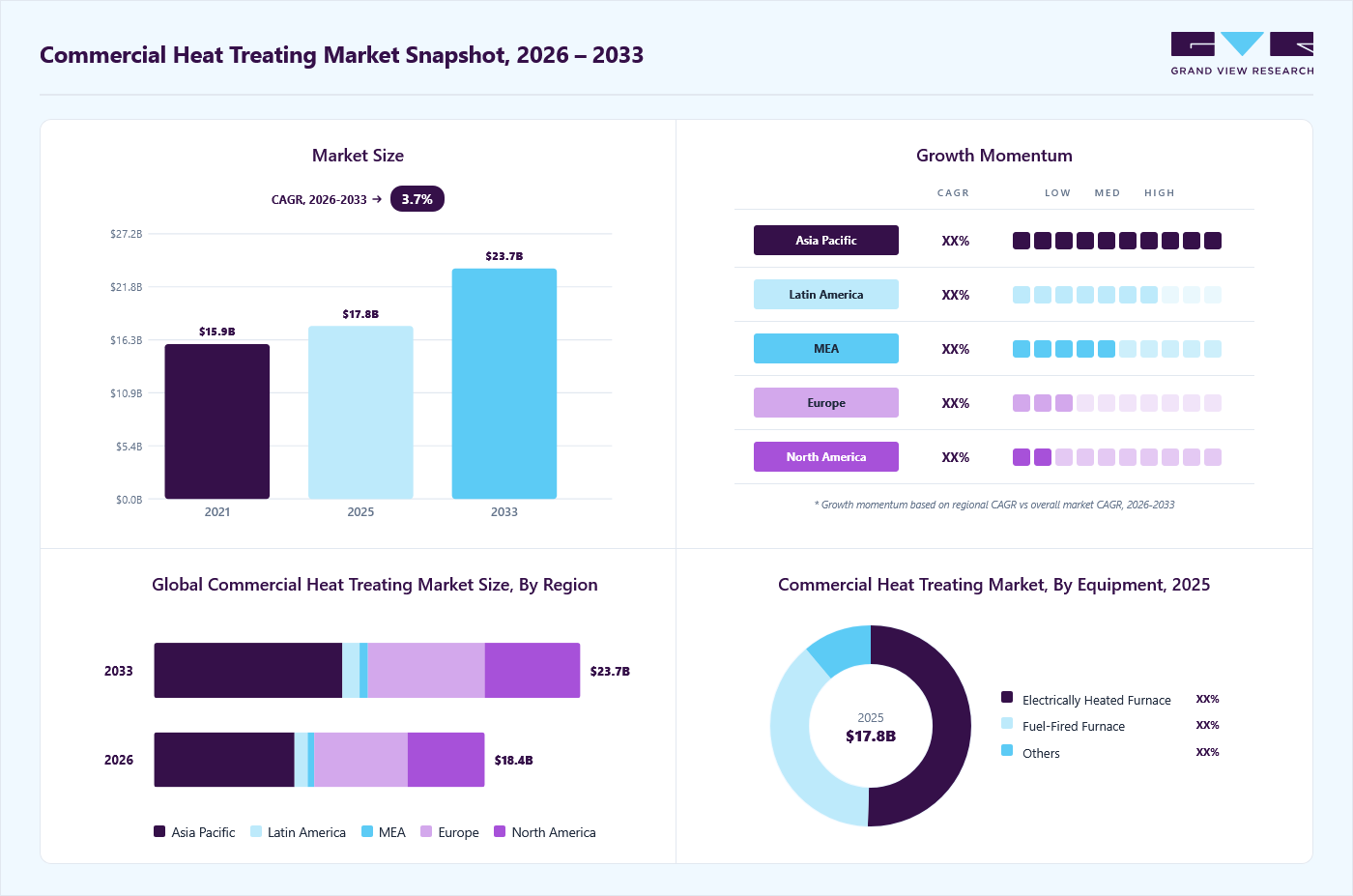
The global commercial heat treating market size was valued at USD 17.8 billion in 2025 and is projected to grow from USD 18.4 billion in 2026 to USD 23.7 billion by 2033, at a CAGR of 3.7% from 2026 to 2033. Asia Pacific dominated the market, accounting for the largest revenue share of 42.3% in 2025. The industry is driven by increasing demand for precision-engineered metal components across the automotive, aerospace, industrial machinery, energy, and medical equipment sectors.
 Source: Grand View Research, IR Documents, Primary Interviews, Paid DatabasesTo learn more about this report,
 Download Free Sample Report
Key Market Trends & Insights
- By material: Steel segment dominated the market and accounted for a revenue share of 80.0% in 2025.
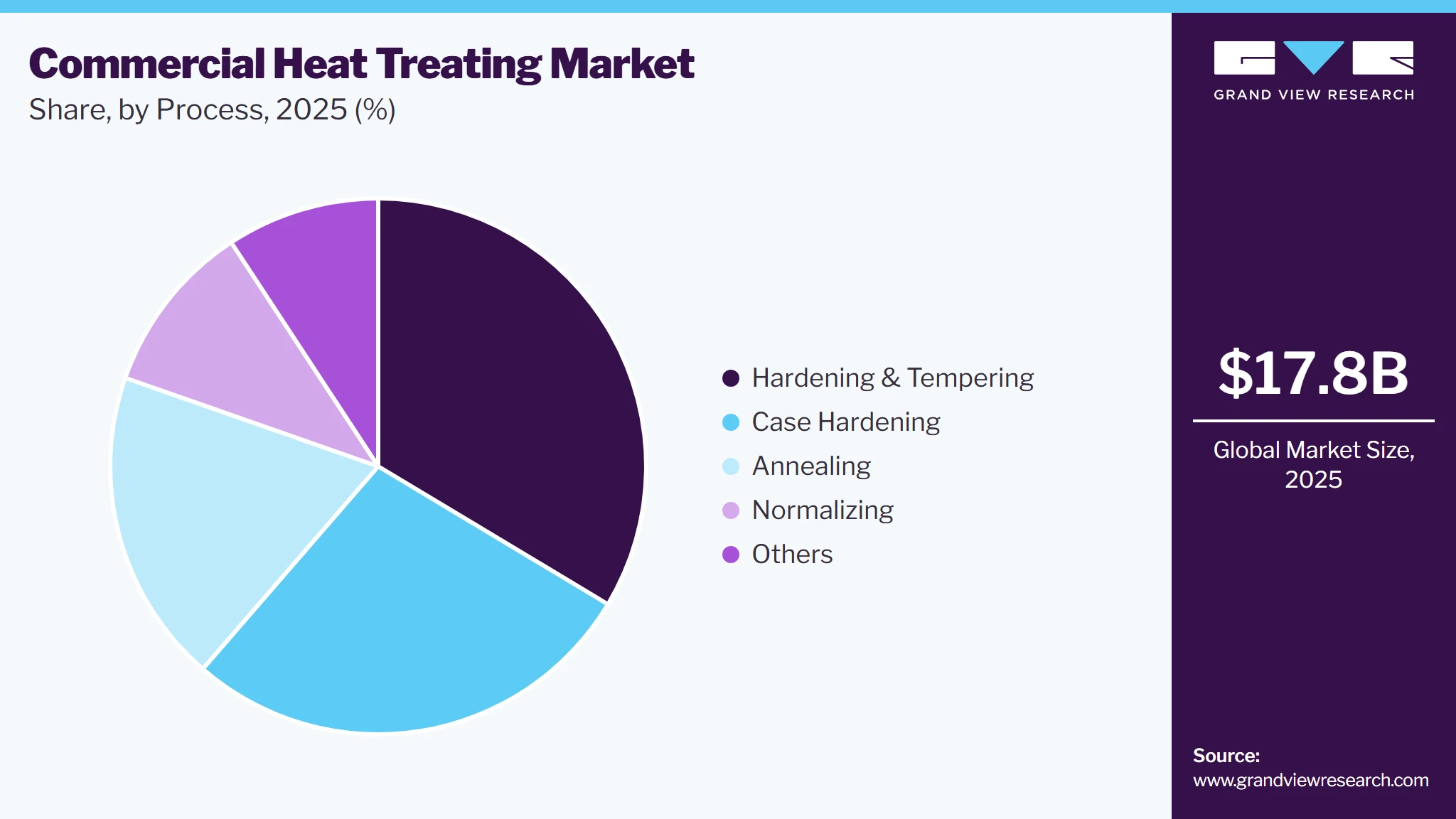
- By process: Hardening & tempering segment dominated the market and accounted for a revenue share of 33.6% in 2025.
- By equipment: Electrically heated furnace segment accounted for the largest share of 50.4% in 2025.
- By application: Automotive segment dominated the market, accounting for 34.6% share in 2025.
Regional Highlights
- Largest market: Asia Pacific (42.3% revenue share, 2025)
- By country: China held the largest market share in 2025.
Market Size & Forecast
- Market size in 2025: USD 17.8 Billion
- Estimated market size in 2026: USD 18.4 Billion
- Projected market size by 2033: USD 23.7 Billion
- CAGR (2026-2033): 3.7%
Prism AI by Grand View Research Free to tryAsk a question about the commercial heat treating market✓Every figure cited from GVR research Prefer the report? Download free sample →
Manufacturers are relying on outsourced heat treating services to improve hardness, wear resistance, fatigue strength, and dimensional stability while reducing capital investment in in-house processing facilities.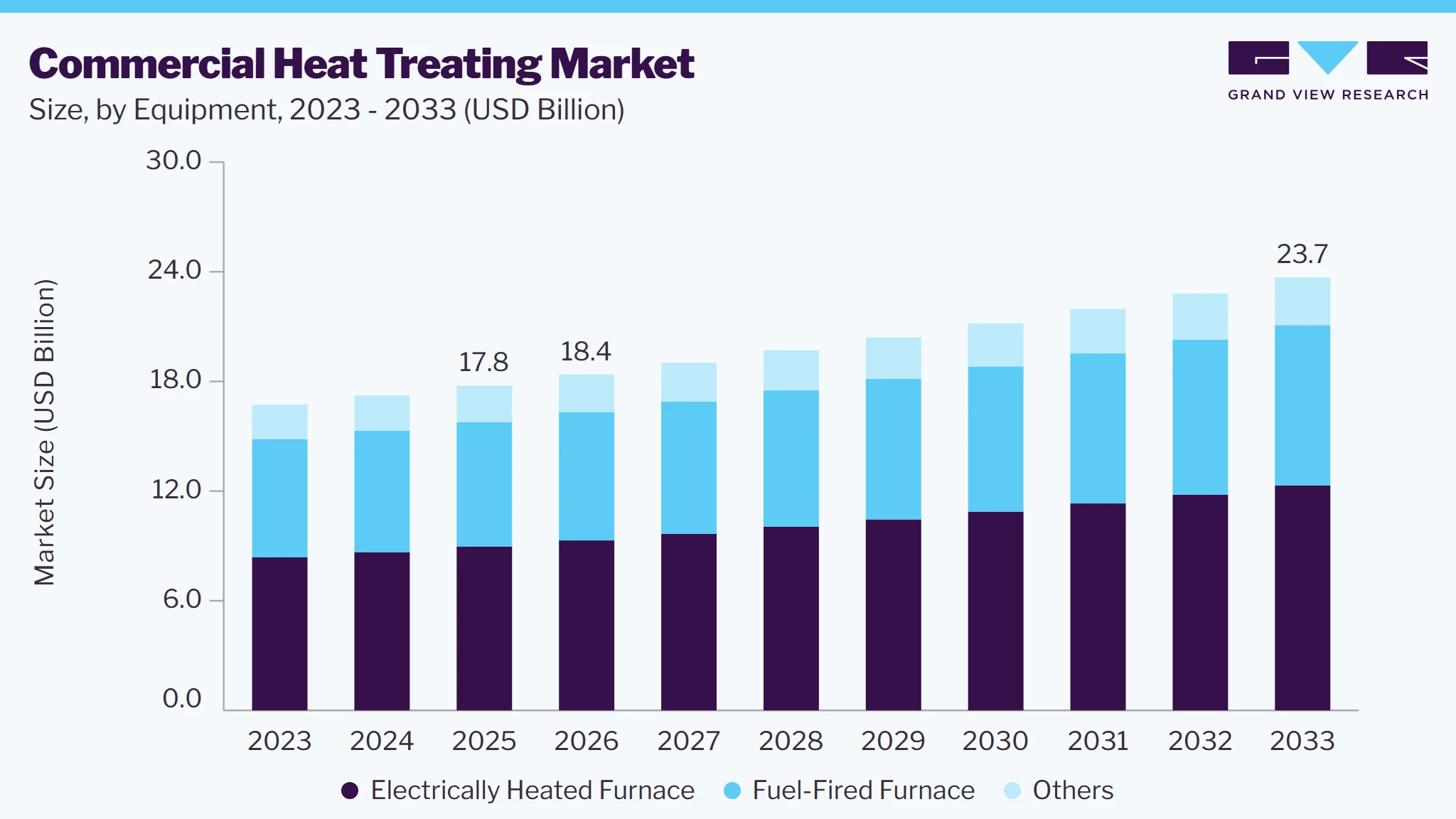 To learn more about this report, Download Free Sample Report
Growing adoption of high-performance alloys and lightweight materials has increased the need for advanced thermal processing techniques that ensure consistent metallurgical properties.
Market Dynamics
The industry is benefiting from the increasing preference among manufacturers to outsource thermal processing operations to specialized service providers. Outsourcing enables companies to access advanced processing technologies, certified quality systems, and metallurgical expertise without investing in capital-intensive furnace infrastructure or specialized workforce training. Growing production of precision-engineered components for automotive, aerospace, industrial equipment, medical devices, energy, and defense applications is generating sustained demand for reliable heat treatment services.
Commercial heat treating operations require continuous operation of high-temperature furnaces, making energy one of the largest operating expenses for service providers. Volatility in electricity and natural gas prices can directly affect production costs and profit margins, particularly for companies operating large-scale thermal processing facilities. At the same time, increasingly stringent environmental regulations governing industrial emissions, energy efficiency, and workplace safety require ongoing investments in modern furnace systems, emissions control equipment, and process optimization technologies.
Market Concentration & Characteristics
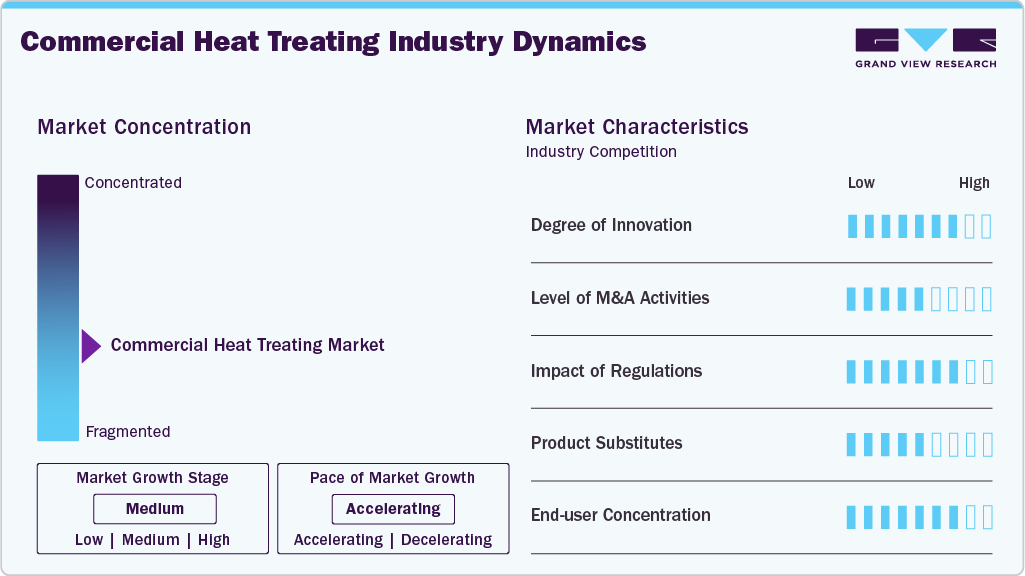
The industry is moderately fragmented, with competition among multinational thermal processing service providers, regional commercial heat treatment companies, and specialized metallurgical service firms. Established companies compete through extensive processing capabilities, certified quality systems, broad geographic presence, and long-term relationships with customers across aerospace, automotive, industrial machinery, energy, medical devices, and defense sectors.
The industry is characterized by continuous advancements in thermal processing technologies aimed at improving metallurgical performance, operational efficiency, and process reliability. Commercial heat treating companies are investing in vacuum furnaces, induction heat treating systems, controlled atmosphere furnaces, automated material handling, and digital process monitoring to achieve precise temperature control, consistent material properties, and complete production traceability.
 To learn more about this report, Download Free Sample Report
Merger and acquisition activity is increasing as commercial heat treating companies seek to strengthen regional presence, expand processing capabilities, and broaden their customer base. Strategic acquisitions of independent heat treatment facilities and specialized thermal processing businesses enable service providers to increase production capacity, enter high-value industrial segments, and enhance service offerings.
Regulatory compliance remains a critical competitive factor in the industry. Service providers must comply with internationally recognized quality and process standards, including NADCAP for aerospace applications, CQI-9 for automotive heat treatment, and quality management systems such as ISO 9001 and IATF 16949. Environmental regulations governing furnace emissions, workplace safety, and energy efficiency are also encouraging investments in low-emission furnace technologies, advanced process controls, and energy-efficient thermal processing systems.
Analyst Perspective
The industry is growing steadily as manufacturers outsource thermal processing to improve the strength, durability, and performance of metal components. Demand is supported by industries where precision heat treatment is critical for product quality and reliability. Outsourcing enables manufacturers to reduce capital investment, lower operating costs, and access advanced processing technologies without maintaining in-house facilities. The increasing use of high-strength alloys, lightweight materials, and precision-engineered components is further driving demand for specialized heat treatment services. Service providers are investing in energy-efficient furnaces, automation, and digital process monitoring to enhance productivity and quality.
Material Insights
The steel segment dominated the market and accounted for a revenue share of 80.0% in 2025. Its extensive use in automotive, aerospace, industrial machinery, energy, construction, and defense applications continues to drive demand for commercial thermal processing services. Heat treatment processes, including hardening, tempering, annealing, normalizing, and carburizing, are widely employed to improve mechanical properties, fatigue life, wear resistance, and dimensional stability.
The cast iron segment is gaining traction as manufacturers seek to improve the durability and operational performance of components used in heavy-duty industrial applications. Thermal processing enhances the strength, hardness, machinability, and wear resistance of cast iron parts, making them suitable for mining equipment, agricultural machinery, commercial vehicles, power generation systems, and industrial machinery.
Equipment Insights
The electrically heated furnace segment accounted for the largest share of 50.4% in 2025. Its widespread adoption is attributed to precise temperature control, uniform heat distribution, and the ability to deliver consistent metallurgical properties across a broad range of thermal processing applications. These furnaces are extensively utilized for vacuum heat treating, annealing, tempering, and brazing processes in aerospace, automotive, medical device, and precision engineering industries.
The fuel-fired furnace segment is projected to grow at a CAGR of 3.2% during the forecast period, supported by continued demand from steel processing, forging, foundries, heavy machinery, and energy industries. These furnaces are preferred for high-capacity thermal processing of large and complex metal components, particularly in applications requiring elevated operating temperatures and continuous production.
Application Insights
The automotive segment accounted for the largest revenue share of 34.6% in 2025. High production volumes of gears, crankshafts, camshafts, transmission components, bearings, springs, and other critical drivetrain parts continue to generate substantial demand for commercial heat-treating services. Thermal processing is essential for enhancing hardness, fatigue strength, wear resistance, and dimensional stability, enabling components to meet stringent durability and performance requirements.
The aerospace segment is projected to grow at a CAGR of 4.5% during the forecast period. The growth is driven by increasing demand for heat treatment of aircraft structural components, landing gear systems, turbine parts, fasteners, and engine components manufactured from titanium, nickel-based alloys, and specialty steels. Commercial heat treating ensures the metallurgical integrity, mechanical strength, and fatigue performance required for safety-critical aerospace applications.
Process Insights
The hardening & tempering segment dominated the market and accounted for a revenue share of 33.6% in 2025. Its widespread adoption across automotive, aerospace, industrial machinery, energy, and defense manufacturing is attributed to its ability to enhance the hardness, tensile strength, toughness, and fatigue resistance of critical metal components. The process delivers the mechanical properties required for high-load and high-wear applications while ensuring dimensional stability and consistent performance.
 To learn more about this report, Download Free Sample Report
The case hardening segment is anticipated to register the fastest CAGR over the forecast period, driven by increasing demand for components that require superior surface hardness without compromising core toughness. The process is extensively employed for gears, bearings, shafts, transmission systems, and other powertrain components operating under severe wear and cyclic loading conditions. Growing production of high-performance automotive, aerospace, and industrial equipment, coupled with increasing emphasis on extending component service life and reducing maintenance requirements, is expected to support the adoption of case hardening across commercial heat treating facilities.
Regional Insights
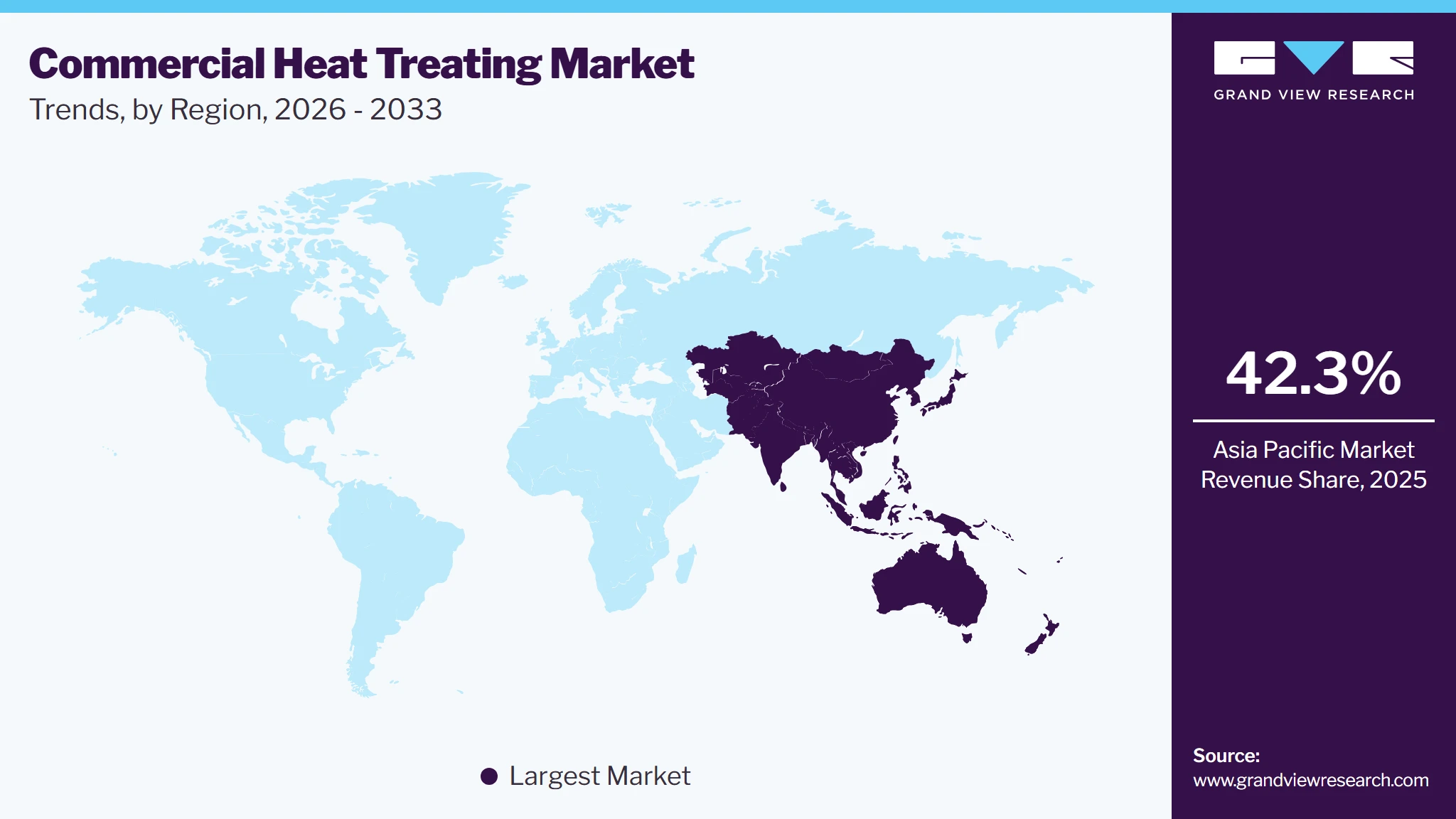
The commercial heat treating market in Asia Pacific accounted for the largest share of 42.3% in 2025, supported by the region's extensive manufacturing ecosystem and high production volumes across the automotive, industrial machinery, electronics, aerospace, shipbuilding, and metal fabrication industries. Increasing industrialization, expansion of precision manufacturing, and continuous investments in production facilities are generating sustained demand for commercial heat-treating services. The growing adoption of advanced manufacturing technologies, coupled with increasing outsourcing of thermal processing operations, continues to strengthen the region's market position.
 To learn more about this report, Download Free Sample Report
China Commercial Heat Treating Market Trends
The China commercial heat treating market is driven by its large-scale industrial manufacturing sector and extensive production of automotive components, industrial equipment, construction machinery, and high-performance metal products. Continuous investments in advanced manufacturing, expansion of electric vehicle production, and modernization of industrial facilities are increasing the demand for commercial heat-treating services.
The commercial heat treating market in India is witnessing steady growth, supported by expanding automotive production, engineering industries, capital goods manufacturing, and infrastructure development. Increasing localization of component manufacturing and rising investment in industrial production facilities are creating new opportunities for commercial heat treating service providers. Growing demand for precision-engineered components, combined with the expansion of organized metal processing and industrial supply chains, is contributing to the continued development of the market.
North America Commercial Heat Treating Market Trends
The North America commercial heat treating market is driven by a mature manufacturing ecosystem and a strong concentration of aerospace, automotive, defense, energy, and industrial machinery manufacturers. Increasing outsourcing of thermal processing operations to specialized service providers, combined with demand for high-quality metallurgical performance, continues to support market expansion. Investments in vacuum furnaces, induction heat treating systems, automation, and digital process monitoring are improving operational efficiency and enabling commercial heat treaters to meet stringent customer and regulatory requirements.
The commercial heat treating market in the U.S. accounted for the largest share in North America, reflecting the country's extensive industrial production and well-established aerospace, automotive, medical device, and defense sectors. Commercial heat treating companies are expanding processing capabilities through investments in advanced furnace technologies, automated material handling, and quality assurance systems to address increasing demand for precision-engineered components.
The Mexico commercial heat treating market is expanding steadily as growth in automotive manufacturing, metal fabrication, and industrial equipment production increases demand for outsourced thermal processing services. The country's integration into North American manufacturing supply chains and ongoing investments in export-oriented production facilities are creating new opportunities for commercial heat treating providers.
Europe Commercial Heat Treating Market Trends
The commercial heat treating market in Europe is characterized by a strong industrial base and sustained demand from the automotive, aerospace, industrial machinery, energy, and medical device sectors. The region's emphasis on precision manufacturing, product reliability, and environmental compliance is encouraging commercial heat treating companies to modernize their facilities with energy-efficient furnace technologies, advanced process controls, and digital monitoring systems.
The Germany commercial heat treating market is supported by its leadership in automotive manufacturing, industrial engineering, machine tools, and precision metalworking. Demand for certified heat treatment services remains strong as manufacturers seek consistent metallurgical performance for critical components used in high-value industrial applications.
The commercial heat treating market in the UK benefits from a diverse manufacturing landscape encompassing aerospace, defense, automotive, and advanced engineering industries. Commercial heat treating service providers are expanding their capabilities to process high-performance materials and increasingly complex component designs required by these sectors. Investments in furnace modernization, digital process optimization, and quality assurance systems are improving processing efficiency and reinforcing the country's role in supplying certified thermal processing services for domestic and export-oriented manufacturers.
Middle East & Africa Commercial Heat Treating Market Trends
The commercial heat treating market in the Middle East & Africa is gaining momentum with the expansion of industrial manufacturing, metal fabrication, and heavy engineering activities across the region. Increasing investments in oil & gas, power generation, mining, construction equipment, and industrial machinery are creating consistent demand for outsourced thermal processing services. The development of industrial zones, localization of manufacturing, and modernization of production facilities are encouraging the adoption of advanced heat treatment technologies to improve component performance and meet international quality standards.
The Saudi Arabia commercial heat treating market is benefiting from the country's ongoing industrial transformation and expansion of high-value manufacturing sectors. Investments in petrochemicals, energy infrastructure, metal processing, and defense manufacturing are increasing the requirement for precision heat treatment of critical metal components. In parallel, modernization of industrial facilities and the adoption of advanced furnace technologies are strengthening the capabilities of commercial heat treating service providers, enabling them to meet the evolving requirements of domestic manufacturers and export-oriented industries.
Latin America Commercial Heat Treating Market Trends
The commercial heat treating market in Latin America is supported by expanding automotive manufacturing, metal fabrication, industrial machinery production, and mining activities across the region. Increasing investments in industrial infrastructure and the modernization of manufacturing facilities are driving demand for commercial heat-treating services that improve the mechanical properties and operational reliability of engineered metal components. Growing adoption of outsourced thermal processing is further enabling manufacturers to achieve stringent quality requirements while optimizing production efficiency.
The Brazil commercial heat treating market is supported by its well-established automotive, aerospace, agricultural equipment, and metalworking industries. Demand for commercial heat treating services is increasing as manufacturers focus on enhancing component durability, wear resistance, and fatigue performance for high-value industrial applications. Continued investments in industrial production capacity, modernization of thermal processing facilities, and expansion of domestic manufacturing capabilities are expected to strengthen the market over the forecast period.
Key Commercial Heat Treating Companies Insights
Some of the key players operating in the market include Bluewater Thermal Solutions LLC, Bodycote, East-Lind Heat Treat Inc.
-
Bluewater Thermal Solutions LLC is a U.S.-based provider of commercial heat-treating and thermal processing services. The company operates multiple facilities across North America, serving automotive, aerospace, energy, heavy equipment, and industrial manufacturing industries. Its service portfolio includes carburizing, nitriding, induction hardening, vacuum heat treatment, brazing, annealing, and stress relieving. Bluewater also offers metallurgical testing and process engineering support to optimize component performance.
-
East-Lind Heat Treat Inc. is a diversified material company offering commercial heat treating with advanced connectivity and energy-efficient features. Its products integrate with smart home ecosystems, enabling app control, scheduling, and energy monitoring. Honeywell leverages global R&D expertise and a strong brand reputation to provide reliable, safe, and user-friendly heating solutions across residential and commercial sectors.
Key Commercial Heat Treating Companies:
The following key companies have been profiled for this study on the commercial heat treating market:
-
Bluewater Thermal Solutions LLC
-
Bodycote
-
East-Lind Heat Treat Inc.
-
General Metal Commercial Heat Treating
-
Shanghai Fengdong Heat Treatment Engineering Co., Ltd.
-
Pacific Metallurgical, Inc.
-
Aalberts N.V.
-
Unitherm Engineers Limited
-
TRIAD ENGINEERS
-
HighTemp Furnaces Limited
-
Deck India Engineering Pvt. Ltd.
-
Sourabh Heat Treatments
-
Nitrex
-
Therelek
-
Advanced Heat Treat Corp.
Company categorization
Operating strategies
Competitive Edge
Weakness
Mature Players: Bodycote, Bluewater Thermal Solutions LLC, Aalberts N.V., Nitrex, Advanced Heat Treat Corp., Shanghai Fengdong Heat Treatment Engineering Co., Ltd.
- Expand commercial heat treating capacity through furnace modernization, automation, and process optimization.
- Strengthen market position through certified thermal processing services and long-term partnerships with aerospace, automotive, energy, and industrial manufacturers.
- Comprehensive heat treatment capabilities, internationally certified facilities, and strong metallurgical expertise.
- Multi-location operations with the ability to serve high-volume and complex industrial applications.
- High capital investment for advanced furnace systems and environmental compliance.
- Longer investment cycles and relatively lower flexibility in niche applications.
Emerging Players: East-Lind Heat Treat Inc., General Metal Commercial Heat Treating, Pacific Metallurgical, Inc., Unitherm Engineers Limited, TRIAD ENGINEERS, HighTemp Furnaces Limited, Deck India Engineering Pvt. Ltd., Sourabh Heat Treatments, Therelek
- Focus on specialized heat treatment processes, regional expansion, and customer-specific thermal processing solutions.
- Compete through shorter lead times, application-focused services, and close collaboration with local manufacturers.
- Flexible production capabilities, faster service delivery, and strong expertise in regional industrial applications.
- Ability to provide customized thermal processing for diverse component requirements.
- Limited processing capacity and international presence.
- Lower investment capability for advanced technologies, automation, and global quality certifications.
Recent Developments:
-
In January 2026, Bodycote acquired Spectrum Thermal Processing, a U.S.-based provider of precision commercial heat treating services for the aerospace and defense industries. The acquisition expanded Bodycote's North American service network and strengthened its portfolio of Nadcap-accredited thermal processing capabilities, including vacuum heat treatment, low-pressure carburizing, and gas nitriding. The strategic move enhances the company's ability to serve high-specification manufacturing applications while reinforcing its position in the global market.
-
In May 2025, Aalberts N.V. acquired Paulo Products Company, a North American commercial heat treating service provider specializing in thermal processing, brazing, and metal finishing solutions. The acquisition expanded Aalberts’ commercial heat treating capabilities across automotive, aerospace, defense, and power generation applications while strengthening its presence in the North American market. By integrating Paulo’s established facilities, technical expertise, and certified processing capabilities, Aalberts enhanced its ability to deliver comprehensive commercial heat treating services for high-performance components and meet the increasing demand for outsourced thermal processing solutions.
Commercial Heat Treating Market Report Scope
Report Attribute
Details
Market size value in 2025
USD 17.8 billion
Market size value in 2026
USD 18.4 billion
Revenue forecast in 2033
USD 23.7 billion
Growth rate
CAGR of 3.7% from 2026 to 2033
Historical data
2021 - 2024
Forecast period
2026 - 2033
Quantitative units
Revenue in USD billion and CAGR from 2026 to 2033
Report coverage
Revenue forecast, company ranking, competitive landscape, growth factors, and trends
Segments covered
Material, process, equipment, application, region
Regional scope
North America; Europe; Asia Pacific; Latin America; Middle East & Africa
Country scope
U.S.; Canada; Mexico; UK; Germany; France; Spain; Italy; China; Japan; India; South Korea; Brazil; Argentina; Saudi Arabia; UAE
Key companies profiled
Bluewater Thermal Solutions LLC.; Bodycote; East-Lind Heat Treat Inc.; General Metal Commercial Heat Treating; Shanghai Fengdong Heat Treatment Engineering Co., Ltd.; Pacific Metallurgical, Inc.; Aalberts N.V.; Unitherm Engineers Limited; TRIAD ENGINEERS; HighTemp Furnaces Limited; Deck India Engineering Pvt. Ltd.; Sourabh Heat Treatments; Nitrex; Therelek; Advanced Heat Treat Corp.
Customization scope
Free report customization (equivalent up to 8 analysts working days) with purchase. Addition or alteration to country, regional & segment scope.
Pricing and purchase options
Avail customized purchase options to meet your exact research needs. Explore purchase options
Global Commercial Heat Treating Market Report Segmentation
This report forecasts revenue growth at global, regional, and country levels and provides an analysis of the latest industry trends in each of the sub-segments from 2021 to 2033. For this study, Grand View Research has segmented the global commercial heat treating market report based on material, process, equipment, application, and region:
-
Material Outlook (Revenue, USD Billion, 2021 - 2033)
-
Steel
-
Cast iron
-
Others
-
-
Process Outlook (Revenue, USD Billion, 2021 - 2033)
-
Case Hardening
-
Annealing
-
Normalizing
-
Hardening & Tempering
-
Others
-
-
Equipment Outlook (Revenue, USD Billion, 2021 - 2033)
-
Electrically Heated Furnace
-
Fuel-Fired Furnace
-
Others
-
-
Application Outlook (Revenue, USD Billion, 2021 - 2033)
-
Automotive
-
Machine
-
Construction
-
Aerospace
-
Metalworking
-
Others
-
-
Regional Outlook (Revenue, USD Billion, 2021 - 2033)
-
North America
-
U.S.
-
Canada
-
Mexico
-
-
Europe
-
Germany
-
France
-
Italy
-
Spain
-
UK
-
-
Asia Pacific
-
China
-
India
-
Japan
-
South Korea
-
-
Latin America
-
Brazil
-
Argentina
-
-
Middle East and Africa
-
Saudi Arabia
-
UAE
-
-
Research Methodology
The commercial heat treating market figures in this report are based on a proven research process that combines executive interviews with secondary research from proprietary databases, company filings, and recognized regulatory and institutional sources. Market size is built through value-chain sizing—reconciling supply-side and demand-side estimates—and triangulated with bottom-up and top-down approaches. Every estimate passes multiple levels of expert validation before publication, with each commercial heat treating segment quantified using the revenue-capture definitions in the table below.
Segment Definition
Segment - Material Type
Revenue Capture Definition
Steel
Revenue is generated from commercial heat treatment services provided for carbon steel, alloy steel, stainless steel, and tool steel components, including annealing, hardening, tempering, case hardening, stress relieving, and other thermal processing services supplied to automotive, aerospace, industrial machinery, energy, and construction industries.
Cast Iron
Revenue is generated from commercial heat treatment services provided for gray iron, ductile iron, malleable iron, and other cast iron components, including annealing, stress relieving, normalizing, and specialized thermal processing services supplied for automotive, heavy equipment, industrial machinery, and infrastructure applications.
Others
Revenue is generated from commercial heat treatment services provided for aluminum, titanium, nickel-based alloys, copper alloys, magnesium alloys, and other specialty metals, including solution treatment, aging, stress relieving, annealing, and application-specific thermal processing services supplied to aerospace, medical, defense, electronics, and industrial manufacturing sectors.
Segment - Process
Revenue Capture Definition
Case Hardening
Revenue is generated from commercial case hardening services, including carburizing, carbonitriding, nitriding, nitrocarburizing, and induction hardening, supplied to improve surface hardness, wear resistance, and fatigue strength of metal components for automotive, machinery, aerospace, and industrial applications.
Annealing
Revenue is generated from commercial annealing services, including full annealing, process annealing, stress-relief annealing, spheroidizing, and recrystallization annealing, supplied to improve machinability, ductility, and dimensional stability of metal components.
Normalizing
Revenue is generated from commercial normalizing services supplied to refine grain structure, enhance mechanical properties, and improve the uniformity of steel and cast iron components used across automotive, construction, energy, and industrial manufacturing sectors.
Hardening & Tempering
Revenue is generated from commercial hardening and tempering services supplied to increase the strength, hardness, toughness, and wear resistance of steel and alloy components used in automotive, aerospace, industrial equipment, oil & gas, mining, and heavy machinery applications.
Others
Revenue is generated from commercial heat treatment services, including solution heat treatment, precipitation hardening, stress relieving, vacuum heat treatment, austempering, martempering, cryogenic treatment, and other specialized thermal processing services supplied for precision engineering and high-performance industrial applications.
Segment - Equipment
Revenue Capture Definition
Electrically Heated Furnace
Revenue is generated from commercial heat treatment services performed using electrically heated furnaces, including batch, vacuum, continuous, and controlled atmosphere furnaces, offering precise temperature control and clean processing for high-value and precision-engineered metal components.
Fuel-Fired Furnace
Revenue is generated from commercial heat treatment services performed using natural gas-, LPG-, oil-, or other fuel-fired furnaces, including batch and continuous systems used for large-scale thermal processing of steel, cast iron, and heavy industrial components requiring high production throughput.
Others
Revenue is generated from commercial heat treatment services performed using induction heating systems, salt bath furnaces, fluidized bed furnaces, plasma and hybrid heat treatment equipment, and other specialized thermal processing technologies supplied for niche, high-performance, and application-specific requirements.
Segment - Application
Revenue Capture Definition
Automotive
Revenue is generated from commercial heat treatment services supplied for automotive components, including gears, crankshafts, camshafts, transmission parts, bearings, axles, suspension components, engine parts, and electric vehicle drivetrain components requiring enhanced strength, hardness, wear resistance, and fatigue life.
Machine
Revenue is generated from commercial heat treatment services supplied for industrial machinery and equipment components, including shafts, gears, bearings, rollers, dies, molds, hydraulic components, and power transmission parts to improve durability, dimensional stability, and operational performance.
Construction
Revenue is generated from commercial heat treatment services supplied for construction and heavy equipment components, including fasteners, structural parts, lifting equipment, earthmoving machinery components, wear plates, and hydraulic system parts requiring improved toughness, strength, and wear resistance.
Aerospace
Revenue is generated from commercial heat treatment services supplied for aerospace components, including turbine blades, landing gear, structural components, engine parts, fasteners, and high-performance alloy components requiring precise thermal processing to meet stringent aerospace quality and certification standards.
Metalworking
Revenue is generated from commercial heat treatment services supplied for metalworking tools and components, including cutting tools, dies, molds, punches, tooling inserts, and fabricated metal products requiring enhanced hardness, wear resistance, and dimensional accuracy.
Others
Revenue is generated from commercial heat treatment services supplied for components used in energy, oil & gas, mining, railways, defense, medical devices, agriculture, marine, and other industrial applications requiring specialized thermal processing to enhance mechanical properties and service life.
Estimation Model
Layer Name
Key Question
Description
Heat Treatment Demand Layer
Where are commercial heat treating services required?
Analyze demand across automotive, machinery, construction, aerospace, metalworking, energy, mining, rail, defense, and other manufacturing industries. Assess the requirement for thermal processing to improve hardness, strength, wear resistance, fatigue life, dimensional stability, and metallurgical properties of metal components to establish the addressable demand for commercial heat treating services.
Manufacturing & Industrial Infrastructure Layer
Where is new service demand being created?
Evaluate investments in automotive production, aerospace manufacturing, industrial machinery, metal fabrication, construction equipment, and precision engineering facilities. Assess greenfield manufacturing projects, production capacity expansions, outsourcing trends, and replacement of in-house heat treatment operations that drive demand for commercial heat treating service providers.
Process Adoption Layer
Which heat treatment processes are being deployed?
Segment demand by material, process type, equipment, and application. Apply adoption rates based on component material, mechanical property requirements, production volume, quality standards, and end-use specifications. Assess the adoption of case hardening, annealing, normalizing, hardening & tempering, and other specialized heat treatment processes using electrically heated furnaces, fuel-fired furnaces, and advanced thermal processing technologies.
Revenue Generation Layer
How much market revenue is generated?
Estimate annual commercial heat treating service revenues by material, process, equipment, application, and region. Quantify revenues generated exclusively from outsourced commercial heat treatment services supplied to automotive, aerospace, machinery, construction, metalworking, and other industrial customers. The scope includes revenues from thermal processing services and excludes revenues from the sale of furnaces, heat treatment equipment, consumables, tooling, spare parts, and unrelated manufacturing operations.
Delivered Customizations
This report has been delivered with the following In-depth customizations
Client Request
Customization Delivered
Value Adds
Regional Segmentation
A region-wise demand assessment was conducted for the global commercial heat treating market, with additional focus on major manufacturing economies across North America, Europe, Asia Pacific, Latin America, and the Middle East & Africa. The analysis examined differences in industrial production, automotive and aerospace manufacturing, metal fabrication activity, outsourcing of thermal processing services, and investments in advanced heat treating facilities across key countries and regions.
The assessment helped the client identify high-growth regional markets, evaluate demand across key manufacturing industries, and understand the adoption of commercial heat treating services across major industrial hubs. The findings also supported regional expansion planning, capacity investment decisions, and market prioritization strategies.
Competitive Benchmarking
A comparative assessment of leading commercial heat treating service providers was conducted based on thermal processing capabilities, service portfolio, industry certifications, geographic presence, production capacity, end-use industry focus, and strategic initiatives. The analysis also evaluated capabilities across vacuum heat treating, carburizing, nitriding, induction hardening, annealing, and brazing services.
The benchmarking exercise provided the client with a clearer understanding of competitive positioning, service differentiation, and technical capabilities across the commercial heat treating market. It also supported strategic evaluation of competitors, partnership opportunities, and long-term business expansion planning.
Opportunity Assessment
An opportunity analysis was carried out to evaluate emerging demand across electric vehicles, aerospace manufacturing, medical devices, industrial automation, renewable energy equipment, and advanced metal processing. The study assessed growth potential associated with increasing outsourcing of heat treatment operations, adoption of energy-efficient furnace technologies, and expanding demand for certified thermal processing services across high-value manufacturing industries.
The analysis enabled the client to identify commercially attractive growth opportunities, evaluate future demand trends, and assess high-potential application areas within the commercial heat treating market. It also supported strategic planning related to service expansion, technology investments, and long-term competitive positioning.
Frequently Asked Questions About This Report
The global commercial heat treating market size was estimated at USD 17.8 billion in 2025 and is expected to be USD 18.4 billion in 2026.
The global commercial heat treating market, in terms of revenue, is expected to grow at a compound annual growth rate of 3.7% from 2026 to 2033 to reach USD 23.7 billion by 2033.
Asia Pacific dominated the market, accounting for the largest revenue share of 42.3% in 2025.
Key factors driving the global commercial heat treating market include increasing outsourcing of heat treatment services, expanding automotive and aerospace manufacturing, and growing demand for high-performance metal components. Rising investments in advanced thermal processing technologies, industrial automation, and stringent quality requirements across critical manufacturing industries are further supporting market growth.
Some of the key players operating in the global commercial heat treating market include Bluewater Thermal Solutions LLC.; Bodycote; East-Lind Heat Treat Inc.; General Metal Commercial Heat Treating; Shanghai Fengdong Heat Treatment Engineering Co., Ltd.; Pacific Metallurgical, Inc.; Aalberts N.V.; Unitherm Engineers Limited; TRIAD ENGINEERS; HighTemp Furnaces Limited; Deck India Engineering Pvt. Ltd.; Sourabh Heat Treatments; East-Lind Heat Treat Inc.; Therelek; Advanced Heat Treat Corp.
The automotive segment accounted for the largest revenue share of 34.6% in 2025, while aerospace segment is the fastest growing application.
Electrically heated furnace segment accounted for the largest share of 50.4% in 2025, while fuel-fired furnace segment is the fastest growing equipment.
By material, the steel segment dominated the market and accounted for a revenue share of 80.0% in 2025, while cast iron segment the fastest growing material.
The hardening & tempering segment dominated the market and accounted for a revenue share of 33.6% in 2025, while case hardening segment is the fastest growing process.
About the Author(s)
Advanced Interior Materials Research Team
Advanced Materials · Advanced Interior MaterialsThis report was authored by the advanced interior materials research team at Grand View Research - comprising two research analysts, one senior research analyst, and one industry expert - with specialized expertise in the advanced interior materials segment of the advanced materials industry. All findings are based on proprietary advanced materials databases, executive interviews, and regulatory analysis, subject to internal peer review prior to publication.
Last Updated:
Speak to Analyst

Customize this report to your needs - add regions, segments, or data points, with 20% free customization.
Or view our licence options:


ISO 9001:2015 & 27001:2022 Certified
We are GDPR and CCPA compliant! Your transaction & personal information is safe and secure. For more details, please read our privacy policy.


