
- Home
- »
- Homecare & Decor
- »
-
Connected Gym Equipment Market Size, Share Report, 2033GVR Report cover

Connected Gym Equipment Market (2026 - 2033)
Size, Share & Trends Analysis Report By Product (Cardiovascular Training Equipment, Strength Training Equipment, Functional Training Equipment), By Application (Business-to-Consumer, Business-to-Business), By Region, And Segment Forecasts
Market Size, 2025
$3.0BMarket Estimate, 2026
$3.4BMarket Forecast, 2033
$14.0BCAGR, 2026–2033
22.2%Connected Gym Equipment Market Summary
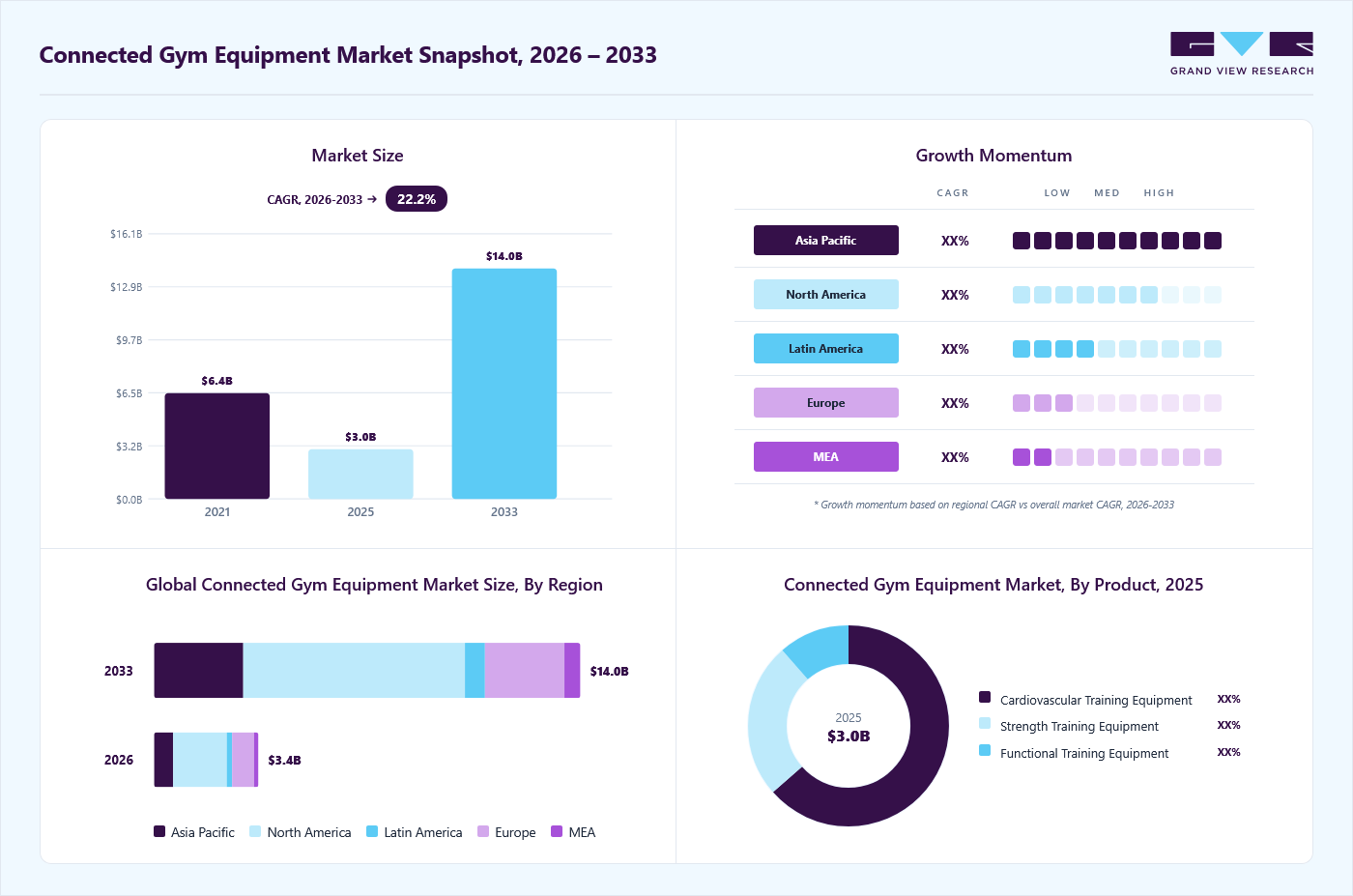
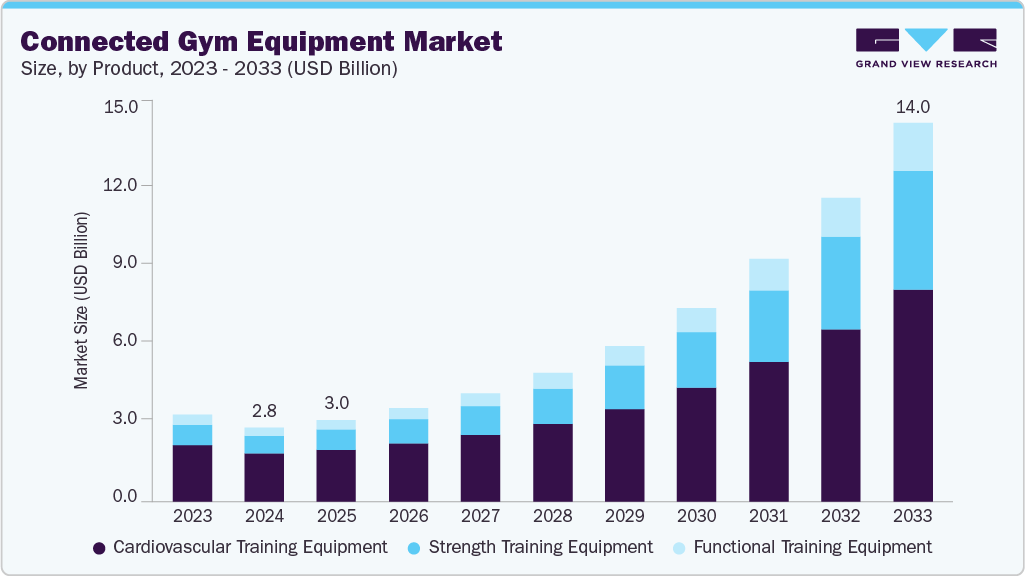
The global connected gym equipment market size was estimated at USD 3.0 billion in 2025 and is projected to grow from USD 3.4 billion in 2026 to USD 14.0 billion by 2033, growing at a CAGR of 22.2% from 2026 to 2033. North America dominated the connected gym equipment market with the largest revenue share of 51.14% in 2025 The industry is driven by rising health consciousness, accelerated home-fitness adoption post-pandemic, and advancements in technology, particularly AI/ML, IoT, and integration with wearables.
 Source: Grand View Research, IR Documents, Primary Interviews, Paid DatabasesTo learn more about this report,
 Download Free Sample Report
 Key Market Trends & Insights
- By product: Cardiovascular Training Equipment segment led the market with the largest revenue share of 63.48% in 2025
- By application: Based on applications, the Business-to-Consumer (B2C) segment led the market with the largest revenue share of 71.96% in 2025.
Regional Highlights
- Largest regional market: North America (51.14% revenue share, 2025)
- Fastest-growing regional market: Asia Pacific (highest CAGR, 2026-2033)
- By country: The U.S. held the largest market share in 2025
Market Size & Forecast
- Market size in 2025: USD 3.0 Billion
- Estimated Market size in 2026: 3.4 Billion
- Projected market size by 2033: USD 14.0 Billion
- CAGR (2026-2033): 22.2%
Three ways to get this report
Buy it, customize it, or ask a question.Ask an Analyst
Analyst response in 1 business day
- AccessReport author, directly
- Reply timeWithin 1 working day
- No sales callDirect answer only
- FormatEmail reply
- CostFree, no cost
Get the Full Report
What the study covers
- FormatsPDF · Excel · Dashboard
- Timeline2026–2033 annual, 2025 base
- Coverage20+ countries, 5 regions
- Companies10+ key players profiled
Customize the Report
20% free customization
- IncludeCountries, segments, points
- TailorTo your product definition
- ExtendDeeper competitor detail
- OrA fully bespoke study
- Turnaround5–10 working days
These innovations enable personalized, data-driven workout experiences and interactive features such as virtual and augmented reality. Subscription-based platforms, gamified workouts, and integration with corporate wellness programs enhance user engagement and retention. Rapid urbanization and increasing disposable incomes, especially in emerging markets, are fueling demand. However, barriers such as high equipment costs, data privacy concerns, and limited internet infrastructure continue to challenge widespread adoption
The growth is driven by increasing consumer demand for convenient, personalized, and engaging workout experiences. Integration of AI, IoT, and real-time tracking technologies enables users to monitor performance metrics, receive virtual coaching, and follow adaptive training programs from home or on the go. Rising health awareness, fast-paced lifestyles, and the growing popularity of hybrid fitness models are accelerating adoption. Smart cardio equipment is becoming the preferred choice across residential and commercial settings, offering scalable, interactive solutions that align with modern fitness expectations.
 To learn more about this report, Download Free Sample Report
 A key trend in this market is the rise of hyper-personalization, where fitness content and routines are tailored to individual needs using advanced analytics and biometric tracking. The convergence of fitness with entertainment, such as gamified workouts and virtual reality experiences, is making fitness more immersive and motivating.
Additionally, increasing integration with wearable devices and mobile apps is creating a seamless fitness ecosystem, allowing users to track not only physical activity but also sleep, nutrition, and stress levels. Strength training-focused connected equipment is gaining popularity alongside traditional cardio machines, reflecting evolving consumer preferences. Moreover, the adoption of connected fitness solutions is expanding beyond individual users to include corporate wellness programs, hospitality sectors, and educational institutions.
As more people embraced digital solutions for their fitness needs, the demand for connected gym equipment, which integrates with smartphones and wearable devices, has significantly surged. This trend was particularly evident in regions with high smartphone penetration and internet connectivity, such as North America, Europe, and parts of Asia. Furthermore, the heightened awareness about the importance of maintaining good health has led to an increased focus on fitness and wellness.
This shift in mindset prompted more individuals to invest in home fitness equipment that could offer personalized workout experiences. Connected fitness equipment, with its ability to provide real-time feedback and track progress, has become a popular choice for fitness enthusiasts looking to achieve their health goals from the comfort of their homes.
In addition, the integration of advanced technologies into gym equipment played a significant role in driving market growth. Innovations such as Artificial Intelligence (AI), Machine Learning (ML), and the Internet of Things (IoT) enabled the development of smart fitness equipment that could offer tailored workout programs, monitor performance, and provide insights into users’ fitness levels. For instance, AI-powered fitness equipment analyzes users’ movements and suggests adjustments to improve their form and prevent injuries.
Moreover, the increasing popularity of virtual fitness classes and online training programs contributed to the growth of the connected gym equipment market. Many fitness brands, such as CorePower Yoga and Peloton, and gyms started offering virtual classes that could be accessed through connected devices, allowing users to participate in live or on-demand workouts from anywhere.
Additionally, the growing adoption of wearable fitness technology fueled the demand for connected gym equipment. Devices such as smartwatches and fitness trackers have increasingly become essential tools for monitoring various health metrics, including heart rate, calories burned, and sleep patterns. When paired with connected gym equipment, these wearables provide a comprehensive view of users’ fitness journeys, enabling them to make data-driven decisions about their workouts and overall health. Such synergy between wearables and gym equipment created a more cohesive and engaging fitness ecosystem.
Market Dynamics
The connected gym equipment market is witnessing strong growth as consumers increasingly seek interactive, data-driven, and personalized fitness experiences. Connected gym equipment integrates internet connectivity, sensors, artificial intelligence, cloud-based analytics, and digital content platforms to provide real-time performance tracking, virtual coaching, workout personalization, and remote fitness engagement. Products such as connected treadmills, exercise bikes, rowing machines, strength training systems, and smart fitness mirrors enable users to access live and on-demand training sessions while monitoring key performance metrics. Growing health consciousness, rising adoption of home fitness solutions, increasing smartphone and wearable device penetration, and advancements in digital fitness ecosystems are expected to continue driving market expansion.
The increasing preference for home-based fitness and personalized workout experiences is a major factor driving demand for connected gym equipment. Consumers are increasingly seeking convenient fitness solutions that eliminate travel time, offer flexible workout schedules, and provide professional-quality training within home environments. Connected equipment enables users to access live instructor-led classes, AI-powered coaching, progress tracking, personalized workout recommendations, and performance analytics, enhancing engagement and exercise adherence.
The growing prevalence of obesity, cardiovascular diseases, diabetes, and other lifestyle-related health conditions has further accelerated consumer focus on regular physical activity. Additionally, rising awareness regarding preventive healthcare and wellness management is encouraging individuals to invest in long-term fitness solutions. The increasing popularity of subscription-based digital fitness platforms, integration with wearable devices, and gamified workout experiences has further strengthened the value proposition of connected gym equipment. As consumers increasingly prioritize fitness, convenience, and personalized health management, demand for smart and connected exercise equipment is expected to continue rising globally.
High initial purchase costs and recurring subscription expenses remain significant barriers to wider adoption of connected gym equipment. Advanced connected fitness products typically incorporate touchscreen displays, sensors, internet connectivity, cloud-based software, AI-driven analytics, and interactive content libraries, making them considerably more expensive than conventional fitness equipment. The premium pricing of connected treadmills, exercise bikes, rowing machines, and smart strength-training systems often limits adoption among price-sensitive consumers.
In addition to equipment costs, many manufacturers rely on recurring subscription models to provide access to live classes, personalized coaching, performance analytics, and premium content. These ongoing fees increase the total cost of ownership and may discourage long-term user retention. Economic uncertainty, inflationary pressures, and changing consumer spending patterns can further impact purchasing decisions for discretionary fitness products. Consequently, affordability concerns continue to pose challenges for market penetration, particularly in emerging economies and middle-income consumer segments.
The rapid advancement of artificial intelligence, machine learning, wearable technology, and digital health platforms is creating significant growth opportunities within the connected gym equipment market. Consumers are increasingly demanding highly personalized fitness experiences that adapt to individual goals, fitness levels, workout history, recovery status, and health metrics. AI-enabled connected equipment can analyze user performance data in real time, automatically adjust workout intensity, provide technique corrections, and generate customized training programs.
The expanding adoption of smartwatches, fitness bands, heart-rate monitors, and health-tracking applications is further enhancing ecosystem integration. Connected gym equipment can increasingly synchronize with wearable devices to deliver comprehensive insights into burned calories, heart rate variability, sleep quality, recovery status, and overall wellness performance. Furthermore, advancements in virtual reality (VR), augmented reality (AR), immersive training experiences, and hybrid fitness models that combine home workouts with digital coaching are expected to create new revenue streams for manufacturers.
Analyst Perspective
The connected gym equipment market is evolving beyond traditional fitness hardware into an integrated digital fitness ecosystem driven by recurring subscriptions, personalized coaching, and data analytics. Long-term growth will be supported by rising health consciousness, increasing home fitness adoption, and greater demand for flexible workout solutions. However, the key differentiator will not be equipment quality alone, but the ability to create a seamless ecosystem that combines connected hardware, AI-driven training, wearable integration, and engaging fitness content. Companies that successfully increase user engagement and subscription retention will be best positioned to capture value, as recurring digital revenues increasingly become more important than one-time equipment sales.
Consumer Surveys & Insights
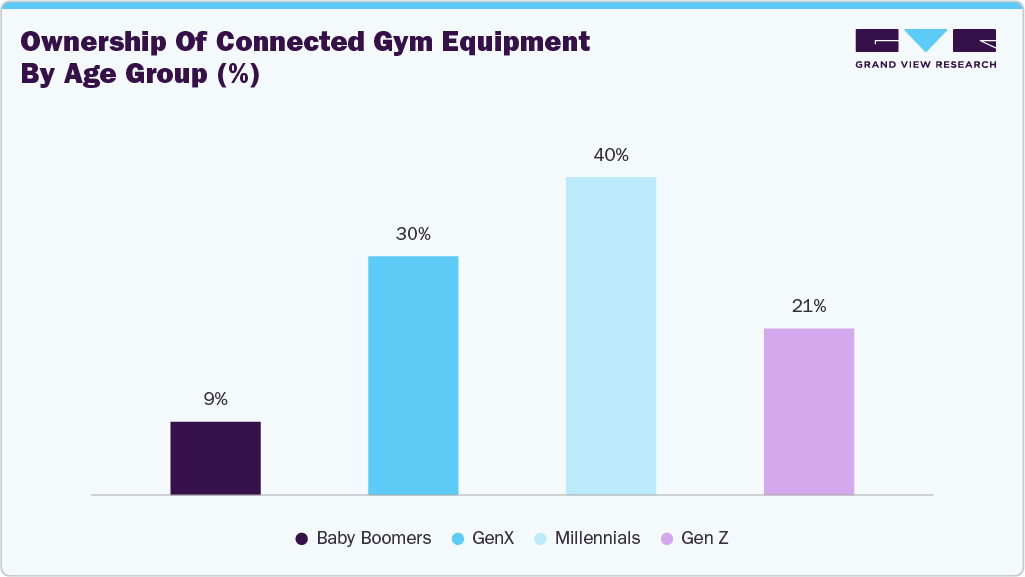
The industry demonstrates diverse age-based adoption patterns, reflecting varying health goals, digital affinity, and purchasing power across demographic cohorts. Millennials (aged 25-40 years) and Generation X (aged 41-56 years) constitute the largest consumer segments within this market. Millennials exhibit high adoption driven by their familiarity with digital technologies, prioritization of fitness and wellness as integral lifestyle components, and strong preference for personalized, data-driven workout experiences.
Generation X, meanwhile, represents a significant revenue-contributing segment, characterized by higher disposable incomes and a pronounced focus on preventive health management and convenience-driven fitness solutions. Their purchasing decisions are influenced by value propositions around holistic health monitoring, injury prevention, and flexible hybrid fitness options that integrate home workouts with gym-based programs.
 To learn more about this report, Download Free Sample Report
 The chart presents ownership of connected gym equipment across different age groups, revealing distinct generational preferences and behaviors. Millennials show the highest ownership, indicating their strong inclination toward integrating technology with wellness. This can be attributed to their higher purchasing power than younger individuals and a lifestyle prioritizing fitness and convenience.
Gen X follows closely, reflecting a balance between disposable income and growing health consciousness as they age. While they may not adopt new tech as quickly as Millennials, they value connected fitness devices' practicality and efficiency, especially for home workouts and personalized routines. Gen Z shows lower ownership levels. This could stem from limited financial resources or a preference for more social or app-based fitness solutions rather than investing in physical equipment. Baby Boomers have the lowest ownership, likely due to less familiarity with newer technologies, a lower perceived need for advanced fitness tracking, or a preference for traditional fitness methods. This generational divide highlights how income, lifestyle, tech comfort, and health priorities influence the adoption of connected fitness solutions.
Product Insights
Based on product, the Cardiovascular Training Equipment segment led the market with the largest revenue share of 63.48% in 2025 and is expected to grow at the fastest CAGR over the forecast period, primarily due to its early adoption of connectivity features and broad consumer appeal across both residential and commercial fitness environments. Equipment such as connected treadmills, stationary bikes, ellipticals, and rowing machines are widely used for weight management, cardiovascular health improvement, endurance training, and general fitness maintenance, making them the most frequently utilized fitness machines globally. Moreover, cardiovascular equipment is highly compatible with digital fitness ecosystems, enabling real-time performance tracking, heart-rate monitoring, live and on-demand classes, virtual coaching, leaderboards, and subscription-based content services. Leading connected fitness brands have largely focused their technological innovations on cardio equipment, further strengthening consumer adoption.
Application Insights
Based on applications, the Business-to-Consumer (B2C) segment led the market with the largest revenue share of 71.96% in 2025, driven by the rapid expansion of home fitness adoption and growing consumer preference for personalized workout experiences. Advances in internet connectivity, mobile applications, wearable integration, and digital fitness content have enabled consumers to access professional-grade training directly from their homes.
 To learn more about this report, Download Free Sample Report
 The shift toward flexible workout schedules, convenience, and privacy has accelerated purchases of connected treadmills, exercise bikes, rowing machines, smart strength-training systems, and fitness mirrors among individual users. Furthermore, subscription-based fitness platforms offering live classes, AI-powered coaching, progress tracking, and customized training programs have significantly enhanced the value proposition of connected equipment for consumers.
Regional Insights
North America dominated the connected gym equipment market with the largest revenue share of 51.14% in 2025. North America Market is driven by high consumer spending on fitness and wellness, widespread adoption of connected technologies, and the strong presence of leading industry players such as Peloton, iFIT, and Echelon. The region benefits from advanced digital infrastructure, high broadband penetration, and widespread use of wearable fitness devices, which facilitate seamless integration with connected fitness equipment. Additionally, growing awareness of preventive healthcare, increasing obesity rates, and the popularity of subscription-based fitness platforms have accelerated demand for smart treadmills, exercise bikes, rowing machines, and strength-training systems. The mature fitness culture across both residential and commercial segments continues to support market leadership in the region.
 To learn more about this report, Download Free Sample Report
 According to the survey, more than 80% of U.S. consumers now view wellness as a priority in their daily lives. The mindset around fitness is evolving, from an intense, performance-driven approach to one that emphasizes mindfulness and overall well-being. Virtual fitness participation in Canada has seen a dramatic rise, with around 4.5 million Canadians now regularly engaging with digital fitness platforms, a 300% jump compared to pre-2020 figures. Research shows that 65% of fitness enthusiasts in Canada intend to continue with a hybrid model, blending virtual and in-person workouts. Additionally, corporate wellness is becoming a key growth driver, as 72% of Canadian employers now provide digital wellness benefits as part of their employee health initiatives.
U.S. Connected Gym Equipment Market Trends
The connected gym equipment market in the U.S. held the largest share of about 81.17% in the North America region in 2025, supported by its large fitness-conscious population, strong purchasing power, and early adoption of digital fitness technologies. The country has emerged as a key hub for connected fitness innovation, with consumers increasingly investing in premium home fitness solutions that offer personalized coaching, live and on-demand classes, and AI-driven workout recommendations. The growing integration of fitness equipment with wearables, health-tracking applications, and subscription-based content platforms has further strengthened market demand. Moreover, the increasing focus on preventive health management and the expansion of hybrid fitness models combining home workouts with digital engagement continue to drive growth across the U.S. connected gym equipment market.
Asia Pacific Connected Gym Equipment Market Trends
The connected gym equipment market in Asia Pacific is experiencing robust growth, driven by rising health consciousness, urbanization, and increasing penetration of smart technologies. The region is witnessing a surge in demand for home-based fitness solutions, largely accelerated by the COVID-19 pandemic, which shifted consumer behavior toward digital health and wellness alternatives. With an expanding middle class and growing internet access, countries in the Asia Pacific are embracing connected fitness as both a lifestyle upgrade and a health necessity. The market is also supported by increased investments in fitness startups, digital infrastructure, and health-tech innovations.
In China, connected fitness has become a booming industry. Brands like Keep and Xiaomi have gained significant traction with affordable smart fitness equipment and app-based platforms offering AI coaching and virtual classes. For instance, according to the General Admission of Sport of China, Keep (fitness app), saw a remarkable increase in revenue during the first quarter of 2022.
Europe Connected Gym Equipment Market Trends
The connected gym equipment market in Europe is evolving rapidly, with consumers increasingly embracing hybrid models that combine in-person gym experiences with virtual training. Post-pandemic recovery in markets like the UK and Germany has accelerated this trend, prompting many gym operators to bundle memberships with digital content. Simultaneously, virtual fitness has become a core component of corporate wellness programs, particularly in sectors such as technology, finance, and government, where employers are offering virtual coaching, app subscriptions, and group challenges.
The adoption of wearables, such as smartwatches and fitness bands, continues to rise, often integrated with smart home equipment like connected bikes, mirrors, and strength systems for real-time feedback and personalized training. At the same time, there is growing consumer demand for holistic wellness platforms that integrate physical fitness with mental health, nutrition, and sleep tracking, particularly among younger, urban users.
Key Connected Gym Equipment Companies Insights
Key players operating in the connected gym equipment market are undertaking various initiatives to strengthen their presence and increase the reach of their products and services. Strategies such as expansion activities and partnerships are key in propelling the market growth.
-
Peloton Interactive Inc. is a dominant player in the connected gym equipment space, known for its high-end indoor cycling bikes and treadmills. Based in New York, Peloton has achieved significant popularity by offering a subscription-based model that integrates live and on-demand fitness classes with its equipment. The company has diversified its product portfolio, adding new devices such as the Peloton Guide for strength training and expanding its digital presence with Peloton App access for users without Peloton hardware. Peloton’s global reach spans North America, Europe, and Asia, capitalizing on the growing trend of home fitness and digital engagement.
-
NordicTrack (ICON Health & Fitness, Inc.) is another key player, recognized for its range of connected gym equipment, including smart treadmills, ellipticals, and strength training devices. Headquartered in Logan, Utah, NordicTrack has incorporated cutting-edge technology into its products, offering interactive training programs and real-time performance tracking. The company has built a loyal customer base by blending innovative design with integrated digital content, attracting both retail and online consumers. NordicTrack's global distribution network strengthens its position in the market, particularly as consumers seek versatile and technology-driven fitness solutions.
Key Connected Gym Equipment Companies:
The following are the leading companies in the connected gym equipment market. These companies collectively hold the largest market share and dictate industry trends.
- Peloton Interactive Inc.
- iFIT Health & Fitness
- Technogym S.p.A.
- Life Fitness
- Tonal Systems, Inc.
- EGYM GmbH
- Precor Incorporated
- Ergatta, Inc.
- Echelon Fitness Multimedia LLC
- Johnson Health Tech Co., Ltd.
Competitive Benchmarking
Category
Operating Strategies
Competitive Edge
Weakness
Established Players (Peloton Interactive Inc., iFIT Health & Fitness, Technogym S.p.A., Life Fitness, Johnson Health Tech Co., Ltd., Precor Incorporated)
- Expand connected fitness ecosystems through integrated hardware, digital content subscriptions, wearable connectivity, and strategic partnerships with gyms, hotels, corporate wellness programs, and healthcare organizations.
- Invest in AI-powered coaching, immersive training experiences, cloud-based performance analytics, and international market expansion.
- Strong brand recognition, extensive distribution networks, and large installed equipment bases.
- Established subscription platforms, broad product portfolios across both residential and commercial segments, and significant R&D capabilities.
- High manufacturing, content development, and customer acquisition costs.
- Greater exposure to supply-chain disruptions and slower product innovation cycles due to larger organizational structures and legacy product lines.
Emerging Players (Tonal Systems, Inc., EGYM GmbH, Ergatta, Inc., Echelon Fitness Multimedia LLC)
- Focus on specialized connected fitness niches such as smart strength training, gamified fitness experiences, digital coaching platforms, and AI-driven personalized workout solutions.
- Leverage direct-to-consumer sales channels, subscription-based business models, community engagement, and technology-led differentiation strategies.
- Faster innovation cycles and ability to introduce disruptive fitness technologies tailored to evolving consumer preferences.
- Agile product development, highly personalized user experiences, and strong focus on software-driven fitness ecosystems.
- Limited financial resources compared to larger incumbents and challenges in scaling manufacturing and global distribution operations.
- Lower brand awareness, smaller customer bases, and greater dependence on external funding to support long-term growth and market expansion.
Recent Developments
-
In October 2025, Peloton Interactive expanded its global footprint with the launch of its inaugural fitness technology showcase in Dubai, UAE. The event, held at the Dubai Opera House, focused on introducing Peloton’s connected gym equipment to the Middle Eastern market. Scheduled for October 15-17, the showcase featured Peloton's latest smart treadmills, cycling bikes, and strength training products, accompanied by live and on-demand fitness classes. In collaboration with the Dubai Tourism Authority, this event reinforces Peloton's commitment to expanding its presence in the growing fitness market in the Middle East, aligning with the region's increasing focus on health and wellness. The initiative also supports Dubai’s vision as a global wellness hub, attracting fitness enthusiasts and reinforcing Peloton's position as a leader in the connected fitness space.
-
In May 2025, NordicTrack collaborated with the International Olympic Committee (IOC) to launch a new line of Olympic-themed connected gym equipment. The collection includes a series of smart ellipticals, treadmills, and rowing machines, each featuring official Olympic branding and digital workouts inspired by Olympic athletes. The launch took place at the 2025 Summer Olympics in Paris, where NordicTrack hosted a special event to showcase the new line at the Olympic Village. This collaboration enhances NordicTrack’s product range by tying it to the prestige of the Olympic Games, allowing users to engage with elite-level training experiences from home. The initiative strengthens NordicTrack's global brand presence and connects fitness technology with the spirit of athletic achievement, tapping into the worldwide Olympic fan base.
Connected Gym Equipment Market Report Scope
Report Attribute
Details
Market size in 2025
USD 3.0 billion
Estimated Market size in 2026
USD 3.4 billion
Projected market size by 2033
USD 14.0 billion
Growth rate
CAGR of 22.2% from 2026 to 2033
Base year for estimation
2025
Historical data
2021 - 2024
Forecast period
2026 - 2033
Quantitative units
Revenue in USD million/billion and CAGR from 2026 to 2033
Report coverage
Revenue forecast, company ranking, competitive landscape, growth factors, and trends
Segments covered
Product, Application, region
Regional scope
North America; Europe; Asia Pacific; Latin America; MEA
Country scope
U.S.; Canada; Mexico; Germany; UK; France; Italy; Spain; Rest of Europe; China; Japan; India; South Korea; Australia & New Zealand; Rest of Asia Pacific; Brazil; Rest of Latin America; Saudi Arabia; South Africa; Rest of Middle East & Africa
Key companies profiled
Peloton Interactive Inc.; iFIT Health & Fitness; Technogym S.p.A.; Life Fitness; Tonal Systems, Inc.; EGYM GmbH; Precor Incorporated; Ergatta, Inc.; Echelon Fitness Multimedia LLC; Johnson Health Tech Co., Ltd.
Customization scope
Free report customization (equivalent up to 8 analysts' working days) with purchase. Addition or alteration to country, regional & segment scope.
Pricing and purchase options
Avail customized purchase options to meet your exact research needs. Explore purchase options
Global Connected Gym Equipment Market Report Segmentation
This report forecasts revenue growth at the global, regional, and country levels and provides an analysis of the latest industry trends and opportunities in each of the sub-segments from 2021 to 2033. For this study, Grand View Research has segmented the global connected gym equipment market report based on product, application, and region:
 To learn more about this report, Download Free Sample Report
 -
Product Outlook (Revenue, USD Million, 2021 - 2033)
-
Cardiovascular Training Equipment
-
Smart Treadmills
-
Smart Bikes
-
Connected Rowers
-
Others (Elliptical Trainers, Stair Climbers, etc.)
-
-
Strength Training Equipment
-
Functional Training Equipment
-
-
Application Outlook (Revenue, USD Million, 2021 - 2033)
-
Business-to-Consumer (B2C)
-
Business-to-Business (B2B)
-
-
Regional Outlook (Revenue, USD Million, 2021 - 2033)
-
North America
-
U.S.
-
Canada
-
Mexico
-
-
Europe
-
UK
-
Germany
-
France
-
Italy
-
Spain
-
-
Asia Pacific
-
Japan
-
China
-
India
-
-
Central & South America
-
Brazil
-
Argentina
-
-
Middle East & Africa
-
South Africa
-
Saudi Arabia
-
-
Research Methodology
Segment Definition
Segment - Product
Revenue capture definition
Cardiovascular Training Equipment
The scope covers connected cardiovascular fitness equipment equipped with internet connectivity, sensors, software platforms, and data-tracking capabilities. Included are smart treadmills, exercise bikes, elliptical trainers, rowing machines, stair climbers, and similar endurance-training equipment. The study encompasses performance monitoring, workout data synchronization, cloud connectivity, mobile application integration, virtual training features, and connected fitness ecosystems across residential and commercial installations.
Strength Training Equipment
The scope includes connected strength-training equipment integrated with digital technologies for tracking workouts, resistance levels, user performance, and exercise progression. Covered products include smart weight machines, connected resistance systems, cable machines, selectorized equipment, and digitally enabled strength-training stations. The study also includes software integration, user analytics, cloud-based performance management, wearable connectivity, and interactive coaching functionalities incorporated within strength-training solutions.
Functional Training Equipment
The scope covers connected functional fitness equipment designed for mobility, flexibility, balance, coordination, and full-body training activities. Included are smart functional trainers, connected fitness stations, sensor-enabled training rigs, interactive bodyweight training systems, and digitally integrated suspension-training equipment. The study encompasses motion tracking, exercise guidance technologies, performance analytics, application connectivity, cloud-based training platforms, and interactive workout experiences across various end-use environments.
Segment - Application
Revenue capture definition
Business to Consumer (B2B)
The scope includes connected gym equipment acquired directly by individual consumers for personal fitness and wellness purposes. Covered products are installed in homes, residential gyms, and private workout spaces and feature connectivity with mobile applications, virtual fitness platforms, wearable devices, and subscription-based content services. The study includes revenues generated through direct sales, online retail channels, and consumer-focused connected fitness ecosystems.
Business to Business (B2C)
The scope covers connected gym equipment supplied to commercial and institutional organizations for use by multiple users. Included are deployments across fitness clubs, health centers, hotels, corporate wellness facilities, educational institutions, sports training centers, and healthcare establishments. The study encompasses network-connected equipment, centralized monitoring systems, member management integration, enterprise wellness platforms, commercial procurement contracts, leasing models, and managed fitness solutions.
Estimation Model
Fitness-Active Population Layer
Technology Readiness Layer
Connected Fitness Adoption Layer
Monetisation Layer
Who has a relevant fitness need?
Who has access to connected ecosystems?
Who actively uses connected fitness solutions?
How much revenue is generated?
Identified the addressable population by analyzing the global adult population participating in fitness activities, gym memberships, home workouts, weight management programs, endurance training, and preventive health initiatives to define the potential user base for connected fitness equipment.
Filtered the exercise-active population using digital infrastructure indicators such as internet connectivity, smartphone penetration, wearable ownership, and smart home technology adoption to determine the technologically accessible market.
Applied adoption rates for connected fitness equipment, digital workout platforms, virtual training programs, fitness subscriptions, and wearable-integrated exercise solutions to convert the digitally reachable population into active connected fitness users.
Combined hardware sales, software subscriptions, premium content memberships, virtual coaching services, and commercial facility deployments to calculate the total addressable revenue opportunity within the connected gym equipment market.
Delivered Customizations
This report has been delivered with the following In-depth customizations
CLIENT REQUEST
CUSTOMIZATION DELIVERED
VALUE ADDS
Connected Cardio Equipment Adoption & Usage Trends
Conducted a focused assessment of connected cardiovascular equipment including smart treadmills, exercise bikes, rowing machines, ellipticals, and their adoption across residential and commercial fitness environments. Evaluated factors such as digital content integration, subscription-based fitness platforms, virtual coaching, and user engagement patterns.
Helps stakeholders identify the highest-demand equipment categories, evaluate consumer workout preferences, and prioritize product development and investment opportunities within the connected fitness ecosystem.
Home Fitness & Consumer Behavior Analysis
Evaluated consumer adoption trends for home-based connected fitness equipment, including purchasing behavior, workout frequency, subscription utilization, wearable integration, and demand for personalized training experiences. Assessed the impact of convenience, health awareness, and digital fitness engagement on equipment adoption.
Provides insights into evolving consumer preferences, supports customer acquisition strategies, and helps manufacturers optimize product positioning, pricing models, and user retention initiatives.
Connected Fitness Technology & Smart Gym Opportunity Assessment
Assessed growth opportunities across AI-powered fitness equipment, cloud-connected training platforms, wearable device integration, performance analytics, virtual coaching, and hybrid fitness models. Evaluated technology adoption barriers, interoperability requirements, and future innovation potential within connected fitness ecosystems.
Supports strategic expansion and innovation planning by identifying emerging technology trends, high-growth investment areas, and long-term opportunities in digitally enabled fitness and wellness solutions.
Frequently Asked Questions About This Report
The global connected gym equipment market size was estimated at USD 3.0 billion in 2025 and is expected to reach USD 3.4 billion in 2026.
The global connected gym equipment market is projected to grow at a CAGR of 22.2% from 2026 to 2033, reaching USD 14.0 million by 2033.
Some key players operating in the global connected gym equipment market include Peloton Interactive Inc., iFIT Health & Fitness, Technogym S.p.A., Life Fitness, Tonal Systems, Inc., EGYM GmbH, Precor Incorporated, Ergatta, Inc., Echelon Fitness Multimedia LLC, and Johnson Health Tech Co., Ltd., among others.
Key factors include increasing adoption of digital fitness solutions, rising demand for personalized workout experiences, growing integration of IoT and AI technologies in fitness equipment, expanding health awareness, and increasing popularity of home-based fitness ecosystems.
Asia Pacific is the fastest-growing region over the forecast period.
The cardiovascular training equipment segment led the market with a 63.48% revenue share in 2025, while strength training equipment is projected to be the fastest-growing segment.
The Business-to-Consumer (B2C) segment held the largest revenue share in 2025, while the home consumer segment is expected to witness the fastest growth during the forecast period.
Smart Treadmills hold the largest share under cardiovascular training equipment in 2025 and is expected to remain the dominant segment throughout the forecast period.
The North America region dominated the global connected gym equipment market, accounting for a 51.14% share in 2025. This is attributable to the rapid development of the health and fitness industry in the U.S., with the highest number of health clubs and memberships.
About the Author(s)
Homecare & Decor Research Team
Consumer Goods · Homecare & DecorThis report was authored by the homecare & decor research team at Grand View Research - comprising two research analysts, one senior research analyst, and one industry expert - with specialized expertise in the homecare & decor segment of the consumer goods industry. All findings are based on proprietary consumer goods databases, executive interviews, and regulatory analysis, subject to internal peer review prior to publication.
Last Updated:
Speak to Analyst

Customize this report to your needs - add regions, segments, or data points, with 20% free customization.
Or view our licence options:


ISO 9001:2015 & 27001:2022 Certified
We are GDPR and CCPA compliant! Your transaction & personal information is safe and secure. For more details, please read our privacy policy.


