
- Home
- »
- Advanced Interior Materials
- »
-
Plastic-to-Fiber Recycling Market Size Report, 2026-2033GVR Report cover

Plastic-to-Fiber Recycling Market (2026 - 2033)
Size, Share & Trends Analysis Report By Plastic Type (PET, PP, PE), By Fiber Type (Staple Fibers, Filament Fibers), By Application (Apparel, Home Textiles), By Region, And Segment Forecasts
Market Size, 2025
$10.5BMarket Estimate, 2026
$11.3BMarket Forecast, 2033
$18.5BCAGR, 2026–2033
7.3%Plastic-to-Fiber Recycling Market Summary
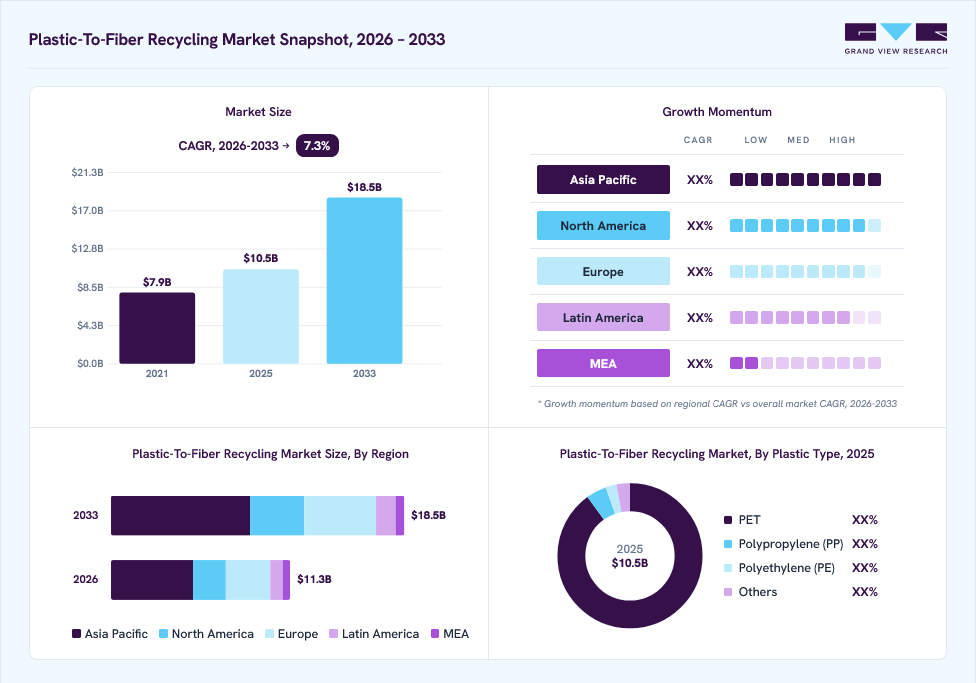
The global plastic-to-fiber recycling market size was valued at USD 10.5 billion in 2025 and is projected to grow from USD 11.3 billion in 2026 to USD 18.5 billion by 2033, at a CAGR of 7.3% from 2026 to 2033. Asia Pacific dominated the market, accounting for a revenue share of 45.6% in 2025. The market is gaining importance as textile manufacturers, apparel brands, and plastic recyclers seek alternatives to virgin fossil-based synthetic fibers.
 Source: Grand View Research, IR Documents, Primary Interviews, Paid DatabasesTo learn more about this report,
 Download Free Sample Report
 Key Market Trends & Insights
- By application: The apparel textiles segment held the largest market share of 52.4% in 2025.
- By fiber type: The staple fibers segment dominated the market with a revenue share of 63.0% in 2025.
- By plastic type: The PET segment held the highest revenue share of 89.9% in 2025.
Regional Highlights
- Largest regional market: Asia Pacific (45.6% revenue share, 2025)
- By country: China held the largest market share in 2025
Market Size & Forecast
- Market size in 2025: USD 10.5 Billion
- Estimated market size in 2026: USD 11.3 Billion
- Projected market size by 2033: USD 18.5 Billion
- CAGR (2026-2033): 7.3%
Three ways to get this report
Buy it, customize it, or ask a question.Ask an Analyst
A direct answer, usually in 1 working day
- AccessReport author, directly
- Reply timeWithin 1 working day
- No sales callDirect answer only
- FormatEmail reply
- CostFree, no cost
Get the Full Report
What the study covers
- FormatsPDF · Excel · Dashboard
- Timeline2026–2033 annual, 2025 base
- Coverage20+ countries, 5 regions
- Companies10+ key players profiled
Customize the Report
20% free customization
- IncludeCountries, segments, points
- TailorTo your product definition
- ExtendDeeper competitor detail
- OrA fully bespoke study
- Turnaround5–10 working days
The market primarily converts post-consumer and post-industrial plastic waste, particularly polyethylene terephthalate (PET), into recycled polyester fibers, filaments, yarns, and nonwoven materials. Rising demand for recycled-content textiles and increasing emphasis on circular material flows are encouraging investment across collection, sorting, processing, and fiber manufacturing.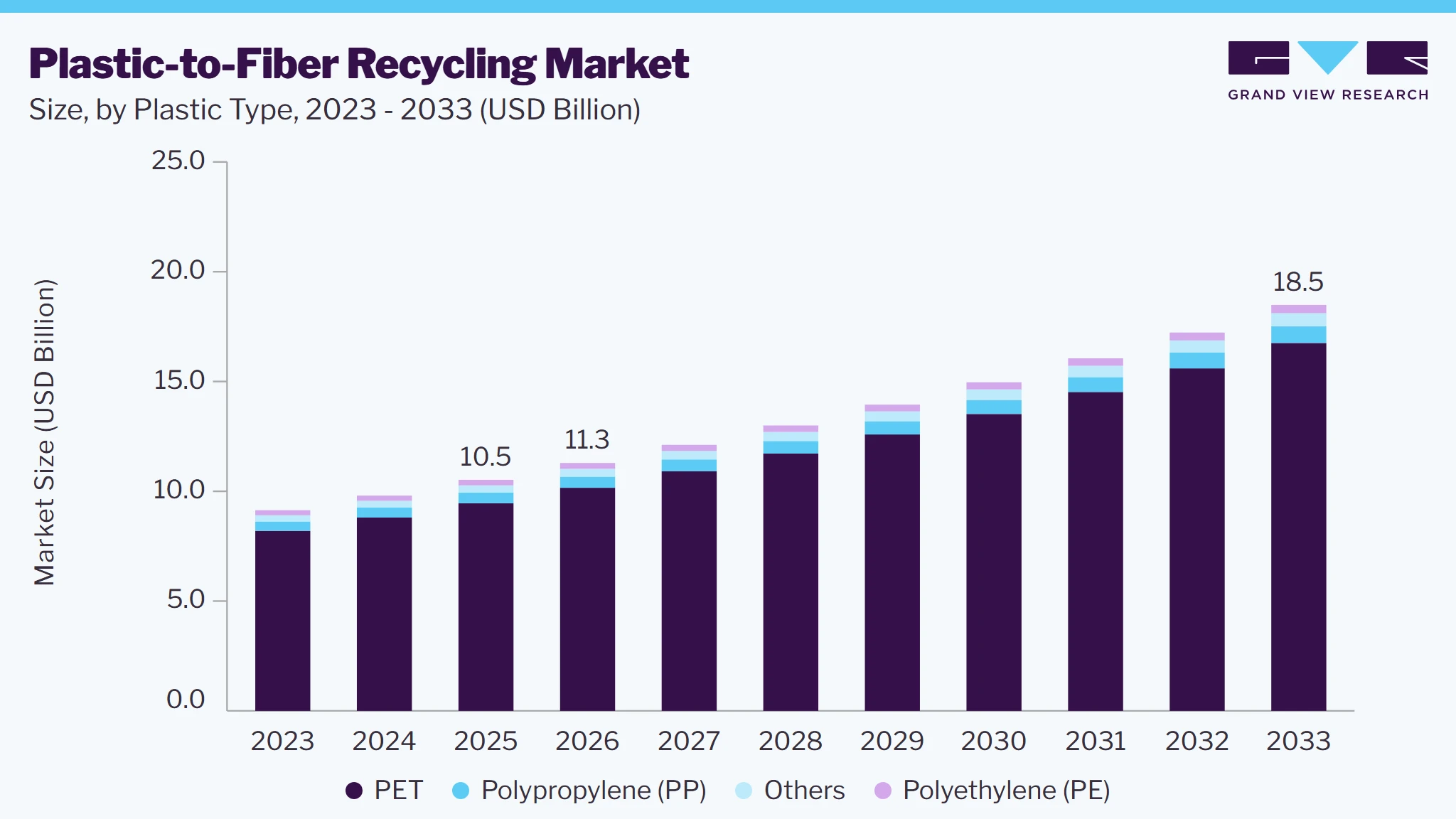 To learn more about this report, Download Free Sample Report
 Growing concerns regarding plastic pollution and textile waste are strengthening demand for technologies that can connect the plastics and textile value chains. Mechanical recycling remains the most established route, involving sorting, washing, shredding, melting, extrusion, and spinning of PET into fibers. However, feedstock quality, contamination, polymer degradation, and competition for high-quality PET waste are creating pressure for more advanced processing technologies. Consequently, recyclers and fiber producers are increasingly evaluating chemical recycling, depolymerization, solvent-based processes, and other technologies capable of producing higher-quality recycled feedstocks.
Technology development is shifting the market from conventional bottle-to-fiber recycling toward broader plastic-to-fiber and textile-to-textile circularity. Mechanical PET recycling continues to provide commercially established recycled polyester, while chemical recycling is being developed to overcome limitations associated with contaminated, blended, or degraded feedstocks. Technologies such as glycolysis, hydrolysis, methanolysis, enzymatic processing, dissolution, advanced sorting, and improved polymer purification are expanding the potential feedstock base.
Market Dynamics
The market is shaped by the transition from linear plastic and textile production toward circular material systems. Demand from apparel, home textiles, automotive textiles, footwear, and industrial applications is encouraging manufacturers to incorporate recycled fibers into their products. At the same time, feedstock availability, processing economics, quality requirements, recycling technology maturity, and regulatory pressure determine the commercial attractiveness of different recycling pathways. The market is gradually moving from conventional PET bottle recycling toward diversified plastic and textile waste feedstocks.
The growing adoption of recycled polyester by apparel and textile manufacturers is a major market driver. Brands are increasingly incorporating recycled fibers into clothing, sportswear, footwear, home textiles, and other products as part of their sustainability strategies. Recycled PET provides an established alternative to virgin polyester because the polymer can be converted into textile-grade fibers through established recycling and extrusion infrastructure. Textile Exchange identifies recycled polyester as an important pathway for reducing dependence on virgin fossil-based polyester.
Increasing pressure to reduce plastic waste is also creating opportunities to connect plastic collection systems with textile manufacturing. PET bottles, packaging waste, and other suitable plastic streams can be collected, sorted, processed, and converted into flakes, pellets, filament, or staple fiber. This creates an integrated value chain involving waste-management companies, recyclers, polymer processors, fiber producers, yarn manufacturers, textile mills, brands, and retailers. The established commercial infrastructure for PET recycling provides a foundation for further expansion of plastic-to-fiber applications.
Feedstock quality remains a major constraint because contamination, additives, dyes, multilayer materials, and polymer blends can reduce recycling efficiency and affect the quality of recycled fibers. Mechanical recycling is particularly dependent on relatively clean and consistent feedstock, while mixed or contaminated materials can require additional sorting and purification. Repeated thermal and mechanical processing can also affect polymer properties, making it difficult to consistently achieve virgin-like fiber performance without blending recycled material with virgin inputs.
Chemical recycling represents a significant opportunity because it can potentially expand the range of plastic and textile waste that can be converted into high-quality fiber feedstock. Depolymerization technologies can break PET into chemical building blocks that can subsequently be purified and converted back into polymer, potentially enabling recycled fibers with properties closer to virgin materials. Other approaches, including enzymatic recycling and solvent-based separation, could improve the processing of difficult or blended waste streams. These technologies are particularly relevant as the industry moves toward textile-to-textile recycling and closed-loop systems.
Market Concentration & Characteristics
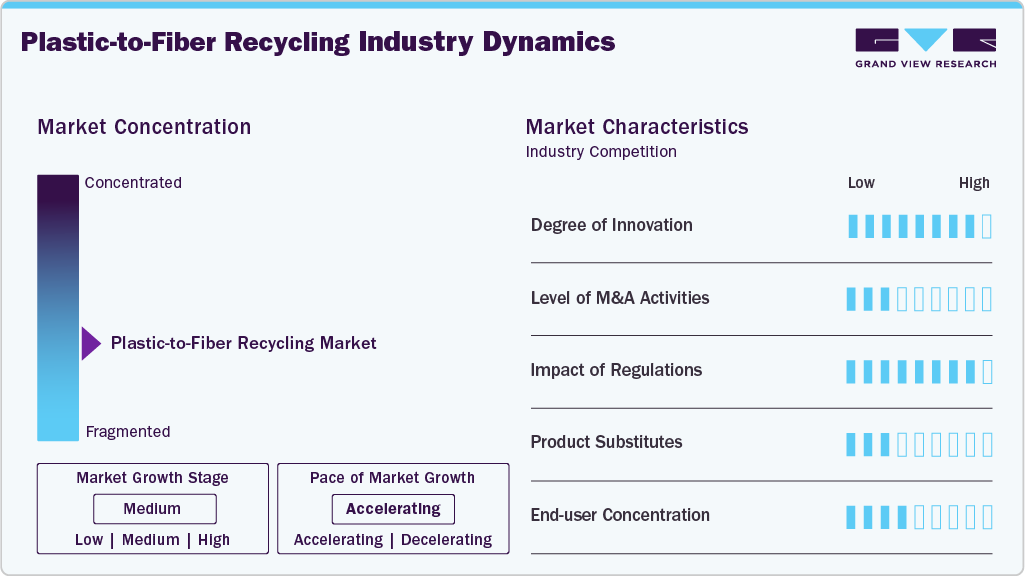
The market is moderately fragmented, with established polyester manufacturers and vertically integrated textile companies operating alongside specialized recyclers, waste-management companies, technology developers, and emerging chemical-recycling companies. Mechanical PET-to-fiber production is relatively mature and has established players and supply chains, while advanced chemical recycling remains more dispersed across technology developers and pilot-to-commercial-scale projects. Market consolidation is expected to increase as companies secure feedstock, develop proprietary recycling technologies, establish fiber-production capacity, and form partnerships across the plastics and textile value chains.
 To learn more about this report, Download Free Sample Report
 The threat of substitutes is moderate because plastic-to-fiber recycled polyester competes with virgin polyester, recycled fibers derived directly from textile waste, recycled nylon, regenerated cellulosic fibers, bio-based fibers, and other preferred-material alternatives. Virgin polyester remains an important competing material because of its established availability, performance, and manufacturing infrastructure. However, increasing regulatory and brand-level sustainability requirements are reducing the long-term attractiveness of virgin fossil-based fibers, while textile-to-textile recycling is emerging as a direct alternative to bottle-derived recycled polyester.
Analyst Perspective
The market is expected to transition from a predominantly PET bottle-to-fiber model toward a broader circular plastics-to-textiles ecosystem, supported by rising demand for recycled polyester, stricter sustainability requirements, and increasing pressure to divert plastic waste from landfills and incineration. Mechanical recycling is likely to remain the dominant pathway in the near term due to established infrastructure and commercial scalability, while chemical recycling and advanced depolymerization technologies are expected to gain traction for contaminated, blended, and difficult-to-recycle feedstocks. From an industry perspective, feedstock security, recycled-fiber quality, traceability, recycling yield, and cost competitiveness with virgin polyester will remain the key determinants of market success.
Plastic Type Insights
The PET segment held the highest revenue share of 89.9% in 2025, supported by the widespread availability of post-consumer PET bottles and packaging waste and the well-established infrastructure for collecting, sorting, washing, and processing PET into recycled polyester. PET also benefits from strong demand from apparel and textile manufacturers seeking recycled polyester fibers as an alternative to virgin polyester. The maturity of mechanical PET recycling, combined with established relationships among recyclers, fiber producers, and global apparel brands, continues to strengthen PET's dominance in the market.
The polypropylene (PP) segment is expected to grow at a CAGR of 5.9% over the forecast period, as recycling technologies increasingly enable the conversion of PP waste into fiber-grade materials. Growing volumes of PP packaging, industrial materials, nonwoven products, and textile waste are creating opportunities to expand the feedstock base beyond PET. Improvements in sorting, purification, extrusion, and fiber-spinning technologies are supporting the development of recycled PP fibers for applications including automotive, industrial, and technical textiles. Increasing demand for recycled-content materials and efforts to diversify plastic feedstocks are expected to further support the segment.
Fiber Type Insights
The staple fibers segment held the highest revenue share of 63.0% in 2025, driven by the extensive use of recycled polyester staple fibers across apparel, home textiles, nonwovens, furnishings, and industrial applications. Recycled staple fibers can be blended with other fibers and processed through conventional textile manufacturing systems, making them commercially attractive to manufacturers seeking to incorporate recycled plastic content. Established mechanical recycling processes and broad downstream applications have supported the widespread adoption of recycled staple fibers, particularly those produced from PET waste.
The filament fibers segment is expected to grow at a CAGR of 7.7% over the forecast period, as textile manufacturers increasingly demand recycled fibers that can deliver higher performance, consistency, and aesthetic characteristics for apparel and technical applications. Recycled filament yarns are particularly relevant to sportswear, activewear, fashion textiles, and premium applications where smoothness, strength, and continuous yarn characteristics are important. Advances in polymer purification, melt processing, and spinning are improving the quality of recycled filament fibers, while increasing brand commitments to recycled materials are creating additional opportunities for their adoption.
Application Insights
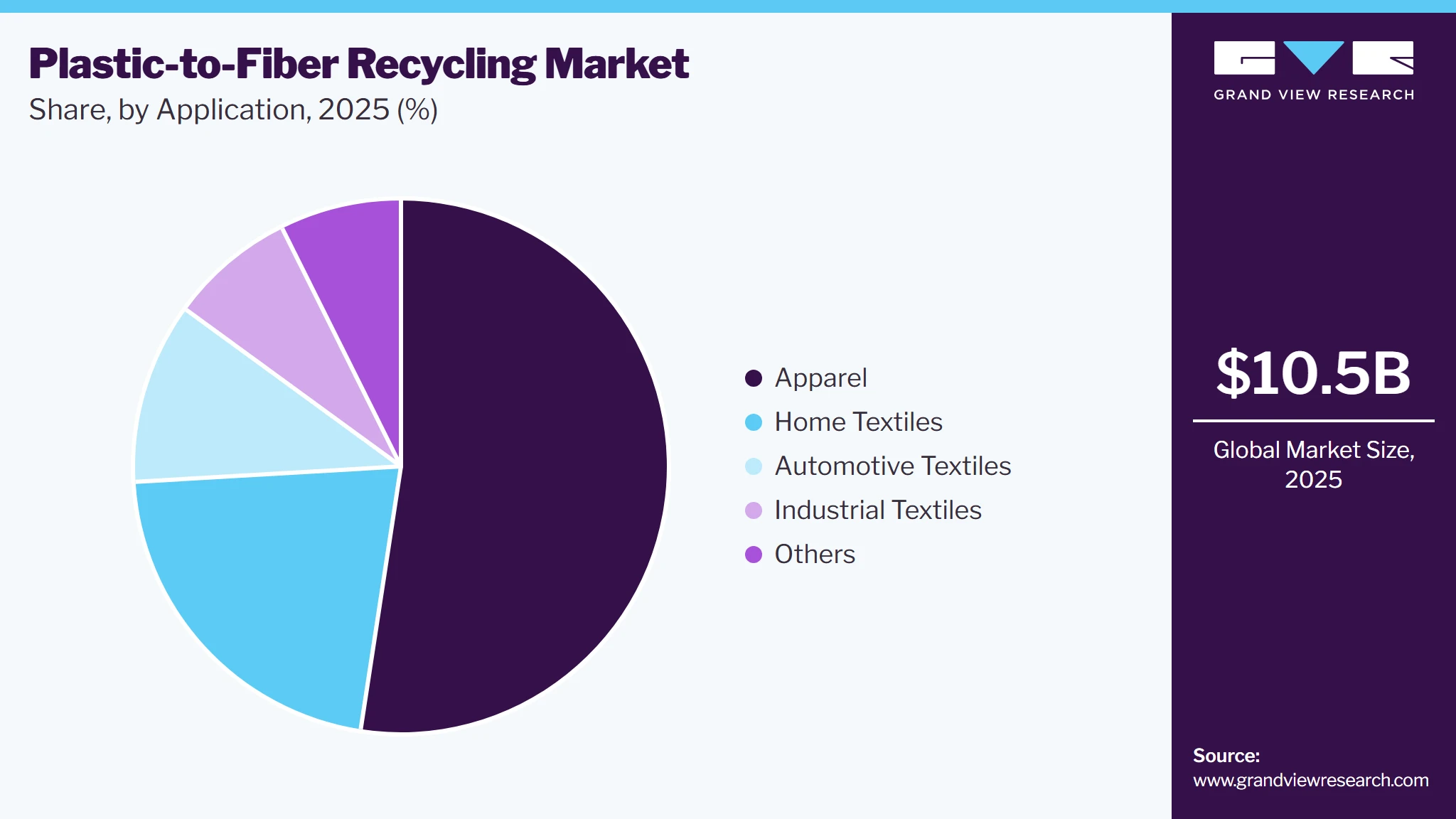
The apparel segment held the highest revenue market share of 52.4% in 2025, due to the extensive adoption of recycled polyester fibers in clothing, sportswear, activewear, outerwear, and other garment categories. Major apparel brands increasingly incorporate recycled synthetic fibers into product collections to reduce reliance on virgin fossil-based materials and meet sustainability objectives. The established supply chain from PET collection and recycling to polyester fiber and yarn production further supports the use of recycled fibers in apparel. Growing consumer awareness and sustainability commitments across the fashion industry continue to reinforce demand.
 To learn more about this report, Download Free Sample Report
 The automotive textiles segment is expected to grow at a CAGR of 8.1% over the forecast period, as vehicle manufacturers increasingly incorporate recycled materials into interior and technical textile components. Recycled polyester and other plastic-derived fibers can be used in carpets, seat fabrics, headliners, trunk liners, insulation, and other interior applications, where durability and material performance are important. Increasing emphasis on vehicle lightweighting, recycled content, circular material use, and lower environmental impact is encouraging automotive manufacturers and suppliers to expand the use of recycled synthetic fibers.
Regional Insights
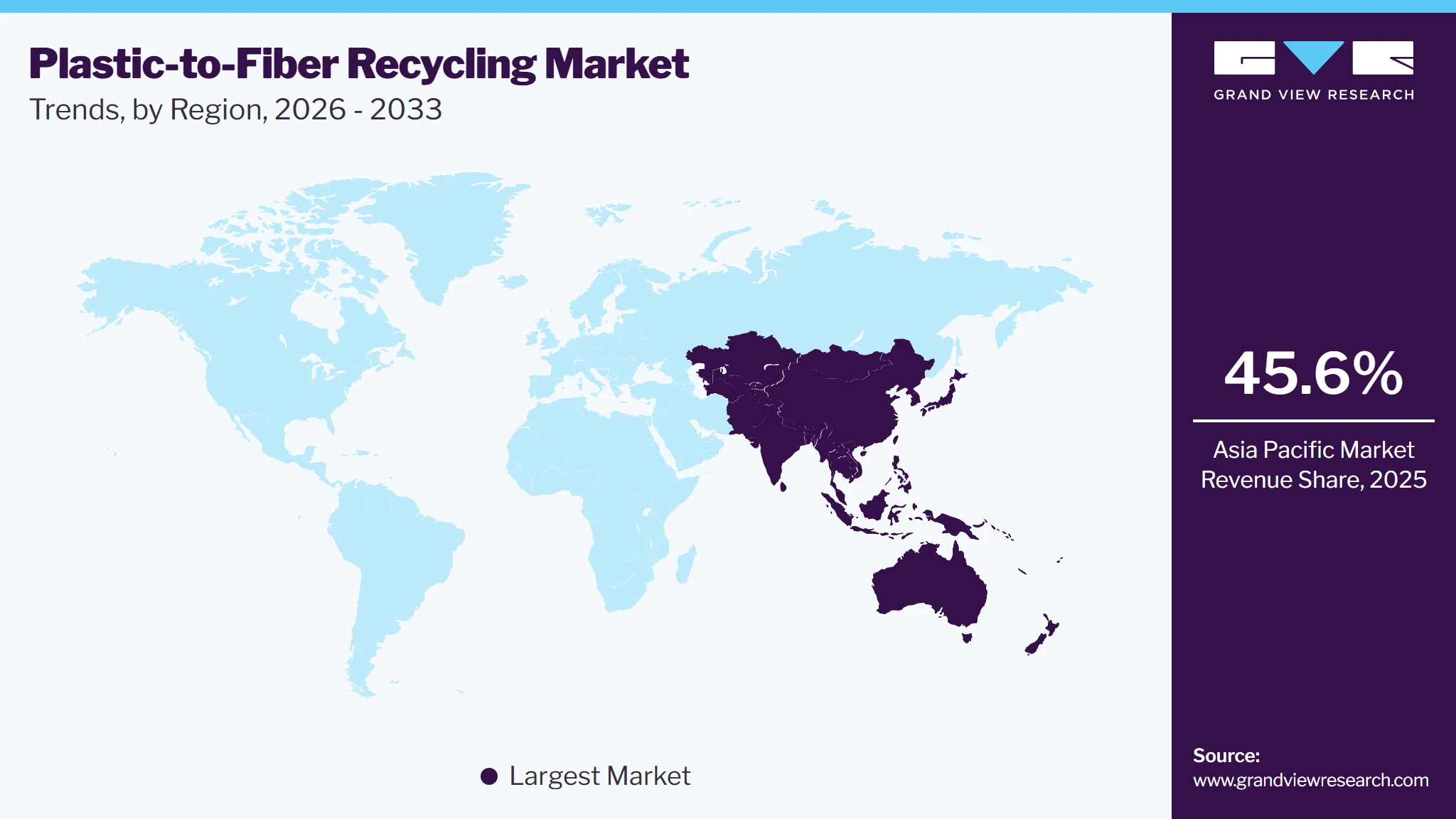
Asia Pacific dominated the global plastic-to-fiber recycling market, accounting for the largest revenue share of 45.6% in 2025, driven by its large polyester, textile, apparel, and plastics industries. The region benefits from extensive PET collection and recycling infrastructure, established polymer-processing capabilities, and proximity to major textile manufacturing clusters. China, India, Japan, South Korea, and Southeast Asian economies are increasingly investing in recycled polyester and circular textile supply chains. Growing sustainability requirements from international brands are encouraging regional manufacturers to increase recycled-content production while improving traceability and recycling efficiency.
 To learn more about this report, Download Free Sample Report
 China Plastic-to-Fiber Recycling Market Trends
The plastic-to-fiber recycling market in China is a major production and has extensive capabilities in plastics recycling, polymer processing, spinning, and textile manufacturing. Its integrated petrochemical-to-polyester and textile value chain provides manufacturers with an established base for expanding recycled polyester production. Increasing environmental requirements and the development of circular-economy initiatives are encouraging greater utilization of recycled materials. Companies are also exploring advanced recycling technologies capable of processing more complex plastic and textile waste.
North America Plastic-to-Fiber Recycling Market Trends
The plastic-to-fiber recycling market in North America has a well-developed PET collection, recycling, polymer processing, and textile manufacturing ecosystem, supporting the production of recycled polyester fibers from post-consumer plastics. The region is witnessing increased interest in domestic recycling capacity as brands and manufacturers seek greater control over recycled feedstock supply chains and traceability. Sustainability commitments from apparel and consumer-product companies are supporting demand for recycled fibers. Advanced recycling technologies are also attracting investment because they offer the potential to process waste streams that are difficult to handle through conventional mechanical recycling.
The U.S. plastic-to-fiber recycling market is supported by established PET recycling infrastructure, large consumer-product markets, and strong demand from apparel, footwear, home-furnishing, and industrial textile companies. Recycled polyester producers are increasingly focusing on improving feedstock quality, collection efficiency, and supply-chain traceability. The market is also seeing growing interest in textile-to-textile and chemical recycling technologies as companies seek alternatives to conventional bottle-derived recycled polyester. Corporate sustainability commitments and circular-economy initiatives are encouraging investment in domestic recycling capacity.
Europe Plastic-to-Fiber Recycling Market Trends
The plastic-to-fiber recycling market in Europe is a key market for plastic-to-fiber recycling because sustainability regulation is closely integrated with textile and circular-economy policy. The EU is strengthening requirements covering textile waste collection, producer responsibility, recyclability, and circular product design, creating stronger incentives for recycled fiber adoption. European brands and textile manufacturers are increasingly seeking recycled materials with a verifiable chain of custody and improved environmental credentials. The region is also an important center for textile-to-textile recycling and advanced polymer-recycling technology development.
Germany plastic-to-fiber recycling market has a well-developed recycling industry, strong environmental regulations, and advanced mechanical engineering capabilities supporting plastic and textile recycling technologies. The country's textile and chemical industries are increasingly interested in circular material systems and high-quality recycled polymers. German companies are involved in sorting, recycling equipment, polymer processing, textile manufacturing, and technology development, creating opportunities across the plastic-to-fiber value chain.
Central and South America Plastic-to-Fiber Recycling Market Trends
The plastic-to-fiber recycling market in CSA presents emerging potential for plastic-to-fiber recycling due to increasing plastic-waste generation, expanding textile industries, and growing sustainability requirements from international apparel brands. Brazil and Mexico provide important manufacturing and consumer markets, while other countries are developing collection and recycling infrastructure. PET bottle recycling represents the most accessible entry point because the material has an established recycling pathway and can be converted into polyester fiber.
Middle East & Africa Plastic-to-Fiber Recycling Market Trends
The plastic-to-fiber recycling market in CSA is at an earlier stage of development but offers long-term potential as governments and businesses increase focus on waste management, circular economy, and sustainable manufacturing. Gulf countries are investing in recycling infrastructure and diversification of manufacturing activities, creating opportunities for advanced plastics recycling and polymer-processing facilities. Africa offers substantial potential for PET collection and recycling because of growing urbanization and plastic-waste challenges, although collection and sorting infrastructure remains uneven across countries.
Key Plastic-to-Fiber Recycling Company Insights
Some of the key players operating in the market include Indorama Ventures and Far Eastern New Century.
-
Indorama Ventures is a Thailand-based global chemical and intermediate manufacturer with a strong presence in PET, recycled PET, polyester fibers, and yarns. The company operates recycling facilities that convert post-consumer PET waste into recycled materials, including recycled polyester fibers used across textile and apparel applications.
-
Far Eastern New Century is a Taiwan-based diversified manufacturer operating across petrochemicals, polyester, textiles, and recycled materials. The company produces recycled polyester fibers and yarns from post-consumer PET bottles and has developed technologies supporting bottle-to-fiber recycling. Its integrated supply chain, recycling capabilities, and relationships with international textile and apparel brands strengthen its position in the recycled fiber market.
Aquafil and Nan Ya Plastics Corporation are some of the emerging market participants.
-
Aquafil is an Italy-based manufacturer specializing in synthetic fibers, particularly nylon, with its ECONYL regeneration system representing its key circular-economy offering. The company collects nylon waste, such as discarded fishing nets, fabric scraps, and other nylon-based materials, and regenerates it into high-quality nylon yarn.
-
Nan Ya Plastics Corporation is a Taiwan-based manufacturer with operations spanning plastics, petrochemicals, polyester materials, fibers, and electronic materials. The company produces polyester fibers and recycled polyester materials using recovered PET feedstock, supporting applications in textiles and industrial products.
Key Plastic-to-Fiber Recycling Companies
The following key companies have been profiled for this study on the plastic-to-fiber recycling market.
-
Indorama Ventures
-
Far Eastern New Century
-
Unifi, Inc.
-
Reliance Industries Limited
-
Hyosung TNC
-
TEIJIN LIMITED
-
Nan Ya Plastics Corporation
-
Aquafil
-
JB Ecotex
-
Alpek Polyester
Competitive Benchmarking
Category
Operating Strategies
Competitive Edge
Weakness
Established Players Indorama Ventures, Far Eastern New Century, UNIFI, Inc., Reliance Industries Limited, Hyosung TNC, TEIJIN LIMITED
- Invest in advanced mechanical and chemical PET recycling technologies to convert post-consumer and post-industrial plastic waste into recycled polyester fibers, yarns, and fiber-grade materials.
- Expand recycling and fiber-production capacity through partnerships with apparel brands, textile manufacturers, recyclers, waste-management companies, and plastic-feedstock suppliers.
- Focus on improving recycled fiber quality, polymer purity, recycled content, traceability, processing efficiency, and scalability while integrating recycling into existing polyester manufacturing operations.
- Large-scale manufacturing infrastructure and established polyester production capabilities enable efficient integration of recycled plastic feedstock into fiber production.
- Strong relationships with global apparel brands, textile manufacturers, and downstream customers support commercial adoption of recycled polyester.
- Established collection, recycling, polymer-processing, and fiber-manufacturing capabilities provide advantages in feedstock access, production scale, quality consistency, and geographic reach.
- High capital requirements for recycling plants, polymer-processing infrastructure, collection systems, and capacity expansion.
- Dependence on consistent supplies of suitable PET and other recyclable plastic feedstock, with contamination and quality variations potentially affecting processing efficiency and fiber quality.
- Large established production systems can face challenges in rapidly adapting to emerging recycling technologies and more complex waste streams compared with specialized technology developers.
Emerging Players Nan Ya Plastics Corporation, Aquafil, JB Ecotex, Alpek Polyester
- Develop and commercialize advanced plastic-recycling and regenerated-fiber technologies targeting PET, nylon, discarded fishing nets, plastic waste, and other suitable feedstocks for recycled fiber production.
- Expand through partnerships with apparel brands, textile manufacturers, recyclers, waste collectors, retailers, and sustainability-focused organizations to secure feedstock and increase downstream adoption.
- Prioritize improvements in fiber quality, recycled content, feedstock flexibility, process efficiency, traceability, circularity, and production scalability.
- Specialized expertise in recycled synthetic fibers and plastic-to-fiber conversion technologies provides differentiation from conventional virgin-fiber producers.
- Proprietary recycling processes can enable higher-value utilization of difficult-to-recycle plastic waste and provide alternatives to virgin polyester and polyamide.
- Strong sustainability positioning and partnerships across the textile value chain can support customer differentiation and accelerate adoption of recycled fibers.
- Relatively smaller production scale and geographic footprint compared with the largest integrated polyester and chemical manufacturers.
- Greater dependence on financing, strategic partnerships, reliable plastic feedstock, and successful commercialization of newer recycling technologies.
- Challenges remain around feedstock collection and sorting, processing costs, technology scale-up, fiber performance, and competitiveness with low-cost virgin synthetic fibers.
Recent Developments
-
In August 2025, Indorama Ventures announced that it had reached the milestone of recycling 150 billion PET bottles across its global operations. The company reported that its recycled PET activities had diverted substantial quantities of plastic waste and continued to support PET flake production for fiber, sheet, and bottle applications.
-
In February 2026, UNIFI introduced a new goal to recycle 65 billion plastic bottles by FY2030, building on its REPREVE platform. The company also reported that REPREVE had transformed more than 46 billion bottles into recycled fiber by early 2026.
Plastic-to-Fiber Recycling Market Report Scope
Report Attribute
Details
Market size in 2025
USD 10.5 billion
Estimated market size in 2026
USD 11.3 billion
Projected market size by 2033
USD 18.5 billion
Growth rate
CAGR of 7.3% from 2026 to 2033
Actual data
2021 - 2025
Forecast period
2026 - 2033
Quantitative units
Revenue in USD billion and CAGR from 2026 to 2033
Report coverage
Revenue forecast, company ranking, competitive landscape, growth factors, and trends
Segments covered
Plastic type, application, fiber type, region
Regional scope
North America; Asia Pacific; Europe; CSA; MEA
Country scope
U.S.; Canada; Mexico; Germany; UK; France; Italy; Spain; China; Japan; India; South Korea; Brazil; Saudi Arabia
Key companies profiled
Indorama Ventures; Far Eastern New Century; Unifi, Inc.; Reliance Industries Limited; Hyosung TNC; TEIJIN LIMITED; Nan Ya Plastics Corporation; Aquafil; JB Ecotex; Alpek Polyester
Customization scope
Free report customization (equivalent up to 8 analysts working days) with purchase. Addition or alteration to country, regional & segment scope.
Pricing and purchase options
Avail customized purchase options to meet your exact research needs. Explore purchase options
Global Plastic-to-Fiber Recycling Market Report Segmentation
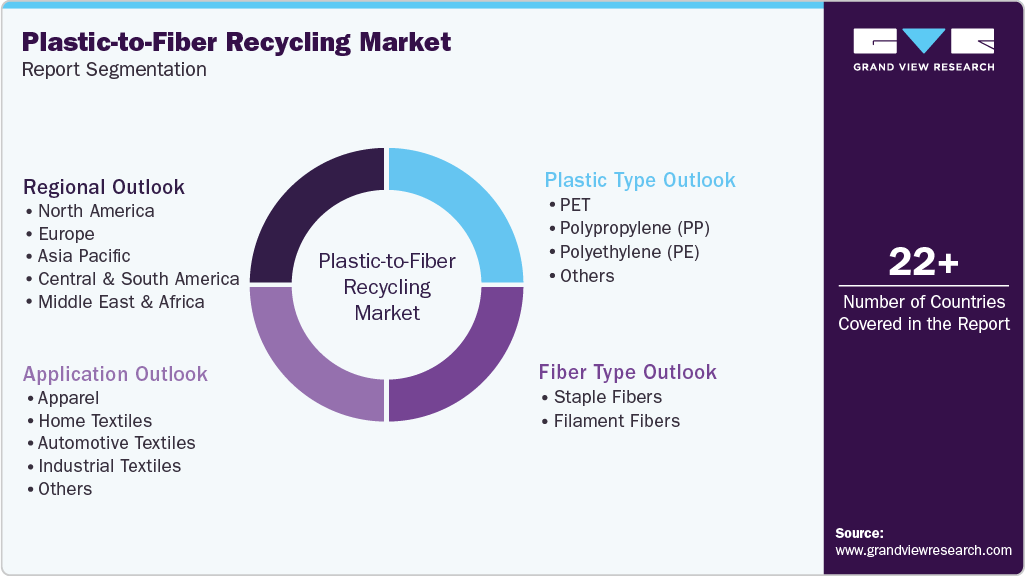
This report forecasts revenue growth at regional & country levels and provides an analysis of the industry trends in each of the sub-segments from 2021 to 2033. For this study, Grand View Research has segmented the global plastic-to-fiber recycling market based on plastic type, fiber type, application, and region:
 To learn more about this report, Download Free Sample Report
 -
Plastic Type Outlook (Revenue, USD Billion, 2021 - 2033)
-
PET
-
Polypropylene (PP)
-
Polyethylene (PE)
-
Others
-
-
Fiber Type Outlook (Revenue, USD Billion, 2021 - 2033)
-
Staple Fibers
-
Filament Fibers
-
-
Application Outlook (Revenue, USD Billion, 2021 - 2033)
-
Apparel
-
Home Textiles
-
Automotive Textiles
-
Industrial Textiles
-
Others
-
-
Regional Outlook (Revenue, USD Billion, 2021 - 2033)
-
North America
-
U.S.
-
Canada
-
Mexico
-
-
Europe
-
UK
-
Germany
-
France
-
Italy
-
Spain
-
-
Asia Pacific
-
China
-
Japan
-
India
-
South Korea
-
-
Central and South America
-
Brazil
-
-
Middle East and Africa
-
Saudi Arabia
-
-
Research Methodology
The plastic-to-fiber recycling market figures in this report are based on a proven research process that combines executive interviews with secondary research from proprietary databases, company filings, and recognized regulatory and institutional sources. Market size is built through value-chain sizing-reconciling supply-side and demand-side estimates-and triangulated with bottom-up and top-down approaches. Every estimate passes multiple levels of expert validation before publication, with each plastic-to-fiber recycling segment quantified using the revenue-capture definitions in the table below.
Segment Definition
Plastic Type
Revenue capture definition
PET
Revenue generated from the sale of textile fibers produced by recycling polyethylene terephthalate (PET) waste, including post-consumer PET bottles, containers, packaging, and post-industrial PET waste, into recycled polyester staple or filament fibers.
Polypropylene (PP)
Revenue generated from the sale of textile fibers produced by recycling polypropylene (PP) waste, including post-consumer and post-industrial PP packaging, textiles, industrial materials, and other suitable PP waste streams into recycled PP fibers.
Polyethylene (PE)
Revenue generated from the sale of textile fibers produced by recycling polyethylene (PE) waste, including HDPE, LDPE, and LLDPE waste from packaging, containers, films, and industrial applications that is processed into fiber-grade recycled materials and textile fibers.
Others
Revenue generated from the sale of textile fibers produced from other recyclable plastic waste streams, including nylon/polyamide, polystyrene, acrylic, and other polymers suitable for conversion into textile or industrial fibers through mechanical, chemical, or other recycling processes.
Fiber Type
Revenue capture definition
Staple Fibers
Revenue generated from the sale of recycled staple fibers produced from plastic waste, including short-length fibers manufactured through recycling and extrusion processes and supplied for spinning, nonwoven production, apparel, home textiles, automotive textiles, and industrial applications.
Filament Fibers
Revenue generated from the sale of recycled continuous filament fibers and yarns produced from plastic waste, including recycled polyester, nylon, and other synthetic filament materials manufactured through extrusion and spinning processes for textile and industrial applications.
Application
Revenue capture definition
Apparel
Revenue generated from the sale of plastic-derived recycled fibers used in apparel and clothing products, including sportswear, activewear, casualwear, outerwear, uniforms, and other garments.
Home Textiles
Revenue generated from the sale of plastic-derived recycled fibers used in home textile products, including bedding, carpets, curtains, upholstery, towels, blankets, and other household textile applications.
Automotive Textiles
Revenue generated from the sale of plastic-derived recycled fibers used in automotive textile applications, including vehicle carpets, seat fabrics, headliners, interior fabrics, insulation, trunk liners, and other automotive textile components.
Industrial Textiles
Revenue generated from the sale of plastic-derived recycled fibers used in industrial and technical textile applications, including filtration materials, geotextiles, protective textiles, reinforcement materials, ropes, conveyor materials, and other technical applications.
Others
Revenue generated from the sale of plastic-derived recycled fibers used in other applications, including footwear, accessories, medical textiles, hygiene products, packaging textiles, and other end uses not covered under apparel, home textiles, automotive textiles, or industrial textiles.
Estimation Model
Layer No.
Layer Name
Key Question
Description
01
Parent Market Analysis
What is the overall size and growth outlook of the global plastic recycling, recycled polyester, synthetic fibers, textile fibers, sustainable materials, and textile recycling markets?
The estimation begins by evaluating the broader plastic recycling, recycled polyester, synthetic fiber, textile fiber, sustainable textile materials, waste management, and textile recycling markets. Plastic waste generation, PET waste availability, recycled polymer production, global fiber production and consumption, polyester demand, textile and apparel manufacturing, recycling infrastructure, and investments in circular materials are analyzed to establish the total addressable market for plastic-to-fiber recycling.
02
Plastic-to-Fiber Fiber Type Penetration Analysis
What proportion of the overall plastic recycling, recycled polymer, and sustainable fiber markets is represented by plastic-to-fiber recycling across waste sources and recycling technologies?
This layer estimates the penetration of plastic-to-fiber recycling within the broader plastic recycling and recycled fiber markets. Adoption is assessed across PET bottles, post-consumer plastic packaging, post-industrial plastic waste, textile waste containing synthetic fibers, and other suitable plastic waste streams. Penetration is further evaluated across mechanical recycling, chemical recycling, depolymerization, dissolution, and other emerging recycling technologies to determine the contribution of recycled plastic-derived fiber production to the overall recycled fiber market.
03
Regional & End-use Demand Assessment
Which regions and end-use industries contribute the highest demand for plastic-to-fiber recycled products?
Market demand is evaluated across major regions based on plastic waste availability, PET collection rates, recycling infrastructure, polyester and textile manufacturing capacity, recycled fiber production, sustainability regulations, circular economy initiatives, and adoption of recycled materials. Demand is further assessed across apparel & textiles, home textiles, nonwovens, footwear, automotive textiles, furnishings, and industrial textiles to determine regional and application-level penetration of plastic-derived recycled fibers.
04
Company Revenue Validation & Market Forecasting
How is the final plastic-to-fiber recycling industry size validated and forecast?
Final estimates are validated using company revenues, plastic recycling and fiber production capacities, recycling and processing capacities, PET collection volumes, recycled polymer and fiber production volumes, product portfolios, manufacturing facilities, technology deployment, recycling yields, sustainability partnerships, certifications, investments, and announced capacity expansions. Bottom-up and top-down approaches are triangulated using company-level, technology-level, waste-stream, regional, and end-use data to generate reliable market estimates and forecasts for the market.
Delivered Customizations
This report has been delivered with the following In-depth customizations
Client Request
Customization Delivered
Value Adds
Plastic Feedstock Availability & Fiber-Grade Recycling Potential Assessment
Analyze the availability of PET bottles, plastic packaging, post-industrial plastics, synthetic textile waste, and other suitable plastic feedstocks, including collection channels, polymer composition, contamination levels, sorting and washing requirements, geographic availability, recyclability, and suitability for conversion into textile-grade fibers.
Helps identify high-potential plastic waste streams and feedstock constraints, enabling recyclers and fiber manufacturers to assess raw-material security, sourcing opportunities, and the scalability of plastic-to-fiber production.
Plastic-to-Fiber Technology & Fiber Quality Assessment
Evaluate mechanical recycling, chemical recycling, depolymerization, dissolution, and emerging recycling technologies based on feedstock compatibility, processing requirements, technology maturity, polymer recovery, fiber yield, fiber quality, energy requirements, scalability, and commercialization status.
Helps technology developers, recyclers, and fiber manufacturers identify the most suitable conversion pathway for different plastic waste streams and assess opportunities to improve polymer recovery, fiber performance, process efficiency, and commercial scalability.
Circular Economy & Regulatory Opportunity Assessment
Evaluate the impact of recycled-content requirements, extended producer responsibility, plastic-waste regulations, textile recycling policies, separate waste collection, circular economy initiatives, and corporate sustainability commitments on the adoption of plastic-to-fiber recycling.
Helps identify regulation-driven demand, compliance requirements, recycled-material adoption opportunities, and emerging investment areas created by the transition toward circular plastics and sustainable textile value chains.
Frequently Asked Questions About This Report
The plastic-to-fiber recycling market size was valued at USD 10.5 billion in 2025 and is estimated at USD 11.3 billion in 2026.
The plastic-to-fiber recycling market is expected to grow at a compound annual growth rate of 7.3% from 2026 to 2033,reaching USD18.5 billion by 2033.
Asia Pacific held the highest revenue market share of 45.6% in 2025.
Key factors include rising plastic waste generation, increasing demand for recycled fibers, sustainability regulations, recycled-content mandates, and advancements in recycling technologies.
The PET segment accounted for the highest revenue share of 89.9% in 2025, driven by its widespread availability and established recycling infrastructure.
Some key players include Indorama Ventures, Far Eastern New Century, Unifi, Inc., Reliance Industries Limited, Hyosung TNC, TEIJIN LIMITED, Nan Ya Plastics Corporation, Aquafil, Alpek Polyester, and JB Ecotex.
The staple fibers segment held the highest revenue share of 63.0% in 2025 while filament fibers segment is expected to be the fastest-growing market.
The apparel segment held the highest revenue market share of 52.4% in 2025, due to the extensive adoption of recycled polyester fibers in clothing, sportswear, activewear, outerwear, and other garment categories.
About the Author(s)
Advanced Interior Materials Research Team
Advanced Materials · Advanced Interior MaterialsThis report was authored by the advanced interior materials research team at Grand View Research - comprising two research analysts, one senior research analyst, and one industry expert - with specialized expertise in the advanced interior materials segment of the advanced materials industry. All findings are based on proprietary advanced materials databases, executive interviews, and regulatory analysis, subject to internal peer review prior to publication.
Last Updated:
Speak to Analyst

Customize this report to your needs - add regions, segments, or data points, with 20% free customization.
Or view our licence options:


ISO 9001:2015 & 27001:2022 Certified
We are GDPR and CCPA compliant! Your transaction & personal information is safe and secure. For more details, please read our privacy policy.


