
- Home
- »
- Bulk Chemicals
- »
-
Reusable Transport Packaging Market Report, 2026-2033GVR Report cover

Reusable Transport Packaging Market (2026 - 2033)
Size, Share & Trends Analysis Report By Materials (Plastic, Wood, Metal), By Product (Pallets, Crates & Totes), By End Use (Food & Beverage, Automotive, Pharmaceuticals & Healthcare), By Usage Model, By Region, And Segment Forecasts
Market Size, 2025
$119.7BMarket Estimate, 2026
$126.7BMarket Forecast, 2033
$191.0BCAGR, 2026–2033
6.0%Reusable Transport Packaging Market Summary
The global reusable transport packaging market size was valued at USD 119.7 billion in 2025 and is projected to grow from USD 126.7 billion in 2026 to USD 191.0 billion by 2033, at a CAGR of 6.0% from 2026 to 2033. The market in Asia Pacific dominated with a revenue share of 32.0% in 2025. The market is driven by rising demand for sustainable and cost-efficient logistics solutions, as companies seek to reduce packaging waste, lower transportation costs, and comply with stringent environmental regulations.
 Source: Grand View Research, IR Documents, Primary Interviews, Paid DatabasesTo learn more about this report,
 Download Free Sample Report
 Key Market Trends & Insights
- By material: Plastic segment held the largest market share of 48.4% in 2025.
- By product: Pallets segment held the largest market share of 43.5% in 2025.
- By usage model: Closed-loop systems segment held the largest market share of 60.9% in 2025.
- By end use: Food & beverage segment held the largest market share of 31.8% in 2025.
Regional Highlights
- Largest regional market: Asia Pacific (32.0% revenue share, 2025)
- By country: China held the largest market share in 2025
Market Size & Forecast
- Market size in 2025: USD 119.7 Billion
- Estimated market size in 2026: USD 126.7 Billion
- Projected market size by 2033: USD 191.0 Billion
- CAGR (2026-2033): 6.0%
Three ways to get this report
Buy it, customize it, or ask a question.Ask an Analyst
Analyst response in 1 business day
- AccessReport author, directly
- Reply timeWithin 1 working day
- No sales callDirect answer only
- FormatEmail reply
- CostFree, no cost
Get the Full Report
What the study covers
- FormatsPDF · Excel · Dashboard
- Timeline2026–2033 annual, 2025 base
- Coverage20+ countries, 5 regions
- Companies10+ key players profiled
Customize the Report
20% free customization
- IncludeCountries, segments, points
- TailorTo your product definition
- ExtendDeeper competitor detail
- OrA fully bespoke study
- Turnaround5–10 working days
Growth in e-commerce, automotive, food & beverage, and pharmaceutical industries is further accelerating the adoption of durable pallets, crates, containers, and intermediate bulk containers for efficient supply chain operations. The market is being strongly driven by the growing emphasis on sustainability and circular economy practices across industries such as food & beverages, automotive, retail, pharmaceuticals, and e-commerce. Companies are increasingly replacing single-use corrugated boxes and plastic packaging with reusable pallets, crates, containers, dunnage, and intermediate bulk containers (IBCs) to reduce packaging waste, carbon emissions, and overall lifecycle costs. Stringent environmental regulations, extended producer responsibility (EPR) policies, and corporate ESG commitments are further encouraging manufacturers and logistics providers to adopt reusable packaging systems that support waste reduction and resource efficiency. To learn more about this report, Download Free Sample Report
 The rapid expansion of global supply chains and e-commerce logistics is also boosting market growth. Reusable transport packaging offers superior product protection, improved load stability, and lower damage rates compared to disposable alternatives, making it highly attractive for industries managing high-volume shipments. The increasing use of automation, warehouse robotics, and RFID-enabled tracking systems is also accelerating adoption, as reusable packaging solutions are often designed for compatibility with automated material handling systems and smart supply chain operations.
Moreover, rising operational cost pressures are pushing businesses toward long-term packaging optimization strategies. Although reusable transport packaging involves a higher initial investment, it significantly lowers recurring packaging procurement, disposal, and reverse logistics costs over time. Industries such as automotive and industrial manufacturing are increasingly implementing closed-loop logistics systems where reusable pallets, totes, and containers circulate continuously between suppliers, manufacturers, and distributors. Growing investments in pooling services and rental-based reusable packaging models are further making these solutions accessible to small and medium-sized enterprises, thereby expanding overall market penetration.
Market Dynamics
The rising adoption of closed-loop logistics systems is significantly driving the market, particularly in industries with repetitive and high-volume supply chains such as automotive, food & beverages, retail, and industrial manufacturing. In these systems, reusable pallets, crates, totes, and containers continuously circulate between suppliers, manufacturers, warehouses, and distributors, reducing dependence on single-use packaging. This model helps companies minimize recurring packaging procurement costs while improving operational efficiency and inventory management across the supply chain.
In addition, businesses are increasingly recognizing the long-term financial and environmental benefits offered by reusable packaging within closed-loop networks. Reusable transport packaging reduces packaging waste generation, lowers disposal expenses, and minimizes product damage during transit due to its superior durability and strength. Companies are also integrating RFID tracking, IoT monitoring, and pooling services into closed-loop logistics operations to enhance asset visibility and optimize return cycles. As organizations continue focusing on cost reduction, sustainability, and supply chain resilience, demand for reusable transport packaging solutions is expected to accelerate further.
Fluctuating raw material prices for plastics, metals, and composite materials act as a significant restraint for the market by increasing manufacturing and replacement costs for pallets, crates, containers, and bulk bins. Variations in crude oil prices directly impact plastic resin costs, while volatility in steel and aluminum markets affects metal-based transport packaging production expenses. These unpredictable price movements create budgeting challenges for manufacturers and logistics providers, particularly for companies operating large reusable packaging fleets. Rising material costs can also delay investment decisions among small and medium-sized enterprises, limiting wider adoption of reusable transport packaging solutions despite their long-term cost advantages.
Market Concentration & Characteristics
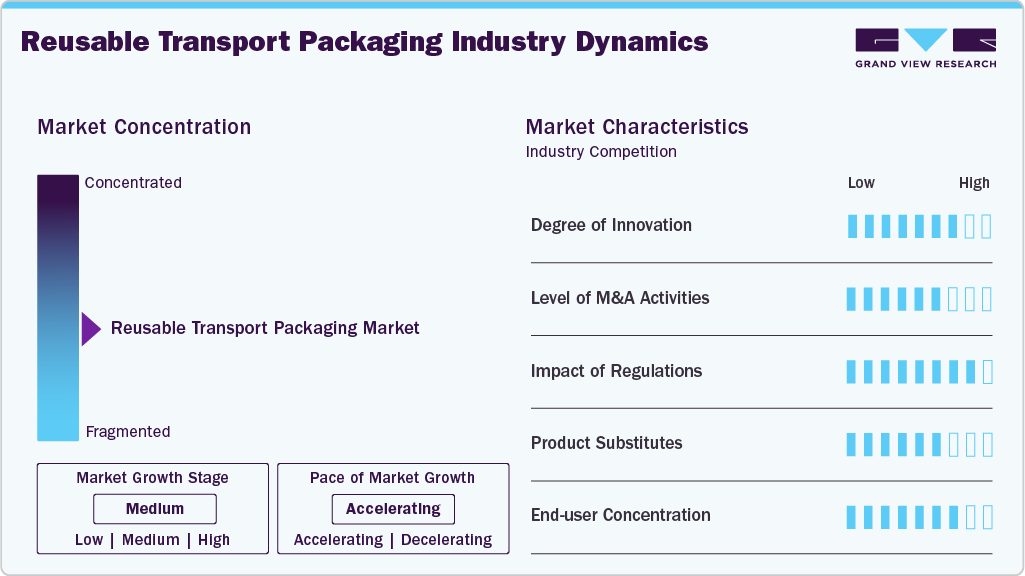
The reusable transport packaging industry is characterized by high durability, long product life cycles, and repeated usage across supply chain operations. Products such as reusable pallets, crates, totes, drums, and intermediate bulk containers are specifically designed to withstand multiple transportation and handling cycles, making them suitable for industries with continuous logistics movement. The market is highly dependent on operational efficiency, product protection, and cost optimization, as businesses increasingly seek packaging solutions that reduce waste while improving transportation reliability and inventory management.
 To learn more about this report, Download Free Sample Report
 The market is also characterized by increasing sustainability-driven innovation and regulatory influence. Manufacturers are focusing on lightweight, recyclable, and high-strength materials to improve packaging performance while lowering environmental impact. Industries such as automotive, food & beverages, pharmaceuticals, retail, and e-commerce are major adopters due to their high-volume shipping requirements and sustainability commitments. In addition, environmental regulations restricting single-use packaging and growing corporate ESG goals are encouraging continuous investment in reusable packaging infrastructure, thereby shaping long-term market expansion and competitive differentiation.
Material Insights
The plastic segment dominated the market in 2025, accounting for 48.4% of the total market share, due to its superior durability, lightweight properties, and cost-effectiveness in repetitive logistics operations. Plastic pallets, crates, totes, and containers offer high resistance to moisture, chemicals, and impact damage, making them ideal for industries such as food & beverages, pharmaceuticals, automotive, and retail. In addition, their compatibility with automated handling systems and the growing availability of recyclable and reusable plastic materials further accelerated market adoption.
The wood segment holds a significant share in the market due to its high load-bearing capacity, widespread availability, and cost efficiency in heavy-duty transportation applications. Wooden pallets and crates are extensively used across industrial manufacturing, warehousing, agriculture, and export logistics because they provide strong structural support for bulk goods and machinery. In addition, wood remains a preferred material in several regions due to its easy repairability, recyclability, and established acceptance in global shipping and storage operations.
Product Insights
The pallets segment dominated the market in 2025, accounting for 43.5% of the total market share, owing to their extensive use in warehousing, transportation, and automated material handling operations across industries. Reusable pallets improve load stability, reduce product damage, and enhance supply chain efficiency in sectors such as food & beverages, automotive, retail, and pharmaceuticals. Their compatibility with forklifts, conveyor systems, and pallet pooling networks further strengthened large-scale adoption globally.
The intermediate bulk containers (IBCs) segment is gaining strong traction in the market due to its ability to safely store and transport large volumes of liquids, chemicals, food ingredients, and pharmaceutical products. IBCs offer high durability, space efficiency, and cost savings through repeated usage and reduced handling requirements compared to smaller containers. Their stackable design, compatibility with bulk logistics systems, and increasing adoption in chemical, food processing, and industrial sectors are further supporting segment growth.
Usage Model Insights
The closed-loop systems segment dominated the market in 2025, accounting for 60.9% of the total market share, due to its ability to provide cost-efficient, highly controlled, and sustainable packaging circulation within established supply chains. Industries such as automotive, food & beverages, and industrial manufacturing extensively use closed-loop networks where pallets, crates, and containers are repeatedly returned, reused, and redistributed between fixed supply chain partners. This system helps reduce packaging waste, lower long-term operational costs, and improve asset tracking and logistics efficiency.
The open-loop/pooling systems segment is gaining strong momentum in the reusable transport packaging market due to the growing demand for flexible and shared packaging networks across multiple users and supply chains. In this model, third-party pooling providers manage reusable pallets, crates, and containers, allowing companies to reduce upfront capital investment and avoid complex asset management responsibilities. The increasing expansion of retail, FMCG, and e-commerce logistics, along with rising emphasis on sustainability and operational efficiency, is further driving the adoption of pooling-based reusable packaging systems.
End Use Insights
The food & beverage segment dominated the market in 2025, accounting for 31.8% of total demand, driven by the industry's high-volume logistics operations and growing focus on hygienic, durable, and sustainable packaging solutions. Reusable pallets, crates, totes, and containers are extensively used for transporting beverages, dairy products, fresh produce, processed foods, and bulk ingredients across supply chains. In addition, increasing pressure to reduce packaging waste and improve supply chain efficiency further accelerated adoption within the sector.
 To learn more about this report, Download Free Sample Report
 The pharmaceuticals & healthcare segment is witnessing strong growth due to the increasing need for safe, hygienic, and temperature-sensitive transportation of medicines, vaccines, medical devices, and healthcare supplies. Reusable containers, insulated pallets, and specialized totes help maintain product integrity while reducing contamination risks during storage and transit. In addition, stringent regulatory standards, expanding global pharmaceutical supply chains, and rising demand for sustainable healthcare logistics solutions are further driving segment adoption.
Regional Insights
The Asia Pacific region dominated the reusable transport packaging market due to rapid industrialization, expanding manufacturing activities, and the strong growth of e-commerce and retail logistics across countries such as China, India, and Japan. The region’s large automotive, food & beverage, electronics, and pharmaceutical industries generate substantial demand for durable and cost-efficient transport packaging solutions. In addition, increasing investments in warehousing infrastructure, export-oriented manufacturing, and sustainable supply chain practices are further accelerating the adoption of reusable pallets, crates, containers, and bulk packaging systems across the region.
 To learn more about this report, Download Free Sample Report
 China Reusable Transport Packaging Market Trends
The reusable transport packaging industry in China is a key market, driven by its massive manufacturing base, strong export-oriented economy, and rapidly expanding logistics and e-commerce sectors. The country’s automotive, electronics, food & beverage, and industrial manufacturing industries generate substantial demand for reusable pallets, crates, totes, and bulk containers to improve supply chain efficiency and reduce packaging waste. In addition, government initiatives promoting circular economy practices, sustainable logistics, and industrial automation are further accelerating the adoption of reusable transport packaging solutions across China.
North America Reusable Transport Packaging Market Trends
The reusable transport packaging industry in North America is a major market due to the strong presence of advanced logistics networks, highly organized retail supply chains, and large-scale automotive and food & beverage industries. Leading companies such as Brambles Limited, ORBIS Corporation, Rehrig Pacific Company, and Schoeller Allibert are expanding reusable pallet, crate, and container solutions across the region. In addition, increasing adoption of pooling systems, warehouse automation, and sustainability-focused logistics practices is further accelerating reusable transport packaging demand in North America.
The U.S. reusable transport packaging market is expected to grow significantly due to the strong presence of advanced manufacturing, highly developed logistics infrastructure, and large-scale retail and food distribution networks. Major end-user brands such as Walmart, Amazon, Coca-Cola, PepsiCo, and Ford Motor Company are increasingly adopting reusable pallets, crates, totes, and bulk containers to improve supply chain efficiency and reduce packaging waste. In addition, rising warehouse automation, e-commerce expansion, and corporate sustainability initiatives are further accelerating reusable transport packaging adoption across the U.S.
Europe Reusable Transport Packaging Market Trends
The reusable transport packaging industry in Europe is a key market for reusable transport packaging due to the region’s strong focus on sustainability, circular economy practices, and stringent regulations on packaging waste reduction. Major end-user brands such as Nestle, Unilever, Volkswagen, Carlsberg Group, and IKEA are increasingly utilizing reusable pallets, crates, and transport containers to optimize logistics operations and meet ESG targets. In addition, the region’s advanced retail infrastructure, cross-border trade activities, and growing adoption of automated warehousing systems are further driving demand for reusable transport packaging solutions.
Key Reusable Transport Packaging Company Insights
The market is characterized by a highly competitive and moderately consolidated environment, with companies competing based on product durability, pooling network strength, customization capabilities, sustainability performance, and logistics efficiency. Market participants are increasingly focusing on lightweight and recyclable materials, RFID-enabled tracking systems, smart packaging technologies, and closed-loop logistics solutions to strengthen their market position. Strategic partnerships, mergers & acquisitions, regional expansion, and investments in automated supply chain infrastructure remain key competitive strategies across the industry. In addition, rising demand from automotive, food & beverage, retail, pharmaceutical, and e-commerce sectors is encouraging manufacturers to develop industry-specific reusable packaging solutions with enhanced operational efficiency and lower lifecycle costs.
-
In July 2025, IPL Schoeller, a North American rigid plastic packaging company, merged with Europe’s Schoeller Allibert, a reusable transport packaging specialist, forming a global sustainable packaging powerhouse with over USD 1.4 billion in annual revenue. This merger is expected to combine strengths across food, automotive, and industrial sectors to drive innovation and sustainability.
-
In February 2025, ORBIS Corporation opened a 660,000-square-foot manufacturing plant in Greenville, Texas, to produce reusable totes and pallets. This expansion boosts ORBIS’s production capacity and supports its commitment to sustainability and the circular economy.
Key Reusable Transport Packaging Companies:
The following key companies have been profiled for this study on the reusable transport packaging market.
- IPL Schoeller
- RPP Containers
- Georg Utz Holding AG
- Rehrig Pacific Company
- SSI SCHAEFER
- ReusePac
- MDI
- Knauf Industries
- Mauser Packaging Solutions
- IFCO SYSTEMS
- PalletOne
- ITB Packaging, LLC
- Tosca Services, LLC
- CHEP
Competitive Benchmarking
Operating Strategies
Competitive Edge
Weaknesses
Mature Players: IPL Schoeller; ORBIS Corporation; Tosca Services, LLC; CHEP; IFCO Systems; Rehrig Pacific Company; Monoflo International
- Focus on expanding automated material handling-compatible solutions, reusable transport packaging (RTP), and specialized pallet pooling models.
- Invest in durable, tracking-enabled (RFID/IoT), and high-load-bearing designs tailored for food & beverage, automotive, and retail automation logistics.
- Expand sustainable manufacturing capabilities utilizing 100% recyclable resins and closed-loop material recovery.
- Strong manufacturing scale, established distribution infrastructure, and integrated logistics pooling networks.
- Advanced R&D capabilities for automated warehouse-compatible and custom-engineered heavy-duty polymer storage solutions.
- Long-standing contracts with multinational e-commerce, food and beverage, and consumer goods leaders.
- Capital-intensive manufacturing processes and infrastructure are required for global pooling maintenance.
- Exposure to fluctuations in post-consumer recycled (PCR) resin costs and heavy polymer manufacturing energy inputs.
- Slower adjustment to hyper-localized or low-volume customization requests due to massive manufacturing scale.
Emerging Players: Polymer Solutions International (PSI); Novatec Pagani S.A. de C.V.; TranPak Inc.; Greystone Logistics; Norplast Peru; TriEnda Holdings LLC
- Target niche agricultural, specific pharmaceutical cleanroom, or single-use regional logistics applications with tailored product dimensions.
- Focus on strategic regional production expansions and flexible, lower minimum-order-quantity (MOQ) contract manufacturing.
- Develop cost-effective lightweight crates and short-cycle pallets to capture entry-level wood-to-plastic conversion markets.
- High operational flexibility and agility in providing application-specific customized dimensions or short product runs.
- Competitive pricing structures and strong customer relationships in target regional or mid-tier industrial sectors.
- Focused innovations on localized agricultural distribution and specialized material handling needs.
- Limited presence in large-scale pooling networks, restricting penetration in highly integrated global supply chains.
- Lower bargaining power in raw material sourcing and polymer resin procurement compared to global industry giants.
- Narrower global distribution and service footprint to support multinational enterprise logistics accounts.
Reusable Transport Packaging Market Report Scope
Report Attribute
Details
Market size in 2025
USD 119.7 billion
Estimated market size in 2026
USD 126.7 billion
Projected market size by 2033
USD 191.0 billion
Growth rate
CAGR of 6.0% from 2026 to 2033
Historical data
2021 - 2025
Forecast period
2026 - 2033
Quantitative units
Revenue in USD million/billion and CAGR from 2026 to 2033
Report coverage
Revenue forecast, company ranking, competitive landscape, growth factors, and trends
Segments covered
Material, product, end use, usage model, region
Regional scope
North America, Europe, Asia Pacific, Latin America, MEA
Country scope
U.S.; Canada; Mexico; Germany; France; UK; Italy; Spain; China; India; Japan; South Korea; Australia; Brazil; Argentina; Saudi Arabia; UAE; South Africa
Key companies profiled
IPL Schoeller; RPP Containers; Georg Utz Holding AG; Rehrig Pacific Company; SSI SCHAEFER; ReusePac; MDI; Knauf Industries; Mauser Packaging Solutions; IFCO SYSTEMS; PalletOne; ITB Packaging, LLC; Tosca Services, LLC; CHEP
Customization scope
Free report customization (equivalent up to 8 analysts working days) with purchase. Addition or alteration to country, regional & segment scope.
Pricing and purchase options
Avail of customized purchase options to meet your exact research needs. Explore purchase options
Global Reusable Transport Packaging Market Report Segmentation
This report forecasts revenue growth at the regional, and country levels and provides an analysis on the latest industry trends and opportunities in each of the sub-segments from 2021 to 2033. For this study, Grand View Research has segmented the global reusable transport packaging market report based on material, product, end use, usage model, and region:
-
Material Outlook (Revenue, USD Billion, 2021 - 2033)
-
Plastic
-
Wood
-
Metal
-
Paper & Paperboard
-
Others
-
-
Product Outlook (Revenue, USD Billion, 2021 - 2033)
-
Pallets
-
Crates & Totes
-
Intermediate Bulk Containers (IBCs)
-
Drums & Barrels
-
Bulk Bins & Containers
-
Plastic Corrugated Boxes
-
Others
-
-
End Use Outlook (Revenue, USD Billion, 2021 - 2033)
-
Food & Beverage
-
Automotive
-
Industrial & Manufacturing
-
Retail & E-commerce
-
Pharmaceuticals & Healthcare
-
Chemicals
-
Others
-
-
Usage Model Outlook (Revenue, USD Billion, 2021 - 2033)
-
Closed-loop Systems
-
Open-loop / Pooling Systems
-
-
Regional Outlook (Revenue, USD Billion, 2021 - 2033)
-
North America
-
U.S.
-
Canada
-
Mexico
-
-
Europe
-
Germany
-
France
-
UK
-
Italy
-
Spain
-
-
Asia Pacific
-
China
-
India
-
Japan
-
South Korea
-
Australia
-
-
Latin America
-
Brazil
-
Argentina
-
-
Middle East & Africa
-
Saudi Arabia
-
UAE
-
South Africa
-
-
Delivered Customizations
This report has been delivered with the following In-depth customizations
Client Request
Customization Delivered
Value Adds
Regional Segmentation Analysis
Detailed analysis of market performance across North America, Europe, Asia Pacific, Latin America, and Middle East & Africa, including country-level demand trends, growth drivers, regulatory landscape, and end-use industry penetration. Customized insights on regional pricing trends, import-export dynamics, and supply chain developments were also provided.
Provided region-wise opportunity mapping, investment hotspots, and emerging market identification to support expansion strategies. Added comparative analysis of regional sustainability regulations, logistics infrastructure, and reusable packaging adoption rates for strategic decision-making.
Cross-Segmentation
Comprehensive cross-analysis of material type, product type, end-use industry, and system type segments to identify high-growth combinations and revenue-generating niches. Included demand comparison across plastics, wood, pallets, IBCs, food & beverages, automotive, and pooling systems.
Delivered actionable insights on the most profitable segment intersections, customer adoption behavior, and future demand outlook. Included strategic recommendations for targeting high-growth applications and optimizing product portfolio positioning across multiple industries.
Competitive Benchmarking
In-depth benchmarking of key market participants based on product portfolio, regional presence, pricing strategy, innovation capability, sustainability initiatives, mergers & acquisitions, and operational strengths. Comparative evaluation of global and regional RTP manufacturers and pooling service providers was included.
Provided competitive positioning matrix, market share assessment, and SWOT-based strategic analysis to identify competitive advantages and market gaps. Added insights on emerging players, technology adoption trends, and partnership strategies influencing industry competition.
Frequently Asked Questions About This Report
The global reusable transport packaging market size was valued at USD 119.7 billion in 2025 and is estimated at USD 126.7 billion for 2026.
The global reusable transport packaging market is expected to grow at a CAGR of 6.0% from 2026 to 2033, reaching USD 191.0 billion by 2033.
Asia Pacific dominated with a 32.0% revenue share in 2025.
Key players include IPL Schoeller; RPP Containers; Georg Utz Holding AG; Rehrig Pacific Company; SSI SCHAEFER; ReusePac; MDI; Knauf Industries; Mauser Packaging Solutions; IFCO SYSTEMS; PalletOne; ITB Packaging, LLC; Tosca Services, LLC; and CHEP.
The reusable transport packaging market is driven by rising demand for sustainable packaging solutions, growth in global logistics and e-commerce, increasing adoption of closed-loop supply chains, and the need to reduce long-term packaging and waste management costs.
The plastic segment led with a 48.4% revenue share in 2025.
The pallets segment led with a 43.5% revenue share in 2025.
The closed-loop systems segment led with a 60.9% revenue share in 2025.
The food & beverage segment led with a 31.8% revenue share in 2025.
About the Author(s)
Bulk Chemicals Research Team
Research · Bulk ChemicalsThis report was authored by the bulk chemicals research team at Grand View Research - comprising two research analysts, one senior research analyst, and one industry expert - with specialized expertise in the bulk chemicals segment of the research industry. All findings are based on proprietary research databases, executive interviews, and regulatory analysis, subject to internal peer review prior to publication.
Last Updated:
Speak to Analyst

Customize this report to your needs - add regions, segments, or data points, with 20% free customization.
Or view our licence options:


ISO 9001:2015 & 27001:2022 Certified
We are GDPR and CCPA compliant! Your transaction & personal information is safe and secure. For more details, please read our privacy policy.


